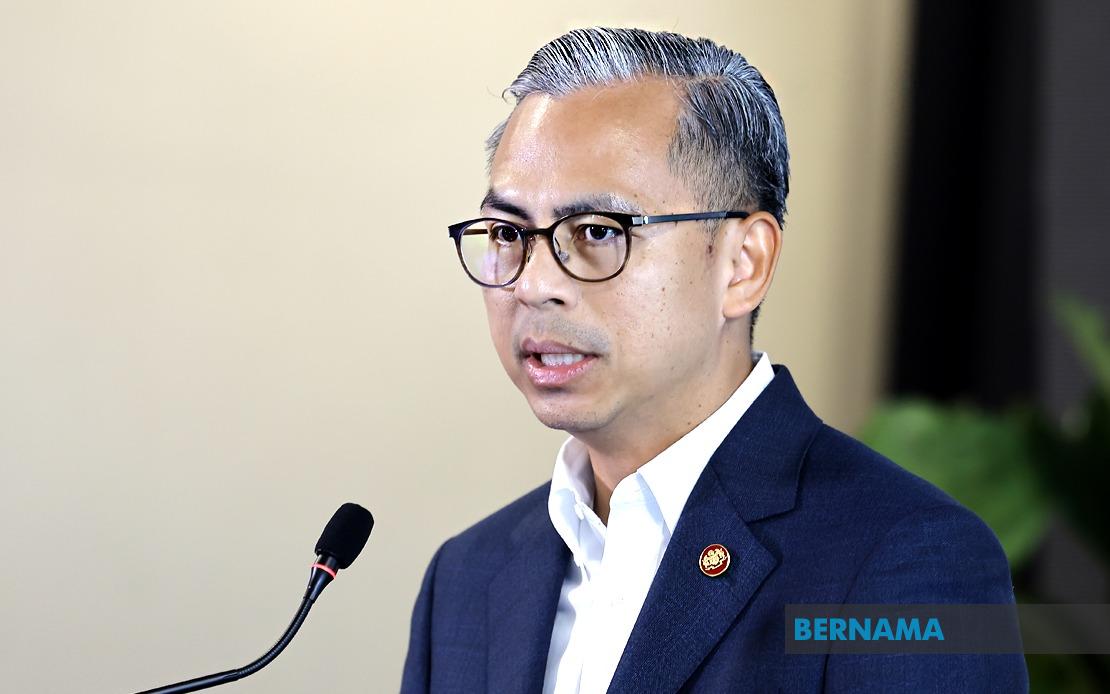
Communications Minister Datuk Fahmi Fadzil is poised to receive one of Malaysia's most prestigious state honours in recognition of his political service and role as spokesperson for the ruling Unity Government coalition. The Penang State Government will confer the Darjah Panglima Pangkuan Negeri (DPPN) on Fahmi during an investiture ceremony that coincides with the 85th birthday celebration of Penang Governor Tun Ramli Ngah Talib, making him the exclusive recipient of this top-tier distinction in 2024.
Fahmi's elevation to Datuk Seri status carries symbolic weight beyond the ceremonial aspects. As the public face of Prime Minister Anwar Ibrahim's coalition government and a senior member of the Amanah party, his recognition by Penang's state authority underscores the continued alignment between the federal Unity Government and the state's political establishment. The honour reflects not only his ministerial portfolio overseeing communications and digital infrastructure but also his prominence as a bridge-builder between competing political factions at the national level.
The broader investiture exercise demonstrates the structured hierarchy embedded within Malaysia's honours system. Beyond Fahmi's singular DPPN award, the state will distribute the Darjah Gemilang Pangkuan Negeri (DGPN)—which also carries Datuk Seri status—to 19 recipients. This tier encompasses figures of considerable institutional standing, including Chief Judge of Malaya Datuk Seri Hashim Hamzah, whose judicial authority extends across peninsular Malaysia's lower courts, and Datuk Abdul Halim Mohammad, who chairs MARA Incorporated, the development agency tasked with advancing bumiputera commerce and entrepreneurship. Invest Penang's chief executive officer Datuk Loo Lee Lian similarly represents the state's economic development machinery, positioning Penang's honours allocation toward recognizing administrators and business leaders instrumental to regional commerce.
Lower-ranking recipients of Datuk status present a cross-sectional view of Malaysian institutional power. Nine individuals will receive the Darjah Yang Mulia Pangkuan Negeri (DMPN), including former Penang police chief Datuk Azizee Ismail and UEM Group managing director Datuk Amran Hafiz Affifudin. The 72 recipients of the Darjah Setia Pangkuan Negeri (DSPN) encompass an even wider professional spectrum: Datuk Meor Ismail Meor Akim, the National Disaster Management Agency's director-general, sits alongside National Disaster Management Agency figures, banking executives such as Datuk Mohd Irwan Mohd Mubarak of Bank Rakyat, and public sector officials like Deputy State Secretary Mohamed Abdul Rahman. This distribution across government, financial services, and defence-adjacent sectors reflects how Malaysian honours systematically recognize institutional gatekeepers across sectors critical to the state's functioning.
The 1,221 total recipients far exceed those receiving individual titles; the remaining cohort receives lower-tier medals and commendations structured hierarchically according to contribution and standing. The Darjah Johan Negeri will go to 92 recipients, while 31 will receive the Bintang Cemerlang Negeri. Merit-based medals form the broadest categories: 194 recipients will be awarded the Pingat Kelakuan Terpuji (Commendation for Good Conduct), 328 will receive the Pingat Jasa Kebaktian (Medal for Service and Dedication), and 463 will obtain the Pingat Jasa Masyarakat (Medal for Community Service). A final 12 individuals will receive the Pingat Bakti Setia (Loyalty Service Medal). This pyramidal structure—concentrating prestige at the apex while distributing recognition broadly at lower levels—embeds social differentiation within the ceremonial apparatus itself.
Penang State Legislative Assembly Speaker Datuk Seri Law Choo Kiang confirmed that the investiture ceremony will unfold over four consecutive days beginning July 11, with sessions continuing July 13 through July 15. Of the 1,221 recipients, 101 will receive state honours carrying titles, while 1,120 will be presented with awards and medals. The staggered schedule accommodates the ceremonial demands of recognizing such a large cohort while maintaining the solemnity expected of official state functions. This extended timeframe also provides media coverage opportunities across multiple days, amplifying the public visibility of honourees and the state government's commitment to recognizing achievement.
The composition of honourees reflects Malaysia's institutional scaffolding across multiple sectors. Speaker Law noted that recipients span civil service members at both state and federal levels, elected politicians, corporate executives, non-governmental organisation officials, local entrepreneurs, and volunteers. This deliberate inclusivity—bridging public administration, private enterprise, and civil society—signals that the honours system seeks to reinforce cohesion across formal and informal institutional networks. By honouring figures from seemingly disparate domains simultaneously, the state implicitly validates the interconnectedness of these domains and rewards those perceived as contributing across them.
For the federal government, Fahmi's singular distinction as the DPPN's sole recipient this year carries diplomatic undertones. It underscores Penang's acknowledgement of his role within the Unity Government coalition, particularly given that Penang itself is governed by a non-federal party alliance led by the Democratic Action Party. The honouring of a federal minister by a state controlled by an opposition coalition normalizes the idea of cross-coalition collaboration and signals that political rivalry need not preclude recognition of individual merit or institutional service. This symbolic gesture becomes especially relevant in Malaysia's contemporary political environment, where coalition stability remains contested and federal-state relations are frequently strained.
The prominence of corporate figures among higher-tier recipients—including D. Murugan of Pelita Samudra Pertama, Saiful Nizam Mohd Yusoff of Menara Rezeki, and Moh See Eng of M Summit Group—illustrates how Malaysian honours systems increasingly recognize private sector actors alongside traditional state servants. This trend reflects Malaysia's transformation toward a mixed economy dependent on both public administration and corporate investment, particularly in developed states like Penang that have positioned themselves as business and technology hubs. By honouring corporate leaders, the state implicitly endorses their economic contributions and creates incentives for continued private investment in state development initiatives.
The inclusion of late film personality Nordin Ahmad among posthumous DSPN recipients represents recognition extending beyond living recipients to cultural figures. Ahmad's career with Cathay-Keris Film Productions, a legendary Malaysian production house, marks him as an architect of Malaysian cinema during its industrial golden era. His posthumous honour underscores how state honours systems can validate cultural heritage and acknowledge contributions to national cultural production—a function increasingly important as Malaysia navigates questions about cultural preservation amid globalization pressures.
For Malaysian and Southeast Asian readers, Penang's comprehensive honours ceremony offers insight into how regional governance systems institutionalize social recognition and reinforce hierarchies of prestige. The multi-day format, the carefully calibrated tiers of distinction, and the deliberate inclusion across sectors and political affiliations demonstrate sophisticated state apparatus functioning. Such ceremonies, while often dismissed as ceremonial excess, actually perform crucial social functions: they legitimize particular forms of achievement, cement networks across institutional domains, and publicly affirm state values regarding merit, service, and contribution. In Malaysia's contested political environment, such moments of institutional consensus—where parties across divides can collectively recognize achievement—become increasingly valuable.

