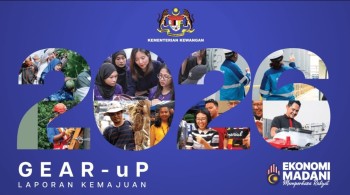
The Government-Linked Enterprises Activation and Reform Programme has entered a critical acceleration phase in its third year, with Malaysia's principal investment vehicles channelling RM20.3 billion into the domestic economy during 2025. This represents a tripling of the RM6.6 billion deployed in 2024, signalling a substantial intensification of the government's push to transform capital into tangible economic outcomes across the nation.
GEAR-uP, orchestrated by the Ministry of Finance since its 2024 launch, represents an ambitious attempt to unlock RM120 billion over a five-year period with the express purpose of reshaping Malaysia's economic structures and industrial capabilities. The initiative operates through six cornerstone institutions: Khazanah Nasional Bhd, the Employees Provident Fund, Permodalan Nasional Bhd, Kumpulan Wang Persaraan (Diperbadankan), Lembaga Tabung Angkatan Tentera, and Lembaga Tabung Haji. Prime Minister Datuk Seri Anwar Ibrahim emphasised that this deployment differs fundamentally from conventional investment strategies, positioning capital not as a vehicle for passive wealth accumulation but as a deliberate instrument of national purpose.
The philosophical underpinning of GEAR-uP reflects a deliberate pivot from traditional capital deployment models. Rather than treating investment returns as an end in themselves, the programme frames capital mobilisation as a means to strengthen economic resilience and distribute growth benefits directly to ordinary Malaysians. This approach acknowledges the persistent external headwinds confronting Southeast Asian economies, from trade volatility to geopolitical uncertainty, while attempting to build domestic economic foundations resilient enough to weather such turbulence.
Significant infrastructure projects underscore the programme's scope. Google's data centre in Selangor, backed by KWAP investment, will contribute 320 megawatts of capacity alongside 26,500 employment opportunities through 2026 and 2027, while parallel digital infrastructure expansion in Johor through Empyrion Digital demonstrates the programme's technology sector focus. Simultaneously, Tenaga Nasional's grid modernisation under its fourth regulatory period commits escalating capital—rising from RM12 billion in 2025 towards RM15 billion by 2027—to support Malaysia's pathway towards 70 per cent renewable energy capacity by 2050.
Capital markets development forms another critical pillar of GEAR-uP's strategy. The initiative deploys specialist investment vehicles including Dana Impak, Dana Perintis, Dana Pemacu, and Ekuinas to shepherd firms through the venture-to-growth transition stage. Khazanah's forthcoming Dana Ciptawan will inject RM200 million specifically targeting Bumiputera enterprises and mid-market Malaysian firms. These mechanisms address a fundamental weakness in Malaysia's economic ecosystem: the structural difficulty faced by emerging companies in accessing growth-stage capital, a constraint that has historically limited the emergence of Malaysian champions across sectors.
The glc value enhancement initiative complements these efforts, targeting RM100 billion in additional market value for government-linked companies by 2028. The newly extended MY Value Up programme applies similar disciplinary frameworks to Malaysia's 88 largest listed companies, creating coherence between government-controlled and publicly listed entities. The Capital Market Masterplan's ambition to achieve RM5.8 to RM6.3 trillion in market capitalisation by 2030 depends substantially on this investment pipeline materialising as planned, indicating that GEAR-uP's success has implications beyond government-linked sectors.
Building Bumiputera economic participation represents a fourth strategic dimension. The programme targets ten Bumiputera company listings during 2026-2027, supported by the 10 Bumiputera Champions Programme designed to scale these enterprises towards competitive viability. Zakat Wakalah, a faith-based financing mechanism, will expand from RM28 million in 2024 towards RM100 million by 2026, extending financial inclusion within the Muslim-majority population. Malaysia Airports' RM11 billion five-year upgrade programme illustrates sectoral depth, with Kuala Lumpur International Airport targeting passenger capacity exceeding 100 million annually, positioning the nation as a regional aviation hub.
Minister of Finance II Datuk Seri Amir Hamzah Azizan reframed GEAR-uP's metrics beyond conventional financial measures, emphasising that programme success ultimately manifests through living wages, graduate employment in quality positions, scaled Bumiputera enterprises, and rootedness of supply chains within Malaysia. This represents a conceptual departure from purely returns-focused investment evaluation, instead privileging distributional outcomes and economic deepening. The GLIC portfolio achieved 8.0 per cent total shareholder returns in 2025, demonstrating that development-oriented capital deployment need not sacrifice financial prudence.
The broader macroeconomic context underpins GEAR-uP's urgency and scope. Malaysia navigated the severe external turbulence of global volatility through institutional reforms undertaken in 2023, providing the stability foundation upon which the current programme builds. The MADANI Economy framework—emphasising simultaneous elevation of both economic ceiling and floor—articulates the intellectual scaffolding underlying capital reallocation. This acknowledges that sustainable growth requires not merely aggregate expansion but inclusive distribution, a principle particularly salient for Malaysia given longstanding concerns regarding inequality and regional development disparities.
Looking forward, GEAR-uP's trajectory through 2026 and into 2027 will determine whether deliberately directed capital deployment can effectively reshape Malaysia's industrial structure and broaden prosperity. The programme's emphasis on placing capital into motion through identifiable projects—data centres, grid infrastructure, airport expansion, Bumiputera enterprise development—contrasts with previous initiatives sometimes characterised as more aspirational than executable. The momentum established through tripled deployment in 2025 must translate into measurable improvements in employment quality, supply chain localisation, and emergent sectoral champions, or risk devolving into another bureaucratic allocation exercise. For Southeast Asian observers evaluating alternatives to market-driven development models, GEAR-uP represents an instructive experiment in whether state-directed capital can catalyse transformation without succumbing to the rent-seeking and inefficiency that has historically plagued such approaches.

