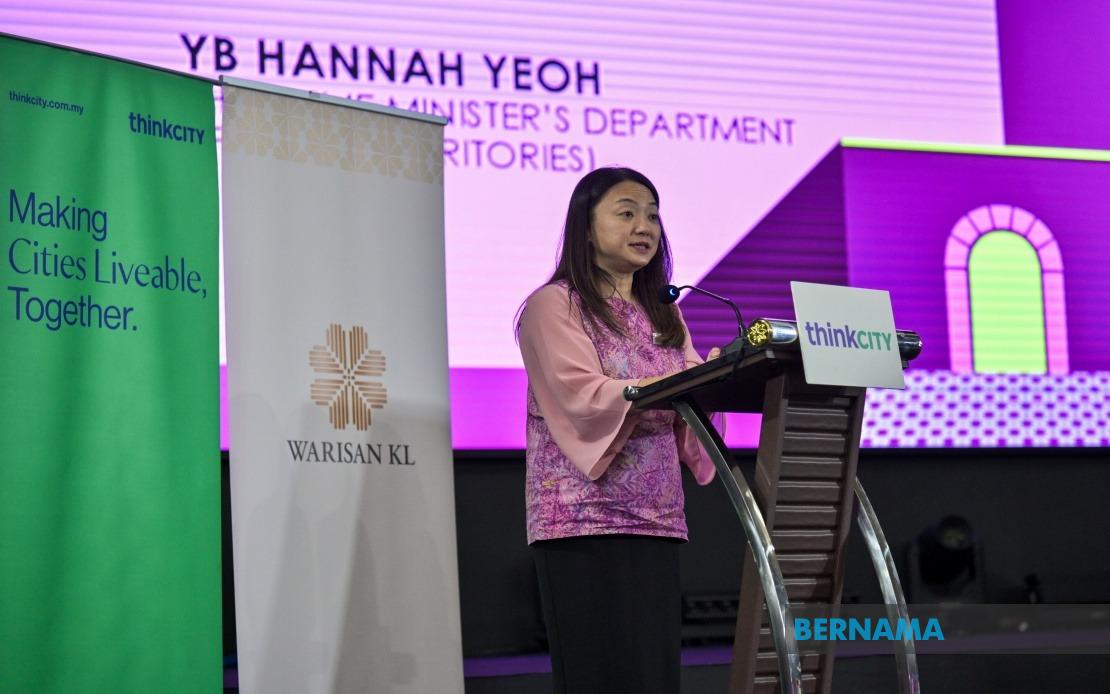
The federal government has committed RM1 million towards rejuvenating downtown Kuala Lumpur through a fresh grants programme designed to preserve the nation's cultural heritage whilst stimulating economic activity in the city centre. Hannah Yeoh, Minister in the Prime Minister's Department (Federal Territories), unveiled the Downtown Kuala Lumpur Grants Programme 2026 during an official launch ceremony in the capital, signalling a deliberate policy shift towards leveraging culture and heritage as economic drivers rather than viewing them as historical relics.
The initiative dispenses funding in tranches ranging from RM30,000 to RM100,000 for each accredited initiative, deliberately targeting grassroots entrepreneurs, creative practitioners and community-based organisations operating within the metropolitan core. This tiered approach reflects recognition that meaningful urban renewal requires support across multiple scales of intervention, from small independent creative ventures to larger coordinated neighbourhood projects. The structure anticipates that microenterprises and arts collectives, often constrained by capital limitations, represent untapped potential for authentic city revitalisation.
Yeoh articulated a philosophical framework underpinning the programme during her remarks, suggesting that Kuala Lumpur's future rests not solely on architectural modernisation but rather on cultivating an environment where residents, businesses and investors choose the city as their preferred location. This framing represents a departure from purely infrastructure-focused urban policy, acknowledging instead that retention of existing populations and attraction of new talent depends on cultural vibrancy, quality-of-life considerations and economic opportunity distributed throughout urban neighbourhoods. The minister's emphasis on deliberate choice—where people elect to remain rather than migrate outward—addresses demographic and economic flight patterns observed in mature urban centres globally.
The federal government's allocation originates from the Ministry of Finance, institutionalising the priority accorded to arts, culture and heritage sectors within Malaysia's broader economic strategy. This budgetary commitment signals that policymakers increasingly recognise creative industries and cultural tourism as legitimate components of national economic planning, not peripheral or discretionary spending. Such positioning carries implications for how arts practitioners and cultural entrepreneurs access policy support and mainstream financing mechanisms that have traditionally favoured manufacturing or technology sectors.
Kuala Lumpur's designation as a UNESCO Creative City provides strategic justification for the initiative, with Yeoh emphasising that such recognition encompasses more than ceremonial status. Rather, UNESCO classification carries tangible economic implications—it serves as international certification attracting visitors, generating tourism revenue and creating employment opportunities across hospitality, retail and creative service sectors. By explicitly linking cultural recognition to job creation and economic strengthening, the minister positions heritage preservation as pragmatic economic policy rather than cultural conservation pursued for its own sake, a framing likely to resonate with stakeholders concerned about immediate fiscal returns.
Amongst her key objectives, Yeoh identified fundamental transformation of Kuala Lumpur City Hall (DBKL) from what she characterised as a regulatory obstruction into a genuine facilitator of urban economic activity. This rhetoric acknowledges persistent criticism that municipal bureaucracies sometimes function as impediments to entrepreneurial initiative through excessive licensing requirements, slow administrative processes and restrictive regulations. By pledging to reorient DBKL's institutional culture toward enabling rather than constraining business activity, Yeoh signals responsiveness to friction points experienced by downtown merchants, restaurant operators and creative enterprises attempting to navigate municipal frameworks.
Administrative coordination for the grants programme falls to Think City, designated as the strategic partner managing application processes and evaluation criteria. This arrangement delegates day-to-day programme administration to an experienced intermediary organisation rather than concentrating functions within government structures, potentially accelerating decision-making timelines and introducing external expertise in assessing creative project viability. The pending announcement of detailed eligibility criteria by Think City will clarify precisely which activities qualify for funding—whether support extends to heritage restoration projects, social enterprises, cultural programming, creative workspace development, or combinations thereof.
Yeoh's explicit invitation for applicants possessing novel concepts suggests openness to unconventional approaches rather than prescriptive funding categories, potentially encouraging experimental ventures that might not satisfy traditional bureaucratic assessment frameworks. This openness towards innovation reflects broader international trends in urban policy whereby municipalities consciously cultivate experimentation, recognising that breakthrough solutions often emerge from pilot initiatives that would never achieve approval through rigid categorical systems. The minister's language regarding fresh ideas attempting to restore vitality to Kuala Lumpur's downtown suggests genuine receptiveness to bottom-up renewal proposals emerging from community stakeholders rather than exclusively top-down masterplanning approaches.
For Malaysian readers, the programme carries broader significance regarding how federal policymakers approach urban management and cultural policy. The visible prioritisation of downtown revitalisation acknowledges that major cities require continuous reinvestment to remain economically competitive and culturally vibrant, particularly as suburban development patterns and digital commerce reshape traditional urban commercial districts. The grants scheme demonstrates government willingness to deploy public resources toward preserving character and vitality in established urban cores, a stance that contrasts with development approaches emphasising peripheral expansion or technological disruption of existing urban ecosystems.
The initiative carries implications extending beyond Kuala Lumpur itself. Successfully demonstrating that heritage-based grants can catalyse authentic urban renewal within Malaysia's largest metropolitan area potentially establishes models applicable to rejuvenating secondary cities, heritage districts and older commercial quarters nationwide. Should the programme generate measurable improvements—whether quantified through business formation rates, tourism spending, resident retention, or cultural programming density—federal policymakers may consider scaling similar approaches to other urban centres facing comparable revitalisation challenges.
For creative practitioners, small business operators and community organisations in downtown Kuala Lumpur, the announcement creates immediate practical opportunity. The RM30,000 to RM100,000 grant ranges, whilst modest individually, can meaningfully support venue renovations, public art installations, cultural programming, heritage documentation projects or social enterprise establishment. However, potential applicants should recognise that forthcoming eligibility criteria and evaluation processes will determine whether their specific concepts align with programme objectives, necessitating careful attention when Think City releases detailed application guidance.
The programme's success ultimately depends on whether proposed interventions generate genuine community benefit and sustainable economic activity rather than merely deploying public funds toward well-intentioned but ultimately hollow initiatives. Meaningful downtown revitalisation requires alignment between government funding, private entrepreneurial response and authentic community engagement, a complex coordination challenge frequently underestimated in initial policy formulation. How Think City manages applications, evaluates proposals and monitors outcomes will substantially determine whether the RM1 million investment produces lasting renewal or becomes absorbed into bureaucratic processes yielding marginal tangible impact on Kuala Lumpur's downtown vitality.

