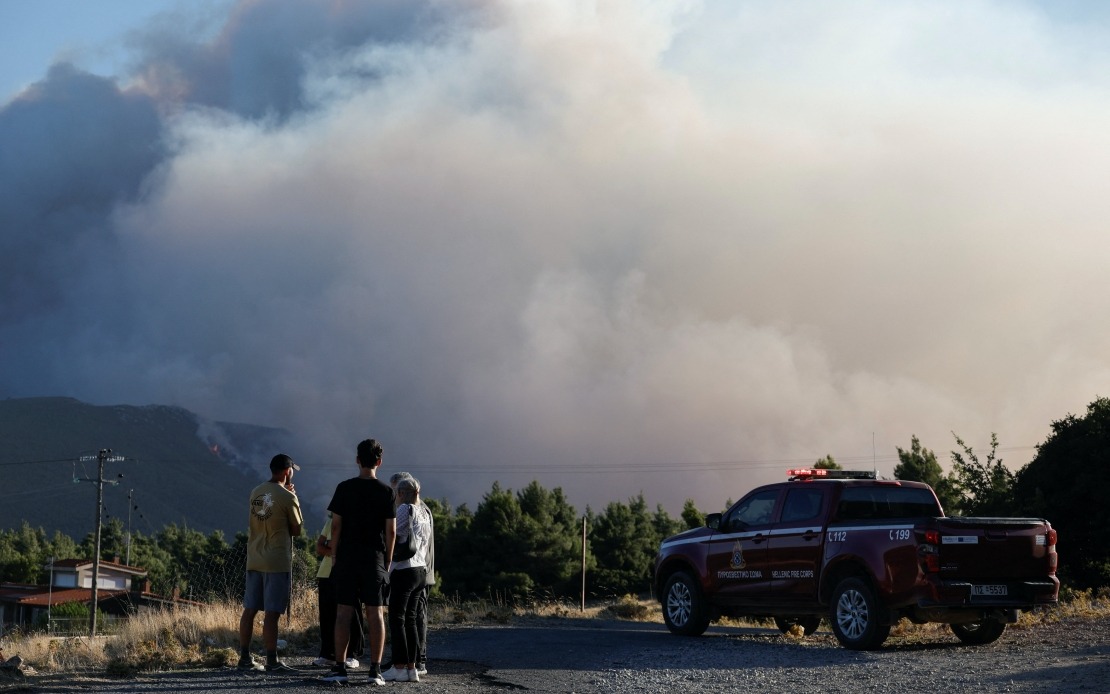
A large-scale wildfire continued to rage west of Athens on Sunday as Greek firefighters worked through the night in what has become one of the most challenging emergency operations in the region in recent months. The conflagration, centred in the Kithairon Mountains, drew an unprecedented mobilisation of resources across the country, with emergency responders backed by military vehicles, volunteer teams, and specialised heavy equipment all converging on the affected area to contain the expanding flames.
The intensity of the firefighting effort underscores the severity of the crisis. At least 500 firefighters were actively engaged in battling the blaze, supported by international reinforcements from Romania and France who arrived to assist their Greek counterparts. As dawn broke, the operation shifted from ground-based containment to aerial bombardment, with firefighting aircraft and helicopters resuming their water-bombing runs against the advancing fire front. This multi-layered approach reflects the difficulty of controlling a wildfire in an environment where conditions continue to deteriorate.
Meteorological conditions have dramatically worsened the spread of the flames, with strong winds funnelling the fire across the landscape at unpredictable speeds. The towns of Veniza and Psatha bore the brunt of initial devastation, but the fire's movement pattern has become the primary concern for officials. Rather than remaining contained in the mountainous western approaches to Athens, the flames have begun a persistent eastward trajectory that brings them closer to population centres. The city of Megara, situated approximately 50 kilometres west of the Greek capital, now faces an imminent threat as the fire approaches within just a few kilometres of its boundaries.
The scale of environmental damage is staggering. Meteorological experts, through analysis published by the news portal Protothema, estimate that approximately 10,000 hectares of land across the north-western and western regions surrounding Athens have already been consumed by the current fires. This represents not merely a loss of vegetation but the destruction of entire ecosystems, agricultural land, and natural resources that will take years to regenerate. The psychological impact on residents in threatened areas cannot be understated, as evacuation orders have transformed normal communities into ghost towns within hours.
The criminal dimension of the crisis has also come to light, revealing that human negligence and potentially deliberate actions may have contributed to the outbreak. Fire department authorities have arrested 13 people nationwide on charges related to negligent arson. These arrests suggest that preventable human actions—whether through carelessness or intentional misconduct—have triggered one of the region's most destructive natural disasters. Such findings typically prompt renewed calls for stricter enforcement of fire safety regulations and penalties for violations.
Beyond the immediate Athens region, Greece faces multiple simultaneous fire emergencies that strain national resources further. The island of Cephalonia is battling its own major wildfire, though fortunately, officials have indicated that towns there do not currently face immediate threat. The situation represents a different crisis management challenge compared to the proximity of flames to urban centres near Athens. Meanwhile, reports from Crete indicate that wildfires there have been substantially extinguished following earlier emergency interventions, though not before the evacuation of several towns and the destruction of up to 200 homes according to local media accounts, though official confirmation remains pending.
The simultaneous nature of these disasters highlights the vulnerability of Mediterranean regions during peak fire season, particularly as climate patterns shift and extreme weather becomes more commonplace. Greece's experience serves as a cautionary tale for neighbouring countries in the Eastern Mediterranean and Southeast European regions, where similar dry conditions and wind patterns create equivalent hazard environments. The mobilisation of international resources from within the European Union demonstrates the cross-border cooperation mechanisms available to Mediterranean nations, yet also raises questions about whether such responses arrive with sufficient speed and scale when conditions deteriorate rapidly.
For Malaysian and Southeast Asian observers, the Greek crisis offers important lessons about disaster preparedness and resource allocation. While tropical forest fires in Indonesia, Malaysia, and neighbouring countries operate under different ecological parameters and present distinct challenges, the fundamental requirement for coordinated emergency response, international cooperation, and rapid decision-making remains universal. The Greek experience demonstrates how quickly a manageable wildfire can escalate into a regional catastrophe, necessitating pre-positioned resources and trained personnel who can be deployed immediately when warning signs emerge.
The ongoing operation in Greece also illustrates the critical importance of meteorological monitoring and early warning systems. The strong winds that accelerated the fire's spread should have been predictable hours in advance, allowing for more proactive evacuation scheduling and resource positioning. National fire management agencies across Asia should examine whether their own early warning protocols incorporate sufficient lead time for civilian evacuation and emergency personnel deployment. The difference between controlled evacuation and chaotic flight can determine whether loss of life occurs alongside material destruction.
As the situation continues to evolve, the focus will intensify on preventing further eastward advancement of the flames. Military involvement in the firefighting effort, while necessary, also indicates the severity that compelled government authorities to deploy armed forces beyond their traditional remit. This escalation suggests that normal civilian emergency services, despite their professionalism and dedication, lack the resources and equipment to independently contain a fire of this magnitude without military support. The cost of such large-scale operations, both in financial terms and in terms of environmental and social disruption, will likely influence policy discussions about fire prevention, land management, and climate adaptation strategies across the European Union in coming months.

