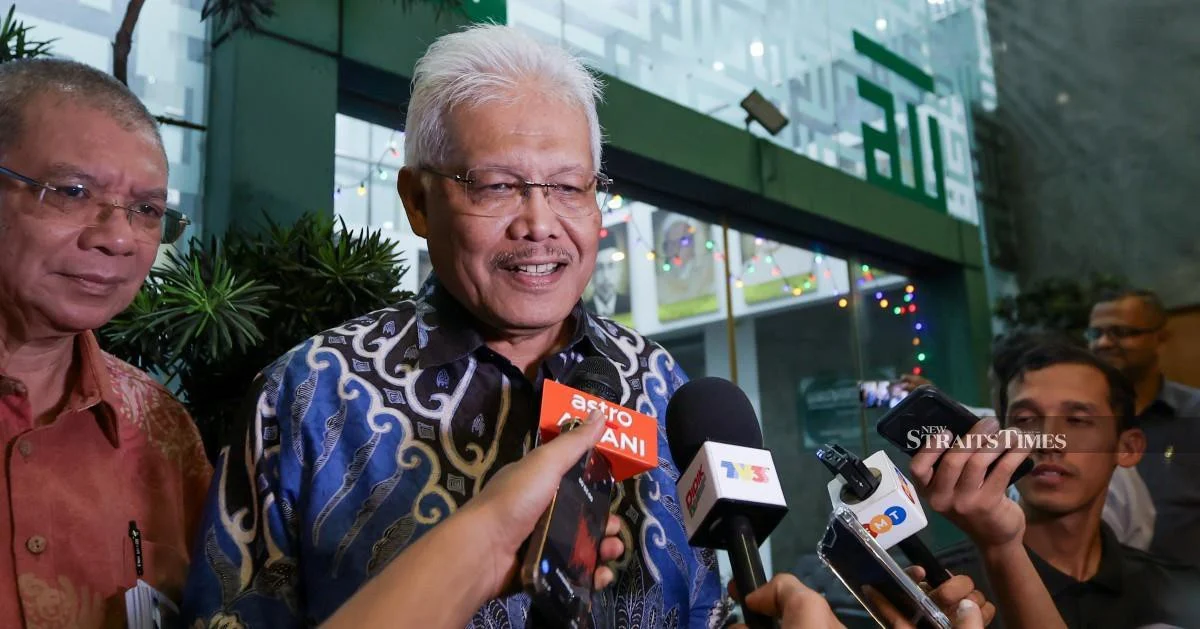
Datuk Seri Hamzah Zainudin is set to reclaim the opposition leader's seat in the Dewan Rakyat on Monday, marking a significant symbolic shift in Parliament's fractious opposition benches. The repositioning will see Bersatu president Tan Sri Muhyiddin Yassin relocated further along the row, a physical manifestation of changing dynamics within the coalition opposing the current government.
The revised parliamentary seating arrangement reflects deeper currents running through Malaysia's opposition landscape. After months of tactical manoeuvring, the reconfiguration signals which figures command primary legitimacy as opposition spokespeople—and by extension, how the various factions view their relative standing and future electoral prospects. The move carries weight beyond mere ceremonial protocol; in Parliament, physical positioning near or away from the Speaker's chair carries implications for visibility, microphone access during debates, and the symbolic authority of leadership.
Hamzah's return to the front-row opposition seat represents a recalibration within a coalition already fractured by competing interests and ideological fault lines. The opposition has struggled to maintain unified messaging and coherent parliamentary strategy, hampered by the presence of multiple parties with divergent agendas. Bersatu, which has occupied an increasingly unstable middle ground between alignment with Anwar Ibrahim's PKR-led government and opposition to it, now finds itself repositioned in this seating shuffle—a possible indicator of broader reordering among opposition ranks.
The timing of this parliamentary seating change comes at a moment when Malaysia's political landscape continues to experience tremors. The opposition's ability to function as an effective check on government power depends partly on its cohesion and command of parliamentary narrative. Having a clearly designated opposition leader with unquestioned standing becomes crucial when attempting to coordinate responses to government legislation, raise accountability questions, and maintain public visibility. Hamzah's restoration to this formal position may signal either consensus-building among fractious opposition elements or, conversely, a forced resolution to ongoing leadership disputes.
Bersatu's repositioning warrants careful scrutiny given the party's complex political journey. Under Muhyiddin's leadership, the party has navigated treacherous terrain—shifting from government partnership to opposition posture depending on parliamentary arithmetic and factional pressure. The party has championed Bumiputera concerns and articulated a distinct economic philosophy, yet struggles with internal coherence and external credibility. Being moved physically away from the opposition leader's seat may represent either tactical withdrawal or a diminished claim on opposition leadership authority.
For Malaysian voters and political observers, these seating arrangements offer readable signals about the opposition's internal pecking order and future direction. When the opposition enters the next election cycle, voters will reference current parliamentary positioning as evidence of which leaders command genuine support among their peers and which have slipped in esteem. The arrangement thus functions as a form of political honesty—a clear, undeniable indicator of contemporary alliances and fractures that cannot be obscured by rhetoric or media messaging.
The Malaysian Parliament operates under conventions and procedures inherited from Westminster tradition, where parliamentary opposition receives certain formal recognitions and privileges. The opposition leader occupies a designated seat, receives priority in debate recognition, and commands a measure of public visibility through parliamentary broadcasts. The assignment of this status through seating arrangements carries constitutional and procedural significance, particularly in a Parliament where narrow majorities and shifting coalitions characterise recent governance.
Hamzah's background as a seasoned politician familiar with both government and opposition roles positions him to navigate the complex dynamics of coordinating disparate opposition groups. His previous experience in ministerial positions and senior party roles suggests capacity to manage the strategic challenges of leading a coalition opposing a government that itself relies on fragile parliamentary support. Yet the opposition leader's effectiveness depends not merely on formal designation but on whether other opposition MPs genuinely defer to his authority and coordination.
The broader Southeast Asian context adds dimension to understanding these parliamentary shifts. Across the region, opposition movements grapple with similar challenges of maintaining coherence across ideological and ethnic lines while mounting effective oversight of incumbent governments. Malaysia's experiment with managing a genuinely competitive opposition within Westminster-influenced parliamentary structures offers lessons—both cautionary and instructive—for democratic development across the region.
Looking forward, the seating arrangement's practical implications extend beyond optics. During parliamentary sessions, the positioning determines who stands first in response, whose voice carries to corners of the chamber most clearly, and whose questions reach media coverage most readily. These procedural factors accumulate into substantive advantages for those occupying favoured positions. For Hamzah, resuming the opposition leader's seat provides formal platform to articulate alternative visions and challenge government policy with heightened standing.
The shuffle also raises questions about the opposition's capacity to present voters with a coherent alternative when elections arrive. A fractured opposition with confused leadership messaging allows governments greater latitude to implement unpopular policies and resist accountability. Conversely, an opposition that coalesces around designated leadership—as this seating change may suggest—potentially strengthens democratic competition and government responsiveness.
As Parliament reconvenes with this new arrangement, Malaysian political observers should watch closely how the repositioning translates into actual parliamentary dynamics. Will Hamzah effectively coordinate opposition responses to government initiatives? Will other opposition MPs defer to his authority? These practical questions will ultimately determine whether the seating chart reflects genuine realignment or merely cosmetic rearrangement of the same underlying fragmentation.