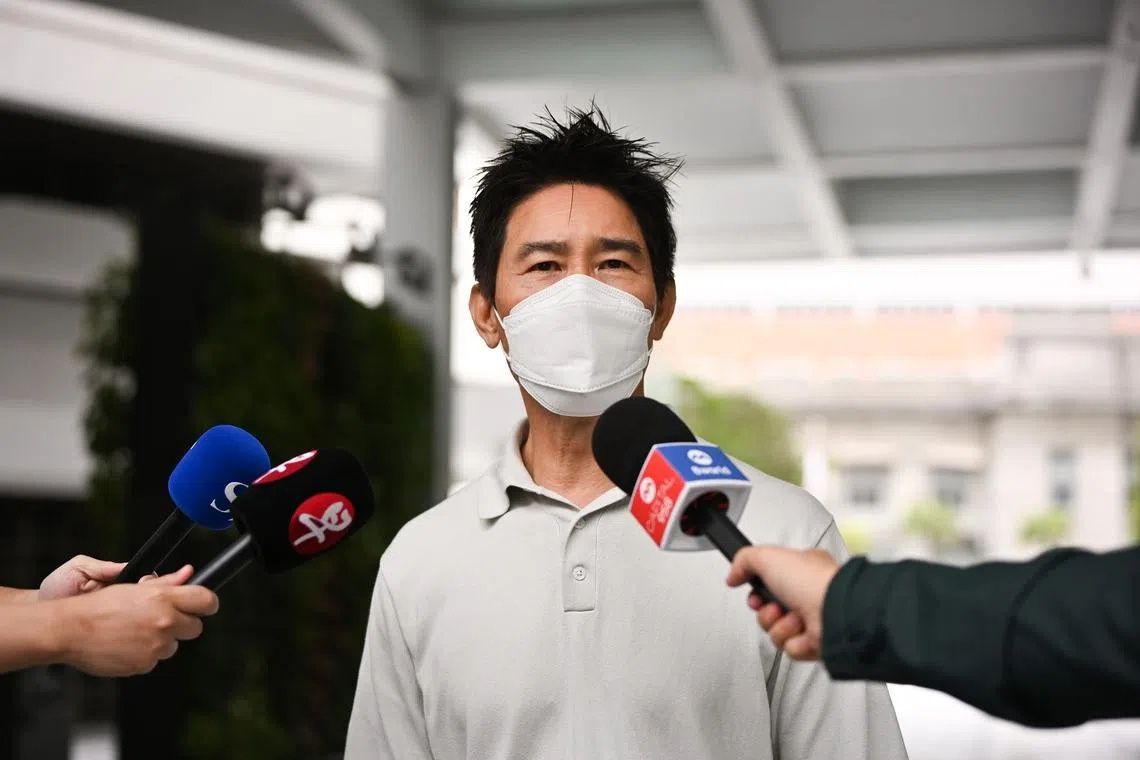
The High Court in Singapore has substantially reduced the custodial sentence handed to former actor Edmund Chen, 64, in connection with a March 2025 traffic accident that left a motorcyclist with serious wrist injuries. Justice Hri Kumar Nair cut the jail term from five days to one day on Monday, while maintaining a five-year driving disqualification that had been imposed alongside the original sentence. The reduction came after Chen's legal team successfully appealed the district judge's decision, arguing that imprisonment was disproportionate to the circumstances of the case.
The accident occurred on the Ayer Rajah Expressway, where Chen, driving in the fourth lane, had significantly slowed his vehicle to change lanes toward the Central Expressway and Seletar Link junction. Having failed to position himself correctly earlier to make the exit, he attempted a late manoeuvre across the third lane using his indicator lights. A 21-year-old motorcyclist approaching from behind could not avoid the suddenly slowed vehicle and collided with it despite attempting to swerve. The impact resulted in multiple wrist fractures requiring surgical intervention at Singapore General Hospital, followed by two days of hospitalization and 99 days of medical leave for the victim.
Senior Counsel Abraham Vergis from Providence Law Asia, who took over Chen's defence on appeal, mounted a multifaceted argument challenging the severity of the original punishment. He emphasized that Justice Nair's assessment acknowledged the original five-day sentence was excessive, even while confirming the threshold for custodial punishment had technically been crossed. Vergis highlighted that the victim's injuries, though classified as grievous hurt, were localized to the extremities and required only local anaesthesia during surgery, suggesting they fell within the less severe range of such injuries. The fact that no permanent disability resulted further supported his position that a fine-based approach would be more appropriate.
The appeal proceedings revealed additional context that may have influenced the court's reconsideration. Dashcam footage from Chen's vehicle showed that his indicator signals were activated during the lane change, and that a passing vehicle had obstructed the motorcyclist's view of his car due to the road's curvature. However, the prosecution and the original trial judge had emphasized that Chen proceeded with his manoeuvre despite two other vehicles sounding warning horns, suggesting a degree of negligence in his decision-making. The footage also documented Chen's vehicle crossing white chevron markings demarcating the junction area, a technical traffic violation that had factored into the district judge's sentencing calculus.
Deputy Public Prosecutor Ben Tan maintained the prosecution's position that a substantial fine approaching the S$5,000 maximum, combined with the five-year driving ban, represented appropriate punishment. The prosecution contended that while the district judge's sentence was on the upper end of the sentencing spectrum, it did not constitute the kind of error warranting appellate intervention. This represented a measured stance from the state, acknowledging that the original sentence may have been strict but not arguing it was fundamentally flawed in principle. Vergis countered that Chen's case did not warrant any custodial element, noting his client's apparent willingness to abstain from driving in the future and the severe psychological trauma already experienced.
Chen, whose legal name is Tan Kai Yuan, had pleaded guilty to one count of causing grievous hurt to the motorcyclist while driving without consideration for other road users. His genuine remorse was evident in his decision to remain at the accident scene to assist the injured victim. The choice of legal representation proved significant in the appeal process; after his initial conviction by District Judge in late January, Chen discharged his counsel from Invictus Law and engaged Contigo Law, ultimately securing Senior Counsel Vergis's expertise for the appellate stage. This change in legal strategy, combined with a more refined argument about the proportionality of sentencing, appears to have resonated with the appellate bench.
The case has drawn particular attention given Chen's standing as a recognizable public figure in Singapore's entertainment landscape. Once a household name through appearances in television dramas including Star Maiden and Patrol, Chen had stepped away from the entertainment industry in 2000 to care for his daughter, Chen Yixin. Though he occasionally returned to acting, most notably in Life Less Ordinary in 2017, he had largely maintained a private profile away from the limelight. His marriage to veteran actress Xiang Yun, known for classic local dramas such as The Awakening, Double Happiness, and The Little Nyonya, further underscored his family's deep roots in Singapore's television heritage.
The appellate decision carries implications for how Singapore's courts calibrate sentences in traffic injury cases involving moderate grievous hurt. By distinguishing between the principle that custodial thresholds had been crossed and the question of appropriate sentence length, Justice Nair provided guidance that courts should carefully examine whether jail terms are necessary even when imprisonment is technically justified. The ruling suggests that factors such as the severity and permanence of injuries, the offender's cooperation and remorse, and the availability of alternative punishments can substantially influence the final sentence even when guilt has been established. For road safety cases specifically, the judgment underscores that the five-year driving disqualification represents a meaningful consequence that may obviate the need for lengthy incarceration.
Chen's ordeal—spending the night before his appeal hearing without sleep, bringing five days' worth of medication to court in anticipation of the original sentence—underscored the personal toll of the legal process. The High Court's intervention reflected a recognition that proportionality in sentencing extends beyond mere technical compliance with statutory thresholds. While the one-day term represents largely time served during court proceedings rather than a meaningful custodial period, it preserves the conviction record and driving ban that substantially reshape Chen's personal and professional landscape. The case illustrates both the serious consequences traffic offences carry in Singapore and the appellate system's willingness to recalibrate penalties when original sentences are deemed manifestly excessive.

