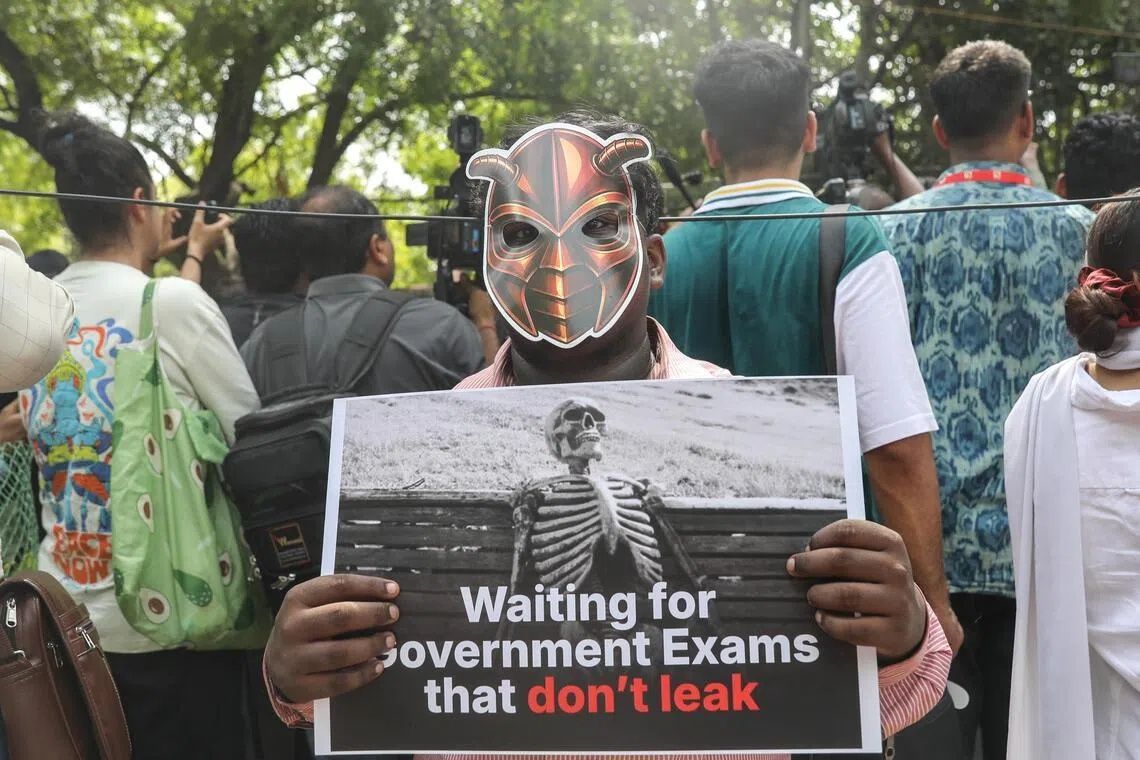
India's 2.2 million medical school aspirants faced a rescheduled entrance examination under extraordinary security conditions on Sunday, June 21, following the cancellation of the previous test after a significant paper leak exposed systemic vulnerabilities in one of the world's most competitive academic gateways. The incident, which triggered widespread public anger and youth-led demonstrations across the country, has exposed deep flaws in India's examination infrastructure and revealed the sophisticated networks operating behind exam fraud schemes.
The original test in May was deemed compromised and scrapped entirely, a rare decision reflecting the severity of the breach. The leak exposed not only the examination paper itself but also the institutional failures that allowed criminal networks to access highly secure materials. The fallout extended beyond the medical entrance test when a separate controversy erupted involving the online marking system for high school examinations affecting nearly two million students, where reports emerged of grade miscalculations and results being assigned to incorrect candidates. These twin crises created a perfect storm of public discontent, with parents and students questioning the reliability of India's entire examination apparatus.
The cascade of failures prompted extraordinary measures from authorities seeking to restore confidence in the system. The National Testing Agency deployed more than 200,000 officials, including police personnel, to oversee the retest across examination centres. Perhaps most dramatically, authorities restricted access to the Telegram messaging application nationwide, citing evidence that cheating networks had used the platform to distribute leaked questions and coordinate exam fraud schemes. This unprecedented step highlighted the desperation to prevent further leaks, though critics and even Telegram's own leadership acknowledged that such restrictions merely redirect fraudsters to alternative platforms rather than addressing root causes.
The retest incorporated multiple technological safeguards designed to prevent future breaches. Biometric authentication systems were implemented to verify candidate identity and prevent impersonation, while AI-enabled camera surveillance monitored examination halls in real time. Question papers themselves were tracked using GPS technology throughout their distribution and storage, creating a digital chain of custody. The National Testing Agency emphasized its commitment to establishing what it termed a "multi-layered security framework" intended to guarantee fair and transparent testing. These measures represented a significant investment in examination infrastructure, though questions remained about whether technology alone could address the deeper institutional corruption evident in the initial breach.
Understanding the scale of the examination's importance clarifies why the scandal resonated so dramatically across Indian society. The National Eligibility cum Entrance Test serves as the sole gateway to approximately 100,000 undergraduate medical seats across India, with millions of aspirants competing annually for these coveted positions. The extreme competition has spawned an enormous coaching industry worth billions of rupees, creating financial incentives for examination fraud and generating opportunities for organised criminal networks. The Central Bureau of Investigation's arrest of the alleged principal architect behind the leak—identified as a chemistry lecturer—revealed that insiders working within the examination system itself were facilitating the breach, suggesting corruption embedded at institutional levels rather than external infiltration.
The human cost of the scandal extended beyond institutional reputation damage. Indian media reported that several teenagers had taken their own lives following the exam cancellation, a tragic manifestation of the immense pressure young people face in India's hyper-competitive academic environment. These deaths amplified public anger and transformed the examination fraud from a technical administrative failure into a broader social crisis. Parents who had invested substantial financial resources in coaching and preparation found their children's efforts rendered meaningless, while students faced psychological devastation at having prepared intensively only to have the examination invalidated through no fault of their own.
The scandal catalysed unprecedented political mobilization among Indian youth. A satirical protest movement called the "Cockroach People's Party" emerged in May and rapidly accumulated millions of followers across social media platforms, channelling youth frustration into demands for accountability. Though satirical in form, the movement's messaging reflected genuine exasperation with governance failures and institutional incompetence. Protesters specifically called for the resignation of Education Minister Dharmendra Pradhan, arguing that his ministry bore responsibility for systemic failures that allowed such breaches to occur. This vocal demand for ministerial accountability from youth voters represented a significant political development in India's democratic landscape.
Pavel Durov, the founder of Telegram, publicly disputed whether blocking his platform would effectively prevent future exam fraud. He contended that restricting a single messaging application would merely redirect cheating networks toward alternative communication channels, and that the fundamental problem lay with individuals working inside the examination system willing to leak materials for profit. This assessment highlighted a crucial reality: technological security measures, while necessary, could never substitute for institutional integrity and effective monitoring of those with access to sensitive examination materials. The Telegram ban thus represented a symbolic government response that satisfied public demands for action without necessarily addressing deeper structural vulnerabilities.
For Southeast Asian observers, the Indian examination crisis carries instructive lessons about the vulnerabilities inherent in large-scale, centralized testing systems, particularly in competitive academic environments. Malaysia and other regional nations operate their own national-level examinations and entrance tests, and the Indian experience demonstrates how quickly public confidence can erode when examination integrity is compromised. The incident also illustrates the difficulty of maintaining secure examination administration while scaling operations to accommodate millions of candidates across distributed geographic areas. The involvement of organized criminal networks and insider corruption suggests that examination fraud represents not merely a technical problem but a persistent feature of highly competitive educational markets wherever institutional safeguards remain inadequate.