Penang's George Town presents itself most easily to visitors through its main arteries and distinct quarters, each telling a different chapter of the Malaysian peninsula's storied past. The most recognizable anchor is the George Town Unesco Historic Site, a heritage zone bound by Beach Street, Armenian Street, Lebuh Carnavon, Lebuh Chulia and Pengkalan Weld, where restored colonial structures and repurposed shophouses line every corner. Yet increasingly, travellers are venturing beyond these mapped tourist corridors to discover that Penang's true character emerges when you move through its lengthier thoroughfares—streets like Jalan Burma that connect heritage to contemporary culture, and history to the island's celebrated food reputation.
Jalan Burma itself stretches almost 5 kilometres from the heritage zone's borders all the way into the more affluent enclave of Pulau Tikus, making it one of George Town's longest arterial roads. Its current name reflects a fascinating linguistic and cultural layering: originally called Burmah Road, as faded signboards and historical maps still attest, the street carried several earlier names across different languages. In Malay, it was known as Jalan Tarek Ayer or Water Cart Road, while Hokkien and Cantonese speakers referred to it as Gui Chia Chui and Water On Bullock Carts respectively—each name rooted in the practicality of its origins as a route for transporting water via bullock-drawn carts during the colonial period. When a substantial Burmese community established itself in the Pulau Tikus area during the 19th century, the road acquired the name by which it is known today, cementing the cultural identity that still marks the neighbourhood with landmarks like Rangoon Road, Mandalay Road and Moulmein Close.
The Burmese heritage remains tangible for those who venture beyond the main street. The Dhammikarama Burmese Temple, established two centuries ago and tucked away on one of the lanes adjacent to Jalan Burma, stands as a living testimony to this community's enduring presence. An information board positioned beneath the Komtar Octopus Pedestrian Bridge offers visitors a simplified historical narrative, though the street's story is best understood by walking it—a journey made accessible by generally safe conditions and reasonable pedestrian infrastructure, with only isolated sections lacking proper pathways. The walk itself, roughly four kilometres for a round-trip excursion combined with exploring the heritage zone's shopping streets like Lebuh Campbell and Lebuh Kimberley, provides both exercise and gradual historical immersion.
What distinguishes contemporary Jalan Burma, however, is how seamlessly it has integrated itself into Penang's food tourism ecosystem. The island boasts 74 Michelin-recognised establishments, with 33 earning the prestigious Bib Gourmand classification—spots celebrated not for fine dining pretension but for delivering exceptional value and authentic flavour. Many cluster within George Town itself, and a disproportionate number occupy the humbler venues that hold particular appeal for visiting food enthusiasts: hawker stalls within food courts and coffeeshops where the sensory experience combines visual theatre, aromatic immersion and genuine culinary expertise. Walking past these establishments in mid-afternoon, watching proprietors prepare dishes to order, transforms eating from mere consumption into participatory experience.
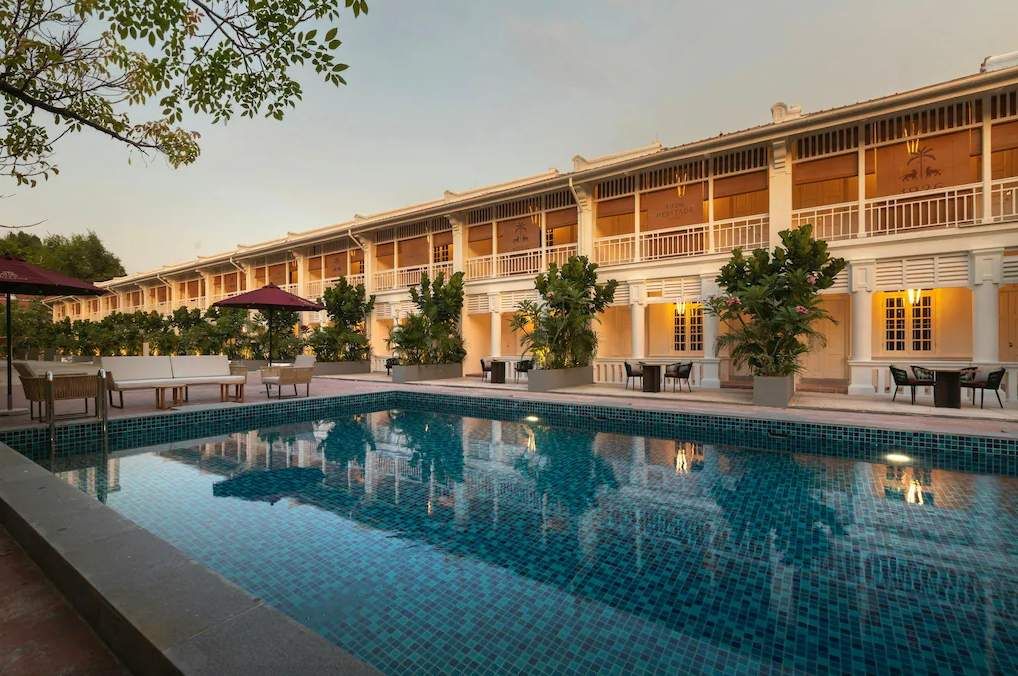
Duck Blood Curry Mee occupies a modest storefront on Jalan Burma, its weathered signage a counterpoint to the architectural treasure standing just a few doors away. The Penang Development Corporation's conversion of what was originally 24 interconnected link houses into a heritage hotel in 1999 represents one of the island's most thoughtful preservation efforts. Constructed in 1926—marking its centennial year—the building embodies the Anglo-Malay architectural vocabulary that defined George Town's colonial period, when British and local government personnel occupied these connected residences. The modernisation into 78 hotel rooms and suites across six categories, ranging from the Heritage Room designed for solo travellers to the sprawling Straits Suite, maintains historical integrity while meeting contemporary hospitality standards.
The hotel's existence on Jalan Burma creates an interesting dialectic: guests arriving expecting colonial nostalgia instead discover themselves positioned at the intersection of heritage preservation and living food culture. This juxtaposition becomes apparent when stepping from air-conditioned accommodation into the street's afternoon heat, umbrella in hand, seeking out Restoran Old Green House and its Bib Gourmand-listed tenant, Green House Prawn Mee & Loh Mee. The original establishment maintains fierce local loyalty despite the existence of a sister location further down Jalan Burma at Green House Prawn Mee/Law Mee Corner; residents consistently direct visitors to the original, a phenomenon reflecting how Penang's food culture combines quality with reputation, requiring navigation by locals' unwritten hierarchies rather than guidebooks alone.
Navigating George Town's food landscape presents visitors with multiple strategies. Some tourists simply follow crowds or mine social media recommendations, returning repeatedly to established favourites. Others structure their meals around dietary preferences—halal, pork-free, street food, cafe culture or the island's famous nasi kandar offerings—using these categories as organizing principles. The Michelin approach appeals to those seeking objective validation, though this metric captures only a fraction of Penang's culinary excellence. A single sit-down meal, whether Bib Gourmand or Michelin-starred, followed by hawker discoveries, provides sufficient gastronomic satisfaction for most visitors, particularly when combined with the physical exertion of walking Jalan Burma's length.
The street itself rewards extended exploration rather than quick transit. Root House by Gen, a modern Chinese restaurant housed within the heritage hotel, represents the upper end of Jalan Burma's dining spectrum—a destination meal rather than a casual stop. Two hours lingering over six carefully composed dishes, conversation flowing, embodies a different mode of food consumption than the quick intensity of hawker-centre eating, yet both belong to Penang's complete culinary vocabulary. The hotel's high-tech amenities, including room water filters with WiFi connectivity, cater to contemporary traveller expectations while maintaining period aesthetic. This balance between comfort and authenticity defines why many visitors base themselves on Jalan Burma rather than in the more touristy heritage zone proper.
Beyond immediate food and accommodation, the street functions as a gateway to George Town's broader cultural offerings. The Hin Bus Depot, while operating primarily on weekends, represents the kind of curated-yet-authentic marketplace that appeals to visitors seeking local artistry rather than mass-produced souvenirs. Here, independent vendors offer handmade clothing, artwork, caricature services and homemade food while live music provides atmospheric accompaniment. This weekend market ecosystem, accessible from Jalan Burma, exemplifies how Penang's tourism has evolved beyond heritage-site gazing toward participatory cultural engagement.
The Michelin Guide's recognition of Penang's food scene, with its concentration of Bib Gourmand and Selected venues, has accelerated international awareness while paradoxically validating what locals have long known: the island's culinary excellence emerges from established communities and family recipes rather than chef-driven innovation. The 33 Bib Gourmand establishments represent this democratic approach to culinary excellence, where a hawker stall's curry noodles can claim the same recognition as a restaurant's composed tasting menu. Visitors navigating Jalan Burma encounter this philosophy embodied in the street's physical reality—heritage preservation alongside working-class food enterprises, colonial architecture framing contemporary life, Burmese cultural landmarks quietly witnessing neighbourhood transformation.
Walking Jalan Burma in Penang's afternoon heat, equipped with borrowed umbrellas and refilled water bottles, participating in its food culture through both hawker stops and restaurant experiences, places visitors at the centre of what makes George Town compelling: a city that refuses neat categorization, instead layering different historical periods, cultural communities and economic strata into a single navigable street. The heritage hotel marking its hundredth year serves as both endpoint and beginning, a structure that connects past preservation efforts with present-day tourism while remaining surrounded by the spontaneous, ungoverned vitality that defines Penang's true character.
%22%2F%3E%3C%2Fpattern%3E%3C%2Fdefs%3E%3Crect%20width%3D%22100%25%22%20height%3D%22100%25%22%20fill%3D%22url(%23ph5iyptg)%22%2F%3E%3Crect%20width%3D%22100%25%22%20height%3D%22100%25%22%20fill%3D%22url(%23ph5iyptp)%22%2F%3E%3Ctext%20x%3D%2250%25%22%20y%3D%2250%25%22%20text-anchor%3D%22middle%22%20dominant-baseline%3D%22central%22%20fill%3D%22rgba(255%2C255%2C255%2C0.95)%22%20font-family%3D%22Georgia%2C%20'Times%20New%20Roman'%2C%20serif%22%20font-weight%3D%22700%22%20font-size%3D%22272%22%20letter-spacing%3D%22-0.02em%22%3EFahmi%3C%2Ftext%3E%3C%2Fsvg%3E)