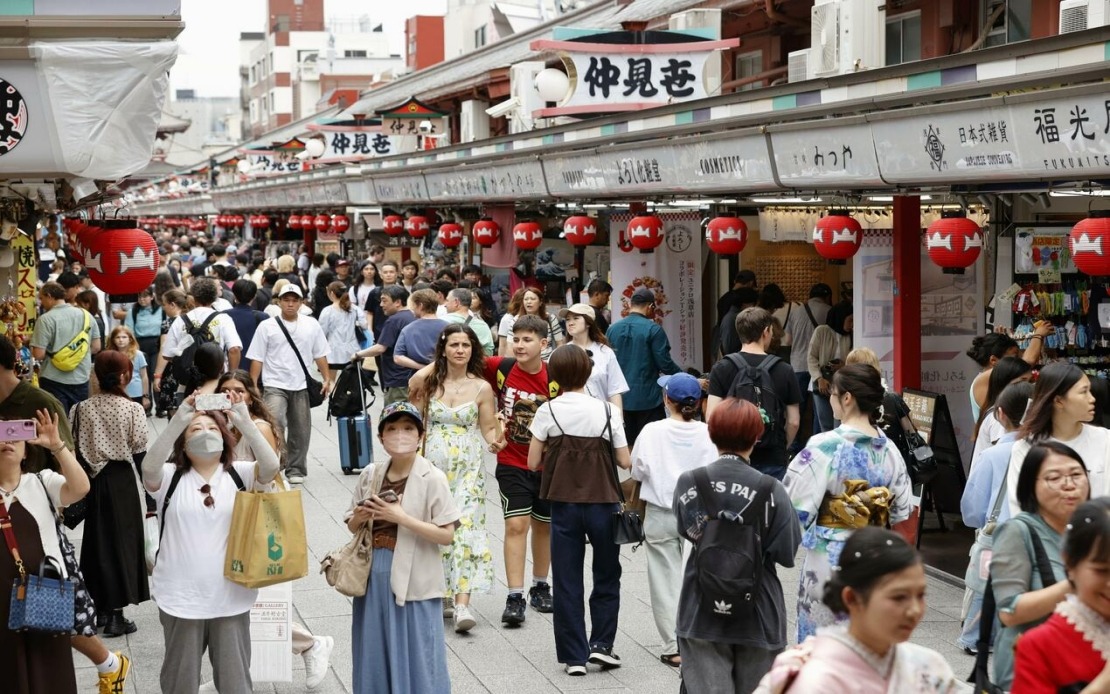
Japan's travel industry faces an unexpected headwind this summer as weakening currency and elevated costs dampen overseas holiday plans. Major travel agency JTB Corp projects outbound trips during the July 15 to August 31 period will decline 8.8 per cent to 2.17 million, marking the first year-on-year contraction since the post-pandemic rebound gained momentum in 2023. The shift represents a notable reversal in travel patterns that had recovered strongly in recent years, signalling broader economic pressures affecting Japanese consumer confidence.
The yen's sustained weakness against major currencies has created a challenging environment for international travel. Japanese holidaymakers are paying substantially more for foreign trips as their purchasing power diminishes abroad. JTB estimates average spending per person per trip will rise 6.3 per cent to 323,000 yen, equivalent to approximately US$2,000, yet this increased outlay is not translating into expanded travel volumes. Instead, consumers are consciously restricting overseas journeys or shortening their duration to manage budgets effectively.
Fuel surcharges imposed by airlines have compounded the affordability crisis. Rising aviation fuel costs, exacerbated by geopolitical tensions in West Asia, have pushed airfare premiums to levels that deter discretionary travellers. These charges, layered atop already-elevated ticket prices stemming from currency fluctuations, create a formidable barrier for families and individuals planning extended holidays. The accumulated impact of weak exchange rates and fuel-related levies has fundamentally altered the calculus of international travel for many Japanese households.
In response to deteriorating economics, Japanese travellers are gravitating toward nearby destinations offering superior value propositions. South Korea has become the dominant choice, capturing 26.2 per cent of outbound travel, followed by Taiwan at 16.2 per cent. This clustering around accessible Asian neighbours reflects rational cost minimisation—proximity reduces airfare expenses whilst regional destinations provide favourable exchange dynamics for Japanese visitors. The pattern underscores how currency weakness and fuel costs are reshaping regional tourism flows across East Asia.
Travelto China faces particular headwinds beyond economic considerations. JTB projects visits to China will tumble to just 10.1 per cent of total outbound travel, representing roughly half the previous year's figure. The decline partly reflects diplomatic tensions following Prime Minister Sanae Takaichi's November remarks regarding Taiwan, which strained Tokyo-Beijing relations. This geopolitical dimension compounds purely economic factors, creating a complex disincentive landscape for China-bound holidays. The combination of political friction and cost pressures has redirected substantial numbers of potential visitors toward alternative destinations.
Domestic travel prospects appear equally constrained, though the mechanics differ from international trips. JTB forecasts domestic journeys will contract 4.4 per cent to 69 million trips, even as per-person spending edges upward by 3.2 per cent to 48,500 yen. The paradox of rising expenditure amid declining volumes reveals that Japanese consumers are economising on trip frequency whilst selectively spending more on experiences they prioritise. Inflation and economic uncertainty are narrowing the class of people able to afford leisure travel altogether, whilst a smaller affluent cohort maintains discretionary spending.
Regional preferences within Japan display clear patterns reflecting tourism infrastructure and cultural appeal. Tokyo's Kanto region, Japan's largest metropolitan area, ranks as the leading domestic destination at 19.0 per cent market share. Kinki, encompassing Osaka and Kyoto, claims 14.9 per cent, whilst Hokkaido in the north attracts 11.2 per cent. These proportions suggest domestic travellers are concentrating visits in established tourism hubs with established attractions and services, perhaps viewing familiar destinations as representing safer value during uncertain economic times.
JTB's analysis reveals deeper consumer psychology reshaping travel behaviour. Company officials note emerging polarisation between two distinct consumer segments: cost-conscious travellers aggressively trimming expenses through shortened itineraries and budget accommodation, alongside affluent consumers determined to take desired trips regardless of price. This bifurcation signals widening income inequality's impact on discretionary spending patterns. Economic pressures are not simply reducing overall travel volumes uniformly but instead creating distinct consumer classes with radically different holiday consumption profiles.
The implications for Southeast Asian tourism warrant serious consideration. Malaysian, Thai, and Vietnamese tourism sectors that depend heavily on Japanese visitor numbers may experience softer demand than recent years suggested. The shift toward South Korea and Taiwan as primary destinations diverts spending away from Southeast Asia's traditional Japanese tourist base. Regional tourism authorities should anticipate sustained pressure on Japanese visitor arrivals and spending levels until currency movements shift or fuel costs moderate.
Understanding this summer's travel projections provides insight into broader Japanese economic health. Consumer confidence remains fragile despite initial pandemic recovery. The willingness to reduce discretionary spending on travel—historically a resilient category—indicates households perceive economic vulnerability despite official optimism. The weakness persists even among relatively affluent populations capable of international holiday spending, suggesting macroeconomic headwinds penetrate deeply into Japanese society.
JTB's projections rest on an online survey conducted in June among potential summer travellers, providing contemporaneous snapshots of consumer sentiment. The methodology captures booking intentions rather than realised behaviour, meaning actual outcomes may diverge depending on unexpected currency movements, geopolitical developments, or fuel price changes. Nevertheless, the directional shift toward contraction appears robust given multiple reinforcing pressures simultaneously constraining Japanese outbound travel.
As summer approaches, these trends will reshape tourism patterns across Asia-Pacific. Japanese consumers voting with their wallets toward budget-friendly regional options reflect rational responses to genuine economic constraints. The question for regional tourism sectors becomes whether they can effectively capture price-sensitive Japanese travellers through targeted marketing and value propositions, or whether the overall decline in Japanese outbound travel will simply reduce the total pool of international visitors available for regional competition.

