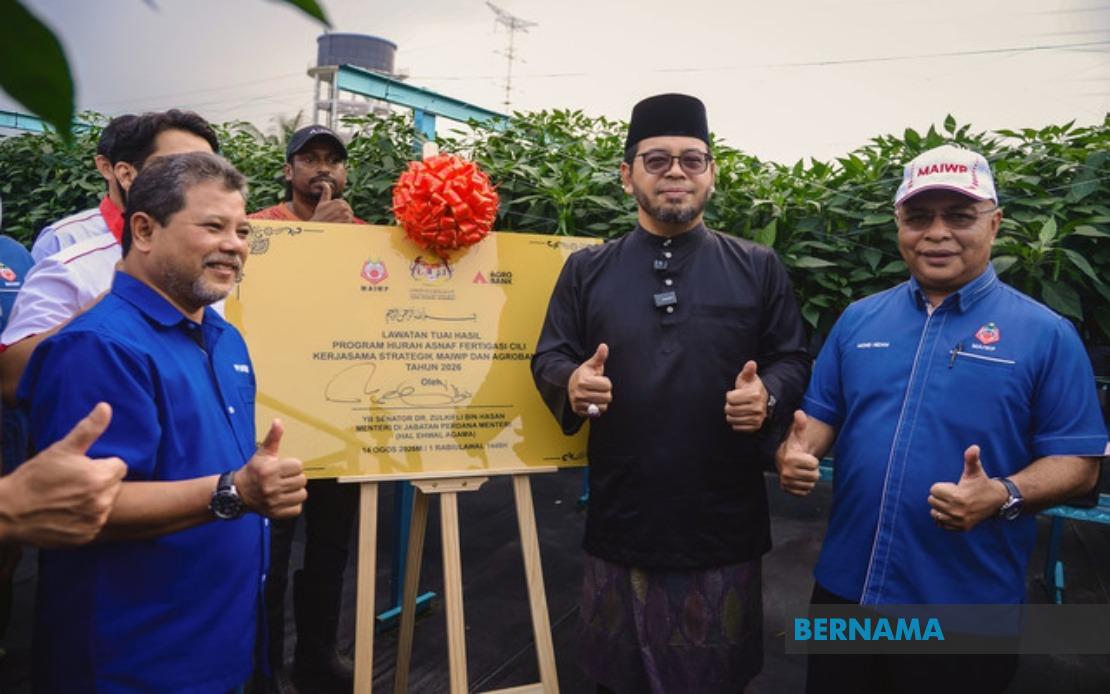
The Ministry in the Prime Minister's Department (Religious Affairs) is substantially scaling up a chilli cultivation project designed to help economically disadvantaged Malaysians achieve financial independence through modern farming techniques. The expansion to five acres represents a major vote of confidence in the fertigation model, which delivers nutrients and water directly to plant roots through drip irrigation systems—a technology increasingly adopted across Southeast Asia to boost yields while conserving resources.
Minister Dr Zulkifli Hasan highlighted the initiative's remarkable early success, noting that the inaugural harvest alone produced more than 16.7 tonnes of chillies and generated returns surpassing RM207,000 for participating asnaf farmers. These figures underscore the commercial viability of the approach within Malaysia's agricultural sector, where labour shortages and water scarcity have become persistent challenges. The production efficiency achieved through fertigation—typically yielding 30 to 40 per cent higher output than conventional farming methods—positions this project as a potential model for broader adoption across the country's smallholder farming community.
Beyond the immediate harvest metrics, the programme strategically incorporates value-addition pathways that could transform participating farmers into entrepreneurs. By facilitating the transition from raw produce sales to processed chilli products such as pastes, powders, and sauces, the initiative opens doors to higher-margin markets and more stable income streams. This downstream diversification is particularly valuable given the volatility of fresh produce pricing, which can swing dramatically based on seasonal supply fluctuations and regional market dynamics. For asnaf participants, this progression from basic farming to small-scale food production represents a tangible pathway toward sustainable livelihoods.
Alinda Rosely, a 49-year-old single mother participating in the scheme, exemplifies the personal transformation the project facilitates. After acquiring specialised knowledge in fertigation management through the programme, she generated RM40,000 in income within a single six-month period during a favourable pricing year. Her testimony carries particular weight in the Malaysian context, where single mothers comprise a vulnerable demographic often excluded from conventional agricultural finance and extension services. Her success demonstrates that systematic skills transfer combined with appropriate technology access can rapidly restore economic security for marginalised groups.
The expansion reflects a broader strategic repositioning within the Majlis Agama Islam Wilayah Persekutuan (MAIWP) to leverage zakat funds more dynamically. Rather than deploying religious endowment resources primarily through welfare assistance—important as that remains—the ministry is channelling capital toward productive infrastructure that generates employment and wealth for beneficiaries. This philosophical shift aligns with contemporary interpretations of Islamic philanthropy that prioritise empowerment over dependency.
Context matters here for understanding the initiative's significance within Malaysia's socioeconomic landscape. The country faces persistent structural inequality, with asnaf populations concentrated in urban fringe areas and rural zones where conventional employment prospects remain limited. Chilli farming, chosen for this project, represents a strategic crop selection given Malaysia's large domestic consumption and growing regional export demand. Chilli prices in Southeast Asian markets have remained relatively stable compared to other vegetables, providing participating farmers with greater income predictability than alternatives such as tomato or leafy green cultivation.
The MAIWP's broader charitable portfolio contextualises this agricultural initiative within its comprehensive poverty-alleviation framework. As of August 2026, the organisation had distributed RM699.57 million through thirty-eight distinct welfare assistance schemes, demonstrating substantial institutional capacity and reach. The decision to invest in productive projects like chilli fertigation reflects confidence that targeted interventions in specific sectors can generate superior long-term outcomes compared to unconditional cash transfers alone, even as emergency assistance remains essential for acutely vulnerable populations.
The fertigation technology itself carries implications beyond simple productivity gains. By reducing water consumption—critical given Malaysia's vulnerability to dry seasons and climate variability—and minimising chemical runoff into waterways, the system delivers environmental co-benefits alongside economic returns. For Malaysian agricultural planners concerned about sustainability, this project demonstrates that poverty alleviation and environmental stewardship need not conflict. The scalability of fertigation to five acres, and potentially beyond, positions it as a replicable model adaptable to different crops and regions throughout the country.
For other Southeast Asian nations grappling with rural poverty and agricultural modernisation challenges, the MAIWP model offers instructive lessons. The integration of religious institutional capacity with agricultural development, coupled with targeted technology transfer and downstream value-chain support, demonstrates how endowment-based charitable systems can function as engines for structural economic change rather than merely palliative relief mechanisms. As the region confronts climate pressures and urbanisation dynamics that strain traditional farming, such evidence-based interventions warrant serious consideration from policymakers across different institutional and cultural contexts.

