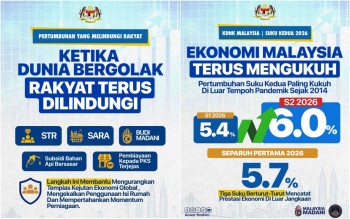
Malaysia's economy expanded at a robust six per cent in the second quarter of 2026, substantially exceeding analyst forecasts and delivering the country's most impressive second-quarter performance in over a decade when measured outside pandemic-inflated comparisons. The achievement, announced by Prime Minister Datuk Seri Anwar Ibrahim, reflects an economy that has defied headwinds from a contracting global economic environment marked by persistent supply chain disruptions and geopolitical tensions in West Asia.
The timing of this expansion carries particular significance given the international backdrop against which it occurred. While major economies worldwide grappled with reduced consumer confidence, supply bottlenecks, and inflationary pressures stemming from regional conflicts, Malaysia's growth trajectory demonstrated resilience and the effectiveness of targeted domestic policy interventions. The six per cent expansion represents not merely a statistical achievement but an indicator that the government's economic management has successfully insulated large segments of the Malaysian population from the worst effects of global instability.
Prime Minister Anwar attributed the country's economic resilience to deliberate policy choices implemented by the MADANI Government, emphasising that the administration's primary objective has been protecting ordinary Malaysians from severe economic dislocation during turbulent international conditions. He highlighted the government's multifaceted approach to economic stabilisation, which extends beyond headline-grabbing relief programmes to encompass behind-the-scenes efforts to maintain price stability and ensure commodity availability across the nation.
The government's social safety net mechanisms emerged as crucial pillars of this stability strategy. The BUDI MADANI initiative, combined with direct cash transfers through Sumbangan Tunai Rahmah (STR) and the broader Sumbangan Asas Rahmah (SARA) assistance programme, provided crucial income support to vulnerable populations during a period of global inflation. These interventions operated in tandem with less visible but equally important measures directed at managing domestic price pressures and preventing supply shortages that might otherwise have triggered panic purchasing or further inflationary spirals.
For Malaysian policymakers and regional observers, the Q2 2026 performance offers validating evidence that proactive counter-cyclical economic management can yield positive results even when external conditions deteriorate markedly. Malaysia's approach contrasts with more hands-off strategies that allow market mechanisms to absorb shocks, instead deploying government resources to maintain purchasing power among lower-income groups and sustaining domestic demand when external markets contracted.
However, the Prime Minister's commentary acknowledged that current achievements, while commendable, represent merely a foundation upon which much additional work must be constructed. Anwar signalled that the MADANI Government recognises the distinction between temporary growth spurts and the establishment of genuinely sustainable economic expansion that distributes benefits equitably across society. This perspective suggests awareness that growth rates divorced from meaningful employment generation or real income improvements among ordinary workers constitute incomplete economic victories.
The government's stated commitment to continuing structural reforms indicates recognition that maintaining economic momentum requires more than short-term stimulus measures or temporary relief programmes. The emphasis on creating quality employment opportunities and strengthening economic fundamentals suggests a policy framework oriented toward long-term productivity improvements rather than consumption-driven growth that cannot sustain itself once stimulus withdraws. This distinction carries particular weight in a regional context where several Southeast Asian economies have experienced boom-bust cycles driven by commodity prices or temporary policy interventions.
For the broader Southeast Asian region, Malaysia's Q2 2026 performance demonstrates that significant economic growth remains achievable despite global headwinds, provided governments implement sufficiently comprehensive policy responses. The comparison with the 2014 baseline proves instructive, as intervening years witnessed varying regional economic performance amid trade tensions, pandemic disruptions, and shifting commodity markets. That Malaysia could generate such strong second-quarter growth in 2026 while much of the global economy slowed suggests that country-specific policy choices and implementation capacity matter substantially in determining relative economic trajectories.
The reference to maintaining sustainable growth momentum while extending benefits to vulnerable populations reflects emerging consensus among development economists that inclusive growth models produce both superior social outcomes and greater macroeconomic stability. When wealth concentration accelerates, consumer spending power in lower income segments diminishes even as headline growth figures expand, eventually constraining overall demand and generating political instability. The MADANI Government's emphasis on ensuring that progress "could be achieved together by the rakyat" through improved incomes and targeted support signals awareness of these dynamics.
Looking forward, the sustainability of Malaysia's growth trajectory will depend critically on the government's ability to translate temporary counter-cyclical measures into permanent improvements in productive capacity, human capital development, and economic diversification. While the Q2 2026 figures demonstrate impressive short-term performance, the real test will involve maintaining growth rates above regional averages over subsequent quarters while simultaneously expanding employment quality and reducing income inequality markers that have widened during recent decades.
The Prime Minister's invocation of continued reform commitments suggests recognition that maintaining economic momentum beyond immediate policy cycles requires deeper institutional and structural changes affecting taxation systems, skills development infrastructure, research and innovation ecosystems, and regional trade integration mechanisms. Malaysia's demonstrated capacity to achieve strong growth despite adverse international conditions has established a baseline from which further improvements should logically emerge if longer-term reform initiatives receive consistent implementation and adequate resource allocation.

