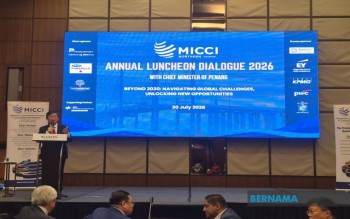
The Malaysian International Chamber of Commerce and Industry (MICCI) has issued a strategic call to its membership base to substantially increase investment in human capital development and innovation initiatives, positioning these areas as essential competitive requirements in an era of accelerating technological change. Speaking at the MICCI Northern Branch Annual Luncheon Dialogue 2026 in George Town on July 30, leadership outlined a vision for businesses that transcends immediate operational pressures and instead anchors strategy in the evolving demands of a digitally transformed economy.
Datuk Brian Tan Guan Hooi, chairman of MICCI's Northern Branch, framed the current moment as one presenting simultaneous challenges and opportunities for Malaysian enterprises. The twin forces of artificial intelligence adoption and widespread automation are fundamentally altering traditional employment structures, yet simultaneously generating entirely new industries and higher-value job categories that did not previously exist. This paradox requires businesses to adopt a dual perspective: recognising the disruption ahead whilst actively preparing their organisations to benefit from emerging opportunities that technological advancement creates.
Central to MICCI's message is the assertion that corporate competitiveness will increasingly depend upon workforce capabilities extending far beyond conventional educational credentials. Tan emphasised that companies must cultivate technical proficiency, foster creative problem-solving capacities, develop strong communication capabilities, and most critically, instil a cultural commitment to continuous learning and professional adaptation. This prescription reflects a deeper understanding that in rapidly evolving technological environments, the specific knowledge or certifications employees hold at any given moment may have diminishing relevance, whilst their capacity to rapidly acquire new skills becomes paramount.
The relationship between Malaysia's education and training infrastructure and actual industry requirements emerged as a central concern in Tan's remarks. He stressed that vocational and tertiary education systems must maintain close alignment with the practical needs and skill shortages that employers currently experience. This observation has particular resonance in Malaysia, where persistent gaps between graduate competencies and employer expectations have constrained productivity gains and contributed to talent mobility challenges within the region. The dialogue between educational institutions and the private sector therefore carries significant economic implications extending beyond individual companies to affect national competitiveness and attractiveness for foreign direct investment.
Tan articulated a strategic framework calling upon businesses to look beyond quarterly earnings pressures and instead strengthen their foundational capabilities through systematic innovation adoption and deliberate human capital investment. He argued that the capacity to develop, retain, and continuously upskill talented employees would function as a primary differentiator determining which companies successfully capture emerging opportunities and which instead face declining market relevance. This perspective aligns with broader regional trends, as Southeast Asian economies increasingly compete not on low-cost labour advantages but rather on the sophistication and adaptability of their workforce.
The MICCI chairman also elevated the question of public-private sector collaboration as fundamental to creating an ecosystem conducive to sustainable business growth across Malaysia. His formulation—that government provides strategic direction and enabling infrastructure whilst the private sector contributes capital, technological innovation, operational experience, and employment generation—reflects an interdependency that cannot be unilaterally managed. Rather than viewing government and business as separate or occasionally adversarial entities, Tan positioned them as complementary actors whose success mutually reinforces. Neither sector, he argued, possesses sufficient resources or mandate to independently achieve its objectives without constructive engagement from the other.
Continuous and substantive dialogue between industry representatives and policymakers emerged as a prerequisite condition for maintaining alignment between business requirements and government initiatives. Tan suggested that policies, infrastructure investments, and support mechanisms risk becoming misaligned with actual commercial needs absent regular communication channels where businesses can communicate their evolving challenges and opportunities directly to decision-makers. For Malaysia, this observation carries weight given the pace of global technological change, which can render even recently implemented policies obsolete if they do not remain responsive to emerging industry trends. The specific policy domains implicated include workforce visa regulations, research and development incentives, digital infrastructure standards, and vocational training subsidies.
MICCI itself was positioned as an institutional bridge between these two sectors, leveraging its longstanding presence in the Malaysian business community to facilitate this critical dialogue. The chamber, which has operated since 1837 and is marking its 189th anniversary in 2026, possesses both historical legitimacy and established networks that enable it to translate industry insights into actionable recommendations for government consideration. This brokering function has become increasingly valuable as the complexity of business operations and regulatory environments expands, creating genuine need for intermediary institutions that understand both commercial imperatives and policy constraints.
The dialogue's broader theme of "Beyond 2030: Navigating Global Challenges, Unlocking New Opportunities" reflected an orientation toward medium-term strategic planning rather than immediate crisis response. The inclusion of Penang Chief Minister Chow Kon Yeow as guest of honour signalled alignment between state-level governance priorities and MICCI's business development agenda, a coordination that matters considerably given Penang's aspirations to position itself as a technology and innovation hub within Southeast Asia. The convergence of business sector perspectives and state leadership at such high-profile events typically precedes policy initiatives, suggesting that recommendations emerging from this dialogue may inform forthcoming state-level investments in education, infrastructure, or business support mechanisms.
For Malaysian enterprises operating within increasingly competitive global markets, MICCI's message carries practical implications that extend beyond abstract principle. Companies that delay investment in systematic talent development and innovation capabilities risk finding themselves structurally unprepared for the labour market, consumer preferences, and operational requirements that will define their industries within five to ten years. The current technological transformation, unlike previous industrial transitions, progresses with sufficient rapidity that even short delays in strategic adaptation can substantially diminish competitive positioning. Organisations that act now to build innovation cultures, establish continuous learning frameworks, and invest in emerging skill areas position themselves to capture disproportionate value from the opportunities that technological advancement will undoubtedly create across the Malaysian and Southeast Asian economies.

