A Malaysian man has been sentenced to 16 months and two weeks in jail for his brief participation in an elaborate Cambodian scam operation that defrauded Singaporeans of millions of dollars. Yip Chee Ming, 30, pleaded guilty to membership in an organised crime syndicate on Friday after being arrested during a coordinated police operation nine months ago. His case illustrates both the vulnerability of Southeast Asian nationals to transnational crime recruitment and the sometimes-comical failures that occur within criminal enterprises operating across borders.
Yip's involvement in the scam world began innocuously when a friend named Jason proposed a lucrative opportunity in October 2024. The two were asked to join a scam centre based in Phnom Penh, Cambodia, where the operation conducted what law enforcement describes as government official impersonation scams—sophisticated frauds in which callers pose as bank officials or government representatives to convince victims to transfer money or reveal personal information. Intrigued by the prospect of steady income, both men agreed to travel to Cambodia after being added to a Telegram group by Tang Soon Wah, one of the syndicate's identified leaders.
The scale of the criminal operation that Yip joined was staggering. Between September 2024 and September 2025, the syndicate orchestrated at least 528 reported scam cases that collectively netted approximately S$52.5 million in losses from Singapore victims alone. The operation maintained a hierarchical structure typical of sophisticated organised crime networks. At the apex were leaders like Tang who managed overall operations and distributed commissions. Below them sat supervisors and trainers who directly overseen the callers—the frontline workers who actually conducted the fraudulent telephone conversations. The syndicate even invested in training infrastructure, with experienced operatives providing scripts to newer recruits and coaching them on subtle techniques, such as adopting a Singaporean accent to build credibility with targets.
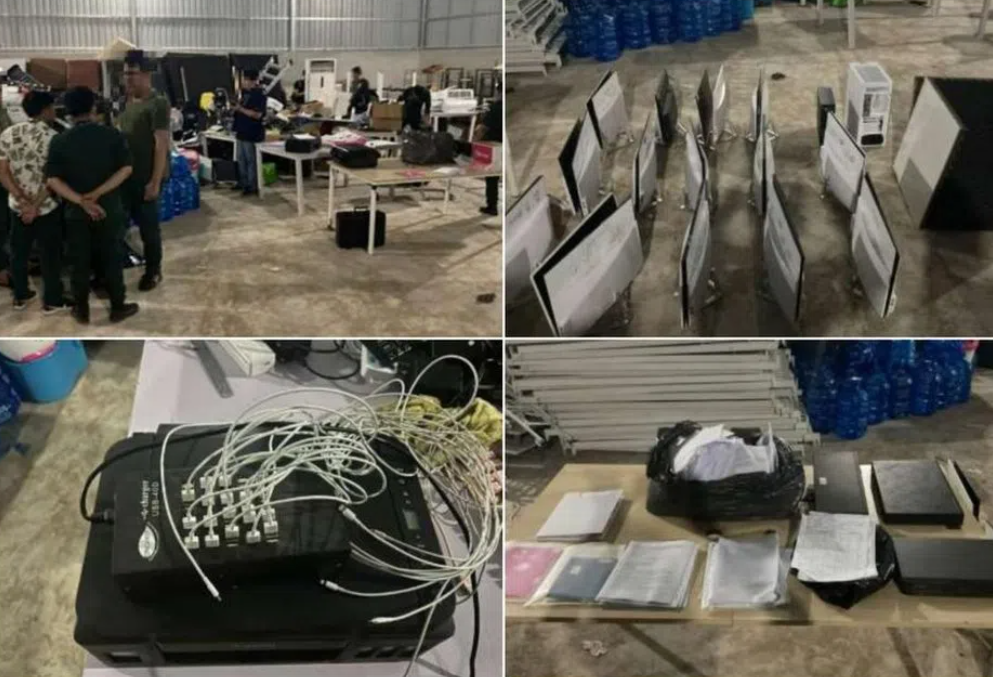
What distinguished this operation from smaller scam units was its integration of financial crime infrastructure. The syndicate maintained a dedicated group of money launderers who converted illicit proceeds into cryptocurrency, thereby obscuring the criminal origins of funds and making them more portable across borders. Court documents reveal the organisation included at least 78 suspected members, suggesting a truly multinational enterprise with cells in multiple countries. The physical nerve centre was located in a five-storey building in Phnom Penh fortified with security guards, reflecting the considerable investment in protecting the operation from law enforcement intervention.
Tang's recruitment pitch included an in-person tour of the facility. Yip and his friend Jason were flown to Cambodia to inspect the compound, where they could see firsthand the infrastructure supporting the fraud operation. The investment in recruitment and vetting, combined with promises of competitive compensation, suggests the syndicate took its talent acquisition seriously. Yip was offered US$1,800 monthly in cryptocurrency—approximately S$2,333—plus a 1 percent commission on every victim he successfully defrauded, making the economics moderately attractive to a Malaysian worker seeking rapid income growth.
However, when Yip commenced work on November 22, 2024, his criminal career encountered an unexpected obstacle: he possessed neither the psychological temperament nor the persuasive capability to deceive vulnerable people. Despite meticulous adherence to the scripts provided by trainers—scripts refined through hundreds of successful deceptions—Yip failed to convince a single target. His first day yielded no successful fraud. On November 23, attempting to salvage the situation, he made additional calls but again failed to dupe anyone into sending money. Within 72 hours of starting, Tang made the business decision to terminate Yip's employment, deleting their message history to cover his tracks. The court documents do not clarify how Yip returned to Malaysia or whether he received any compensation for his failed stint.
Yip's arrest came nearly a year later when Singapore Police and the Cambodian National Police executed a coordinated operation on September 9, 2025, dismantling portions of the syndicate's local operations. Yip was apprehended in Singapore and became one of twelve individuals charged in connection with the organisation. Nine of the accused were Singaporean nationals—Deon Tan Ke Yuan, 25; Lester Ng Jing Hai, 29; Christy Neo Wei En, 29; Heiqal Lee, 30; Tay Jun Xiang, 32; Ng Wei Kang, 33; Zachary Lee Jia An, 35; Melvin Tan Wenzheng, 35; and Lau Haoxiang, 39. Beyond Yip, the remaining accused included Malaysian national Muhamad Asyraf Anuar, 29, and Filipina De Villar Rizalyn Panganiban, 34, underscoring the multinational character of the criminal network.
While the overall volume of scam complaints in Singapore declined during 2025, government official impersonation scams experienced an alarming surge, more than doubling from 1,504 cases in 2024 to 3,363 cases the following year. This category became the fifth most prevalent fraud type in the city-state, suggesting that while authorities made progress against some criminal schemes, perpetrators successfully shifted tactics toward this particular fraud methodology. The spike indicates not merely an increase in criminal ambition but rather an adaptation to evolving victim vulnerability or changing detection patterns by law enforcement.
Yip's sentencing reflects the judicial system's approach to lower-level organised crime participants. Under Singapore law, membership in an organised crime syndicate carries penalties of up to five years' imprisonment and fines reaching S$100,000. The fact that Yip received a sentence of 16 months and two weeks—substantially less than the maximum—likely reflects his minor role, immediate failure as a criminal, and cooperation with authorities. An additional charge relating to actual cheating was taken into consideration during sentencing, though he was not prosecuted on that count given his complete failure to defraud anyone.
The case carries broader implications for Southeast Asia's approach to transnational crime. Malaysian nationals remain attractive recruits for foreign criminal enterprises, whether due to ease of border crossing, shared language capabilities, or perceived reliability as intermediaries. The willingness of Yip and Jason to travel to Cambodia for criminal employment, combined with the syndicate's capacity to identify, vet, and transport recruits, reveals how established these networks have become. For Malaysian authorities and regional law enforcement agencies, the prevalence of Malaysians within international scam operations suggests that counter-fraud initiatives must extend beyond victim protection to include prevention of Malaysian citizens' recruitment into foreign criminal enterprises.
For ordinary Singaporeans and Southeast Asian residents, the proliferation of government official impersonation scams despite law enforcement operations indicates that traditional police responses—arresting individual cells and low-level operatives—may prove insufficient against distributed criminal networks. The syndicate that employed Yip has been partially disrupted, but similar operations likely continue elsewhere in Cambodia and other regional safe havens. The astronomical sums extracted from victims—S$52.5 million across just 528 cases suggests average losses exceeding S$100,000 per incident—demonstrate the economic stakes driving continued recruitment and operation of such schemes across borders.

