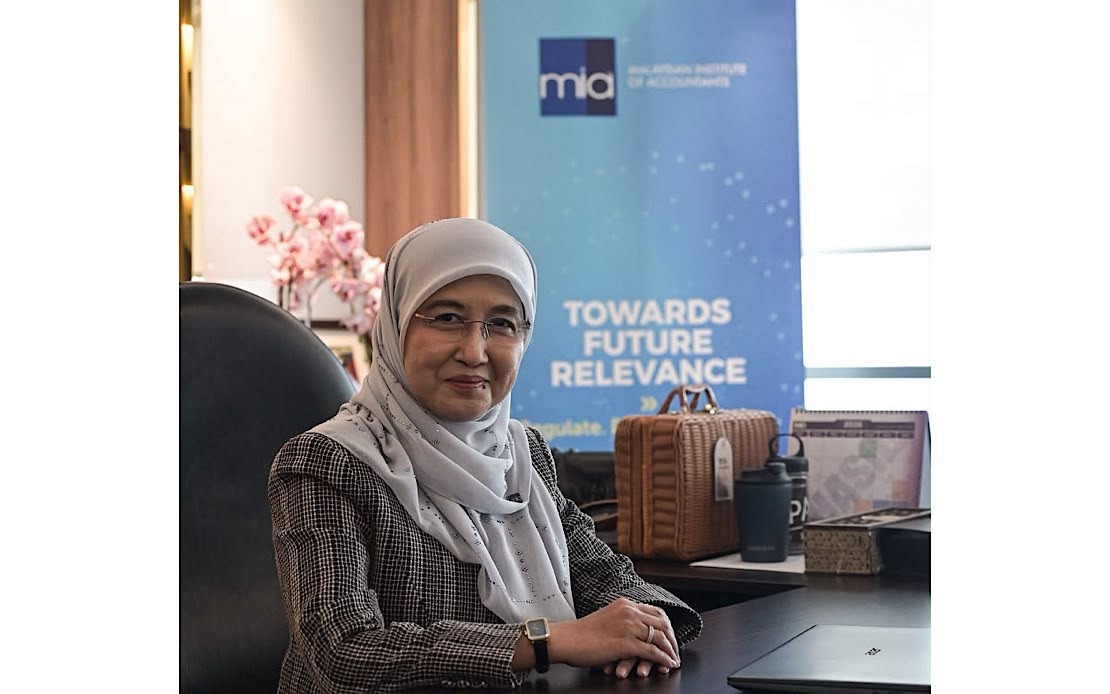
The Malaysian accountancy profession stands at a critical juncture where technological disruption and evolving stakeholder expectations demand a fundamental reimagining of how practitioners create value, according to Malaysia's peak accounting body. The Malaysian Institute of Accountants has positioned a forward-looking evolution as essential to sustaining the nation's competitive edge in an increasingly complex global economy. This transition requires professionals to balance digital transformation with the bedrock principles of integrity and ethical practice that have historically defined accounting as a trusted profession.
Datuk Saniza Said, who made history in December 2025 as the first woman elected president of MIA, articulated a vision in which accountants transcend their traditional role as record-keepers to become comprehensive business strategists. The expansion reflects broader market realities where organisations face unprecedented uncertainty from technological disruption, climate-related risks, and sophisticated financial crime. Modern accountants must therefore develop competencies that span advisory services, strategic decision-making, and stakeholder confidence-building—capabilities that extend well beyond the arithmetic and compliance work that once defined the profession. This repositioning recognises that financial stewardship now encompasses governance, foresight, and value creation across multiple dimensions.
At the heart of this transformation lies an unwavering commitment to the profession's foundational values. Saniza emphasised that ethical principles, transparency, accountability and integrity must remain non-negotiable, even as practitioners adopt new tools and methodologies. The accountancy profession's credibility rests fundamentally on public confidence in the independence and objectivity of financial reporting. In an era marked by escalating financial misconduct and increasingly sophisticated scams, this trust becomes more vital to Malaysia's standing as a transparent, reliable financial destination. Rebuilding and maintaining stakeholder confidence therefore represents not merely a professional obligation but an economic imperative that supports Malaysia's attractiveness to international investors and capital flows.
Technological transformation inevitably reshapes the accounting landscape, yet Saniza cautioned against viewing automation and artificial intelligence as existential threats to the profession. Rather, technology should serve as an enabler that liberates accountants from repetitive, low-value tasks and elevates their capacity to exercise professional judgment where it matters most. She articulated a pragmatic perspective in which AI handles routine bookkeeping and data processing while humans retain responsibility for complex interpretive work that demands contextual understanding, ethical reasoning, and accountability. This division of labour acknowledges the fundamental truth that technology executes instructions but cannot replicate the nuanced judgment accountants must apply when assessing materiality, evaluating risks, or advising on complex transactions.
MIA's chief executive officer G. Shanmugam provided deeper insight into the structural shifts reshaping accountancy work. Automation increasingly assumes responsibility for the transactional processing that once consumed substantial professional time, thereby creating capacity for accountants to concentrate on higher-order functions including data analytics, business strategy consultation, risk management and advisory services. This reallocation mirrors broader economic patterns in which developed financial markets reward sophisticated analysis and foresight over routine execution. For Malaysian accountants seeking career progression and enhanced compensation, the transition toward advisory and analytical work offers genuine opportunity rather than displacement. The profession therefore faces not decline but fundamental transformation in its character and value proposition.
A critical emerging capability concerns foresight and anticipatory analysis. Shanmugam articulated how organisational leaders increasingly expect accountants to function as trusted advisers capable of identifying what stakeholders do not yet perceive. This demands that professionals cultivate predictive analytics skills, trend identification capabilities, and strategic perspective that enables them to counsel organisations on future challenges and opportunities. The expansion reflects recognition that financial control and historical analysis, while important, insufficiently equip organisations navigating rapid change. Accountants must therefore develop forward-looking competencies that help management anticipate market shifts, regulatory transformations, and systemic risks. This repositioning transforms accountants from backward-looking record-keepers into forward-looking business strategists.
Sustainability reporting and assurance represents a particularly significant frontier for professional expansion. MIA's recent launch of its Sustainability Blueprint and Roadmap signals commitment to developing member capabilities in an area where demand continues accelerating. As environmental, social and governance considerations increasingly influence investor decisions and regulatory frameworks, organisations require accountants capable of assessing sustainability data integrity and providing credible assurance over non-financial disclosures. For Malaysian practitioners, this expansion opens new advisory channels while positioning the nation's accountancy profession as capable of serving multinational organisations operating under stringent international sustainability standards. The convergence of financial and sustainability reporting creates opportunities for accountants to extend influence across dimensions previously beyond their traditional scope.
Building these enhanced capabilities demands sustained investment in professional development. MIA currently conducts approximately one thousand Continuing Professional Development programmes annually, supplemented by conferences, online learning platforms and networking initiatives. This infrastructure aims to ensure the organisation's approximately 42,000 members—growing at roughly 1.5 to 2.0 percent annually—remain equipped with contemporary competencies. The emphasis reflects understanding that professional evolution requires deliberate, ongoing investment. Individual accountants cannot assume their initial qualification suffices for career-long relevance; rather, they must commit to continuous upskilling as technological, regulatory and market conditions transform. MIA's programming therefore serves both individual practitioners and the broader profession by establishing standards for contemporary practice.
The technological transition paradoxically enhances rather than diminishes the profession's appeal to emerging talent. By automating mundane transactional work, technology enables younger practitioners to progress more rapidly into analytical, managerial and advisory roles where they exercise greater autonomy and influence. Graduate accountants entering the profession today should anticipate work that is substantively more engaging and intellectually demanding than that performed by previous generations constrained by routine processing obligations. This reallocation of labour represents genuine professional advancement rather than job destruction. For Malaysia, this transformation strengthens the profession's capacity to attract capable young talent and compete globally for professional expertise.
The accountancy profession's evolution ultimately reflects broader economic realities confronting Malaysia and Southeast Asia. As regional economies mature and compete increasingly on sophistication rather than cost, the demand for high-value professional services intensifies. Accountants positioned to provide strategic counsel, manage complex risks, and navigate emerging sustainability demands become essential to organisational success. Conversely, practitioners unable or unwilling to develop beyond traditional compliance work face marginalisation as artificial intelligence and automation assume routine responsibilities. The profession's future therefore depends on collective commitment to transformation—among individuals developing new competencies, among professional bodies investing in development infrastructure, and among regulators fostering environments where innovation can flourish. Malaysia's accountancy profession must embrace this imperative to secure both its own vitality and its contribution to national economic competitiveness.

