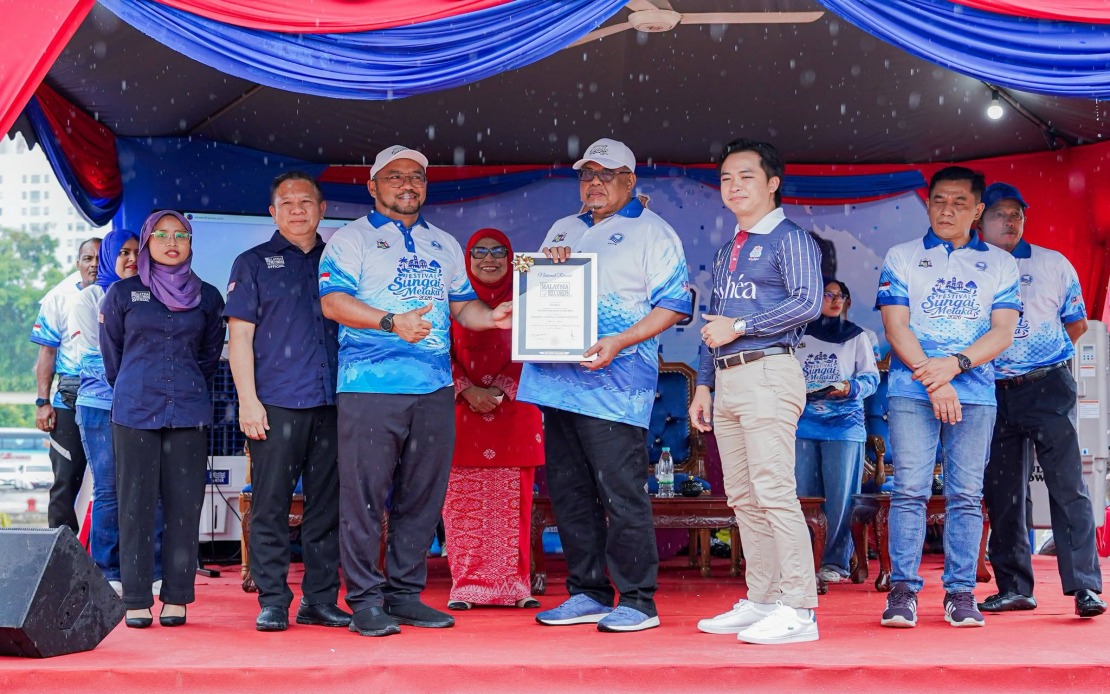
Melaka has continued its remarkable run of international recognition, securing its fourth Malaysia Book of Records (MBOR) accolade in the tourism sector within a compressed three-year timeframe. The latest distinction, which honours the state for maintaining the "Largest Replica" of a notable structure, underscores a deliberate strategy to position the southern state as a destination that blends heritage appeal with contemporary attractions capable of drawing repeat visits and sustained tourist spending.
Chief Minister Ab Rauf Yusoh, speaking at the MBOR Certificate Presentation and Prize Giving Ceremony held at Dataran Pengkalan Rama in conjunction with the Sungai Melaka Festival 2026, framed these achievements as evidence of institutional commitment to innovation rather than mere trophy-collecting. His remarks reflected a growing awareness among Malaysian state governments that tourism accolades carry little value unless translated into measurable economic activity and employment opportunities for local communities.
The Chief Minister explicitly cautioned against allowing records to become decorative wall hangings, instead urging stakeholders to leverage each recognition as a springboard for developing new tourism products, experiences, and marketing campaigns. This pragmatic stance aligns with broader Southeast Asian trends, where competing destinations increasingly measure success not by award counts but by the volume and duration of tourist arrivals and the multiplier effects on local businesses, hospitality sectors, and related supply chains.
Central to Melaka's current tourism narrative is the Sungai Melaka, historically significant as a trading waterway but long neglected as an experiential destination. The state government has embarked on a deliberate revival programme anchored by the Sungai Melaka Festival, now in its seventeenth iteration. This year's edition represents a substantial scaling-up, featuring over thirty distinct programmes distributed across Melaka's three administrative districts and designed to appeal to diverse demographic cohorts and interest groups.
The 17th Sungai Melaka Festival encompasses the river's unique heritage dimensions while actively encouraging community participation through structured competitive events. A freshwater fishing competition emerged as a standout element, offering combined prize money totalling RM30,000, with the first-place winner claiming RM10,000. The sheer prize allocation reflects strategic thinking: substantial monetary incentives function not merely as rewards but as marketing mechanisms capable of attracting serious competitors from neighbouring states and beyond.
The fishing competition drew 1,123 participants, a significant turnout that included both Melaka-based and interstate anglers, some of whom arrived before dawn with equipment and elaborate strategies in hand. This level of engagement demonstrates that niche activities, when properly resourced and promoted, can cultivate dedicated participant communities and justify regular iteration. For Malaysian state tourism boards, this represents a valuable lesson: not all attractions require blockbuster mass-market appeal to generate economic benefit and brand visibility.
Looking forward, Chief Minister Ab Rauf Yusoh signalled intentions to develop the fishing competition into a signature annual tourism product for Melaka, with plans for expanded scale, enhanced competitive format, and prize structures sufficiently attractive to draw participants from across the region. This reflects deliberate portfolio diversification, whereby state governments move beyond conventional cultural performances and historical site visitation to encompass participatory recreational activities that generate ancillary spending on accommodation, dining, transportation, and retail services.
The involvement of the Melaka River and Beach Development Corporation (PPSPM), represented at the ceremony by chief executive officer Shaharul Azuar Idris, underscores institutional coordination essential to sustaining tourism infrastructure and programming. The corporation's stewardship over riverine and coastal assets positions it as a critical coordinator of competing land-use priorities, environmental considerations, and tourism development objectives.
Melaka's record-acquisition momentum arrives amid intensifying regional competition for tourism revenues and international visitor attention. Other Malaysian states, particularly Penang, Johor, and Sabah, have invested substantially in distinctive attractions and experience curation. Melaka's historical status as a UNESCO World Heritage City provides an inherent advantage, yet heritage alone cannot sustain contemporary tourism economies without continuous innovation in programming, infrastructure, and experiential design.
The state's strategy of pursuing MBOR recognitions reflects confidence that superlative claims—however niche the metric—generate media coverage, visitor curiosity, and differentiation in crowded tourism markets. However, the sustainability of this approach depends ultimately on converting one-time recognition-seeking into recurring visitation patterns, extended length-of-stay metrics, and repeat-visit behaviour. The Sungai Melaka Festival initiatives, particularly the fishing competition's demonstrated appeal, suggest that Melaka is moving prudently toward experience-driven rather than monument-driven tourism positioning.
For Malaysian tourism policymakers and regional competitors, Melaka's trajectory offers instructive insights. State-level differentiation, robust community engagement mechanisms, and sustained investment in varied programming—rather than dependence on singular flagship attractions—increasingly characterize successful tourism destinations. The forthcoming years will reveal whether Melaka can translate its current momentum and award accumulation into measurable economic multipliers and improved quality-of-life indicators for residents residing in tourism-adjacent sectors.

