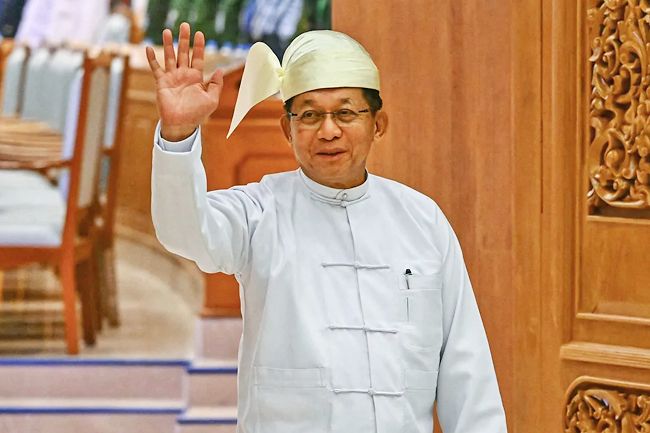
Myanmar's military leader Min Aung Hlaing will travel to Bangkok on August 6 and 7 for discussions with Thai Prime Minister Anutin Charnvirakul, Thailand's foreign minister Sihasak Phuangketkeow confirmed this week following regional diplomatic engagements in Manila. The visit represents another chapter in Thailand's sustained push to rehabilitate Myanmar's standing within ASEAN, a strategy that has increasingly become a flashpoint among the bloc's ten member nations.
Sihasak's confirmation came after what he characterised as a straightforward and transparent dialogue among ASEAN's foreign ministers regarding the optimal approach to Myanmar's diplomatic rehabilitation. The discussions reflected growing tensions within the regional grouping over how to address Myanmar's international isolation following the 2021 military takeover, which dismantled the government of Aung San Suu Kyi. While Myanmar technically retains its membership status in ASEAN, the bloc has systematically excluded junta representatives from its principal forums since the coup, a compromise position that has satisfied neither hawks advocating complete expulsion nor doves pushing for normalisation.
Thailand's prominent role in Myanmar engagement stems from geographic and humanitarian imperatives that distinguish its position from other ASEAN members. Sharing an extended border with Myanmar as it descends into civil conflict, Thailand hosts millions of Burmese refugees and serves as a conduit for both legitimate cross-border commerce and illicit trafficking networks. This complex interdependence has made Myanmar's instability a direct Thai security concern, explaining Bangkok's determination to facilitate dialogue even as the junta remains widely condemned internationally. However, Thailand's dovish approach has exposed fractures within ASEAN, with some members questioning whether engagement legitimises military rule without achieving tangible democratic improvements.
Sihasak articulated a framework he termed a "dual-track approach" to Myanmar reintegration, acknowledging that diplomatic rehabilitation need not require immediate abandonment of ASEAN's established peace principles. He identified pressing bilateral issues requiring urgent attention, notably transnational criminal enterprises, online fraud operations, and drug trafficking that destabilise the Thai-Myanmar border region. These security challenges provide practical justification for sustained high-level engagement independent of broader political considerations, offering Thailand diplomatic cover for its Myanmar strategy within ASEAN circles sceptical of apparent appeasement.
The foreign minister's emphasis on redefining progress metrics reveals sophisticated diplomacy aimed at managing expectations while maintaining momentum toward normalisation. Rather than demanding immediate comprehensive democratic transition, Sihasak suggested incremental benchmarks such as granting ASEAN's special envoy access to detained civilian leaders including Aung San Suu Kyi, or achieving violence reduction along the turbulent Thai-Myanmar border. This gradualist framework implicitly acknowledges that Myanmar's junta will not rapidly transform, but proposes that smaller demonstrable improvements can justify continued engagement and eventual reintegration. The approach prioritises pragmatism over ideological consistency, a significant departure from ASEAN's traditional rhetorical commitment to democracy and human rights.
Sihasak's confidence that Myanmar's recent elections, which formalised Min Aung Hlaing's position as president, might create openings for dialogue with armed ethnic groups represents optimistic interpretation of the junta's intentions. Historical evidence suggests the junta has repeatedly used elections and constitutional reforms as legitimacy exercises rather than genuine democratic transitions, yet Thailand appears willing to interpret the latest elections charitably. The foreign minister explicitly identified ethnic armed organisations along the Thai border as essential interlocutors, recognising that Myanmar's political resolution ultimately requires armed groups' participation rather than top-down military diktat.
Philippine Foreign Minister Theresa Lazaro's suggestion that ASEAN consider appointing a permanent, long-term envoy to Myanmar addresses structural weaknesses in regional diplomacy toward the country. The current system of rotating yearly representatives has demonstrably failed to generate sustained diplomatic progress or consistent pressure on the junta, instead allowing Myanmar to navigate between envoys with differing priorities and relationships. A permanent envoy would accumulate institutional knowledge, develop deeper relationships with Myanmar officials, and maintain continuity across political transitions within member states, potentially enhancing ASEAN's collective leverage.
The proposed envoy arrangement also reflects broader frustration within ASEAN that its diplomatic mechanisms lack adequate resources and institutional depth for complex crisis management. Myanmar represents perhaps the most significant test of ASEAN's relevance as a regional problem-solving forum; failure to achieve meaningful progress risks undermining the bloc's credibility on other transnational challenges. By professionalising the Myanmar engagement through dedicated representation, ASEAN might demonstrate renewed commitment to the five-point peace plan while simultaneously acknowledging that yearly rotations have proven insufficient.
For Malaysian readers, these developments carry substantial implications given Malaysia's exposed position to Myanmar-related crises including refugee movements, human trafficking, and maritime security challenges. Malaysia has historically maintained a more critical stance toward the junta compared to Thailand, advocating stronger ASEAN positions on democratic principles. The divergence between Thai and Malaysian approaches reflects broader strategic differences, with Thailand prioritising bilateral stability and Malaysia emphasising collective ASEAN integrity. As Thailand consolidates its Myanmar engagement strategy, Malaysia will face mounting pressure to either align with the pragmatic bilateral approach or maintain principled criticism that may increasingly isolate Malaysian positions within ASEAN forums.
The trajectory toward Myanmar's gradual reintegration appears increasingly inevitable despite resistance from some quarters, driven by Thailand's determination, geographic realities, and the practical difficulties of indefinitely excluding a neighbouring state from regional structures. However, the pace and conditions of reintegration remain contested. Thailand's August talks with Min Aung Hlaing will likely crystallise the contours of ASEAN's Myanmar policy for the coming months, potentially establishing whether incremental engagement can eventually translate into renewed junta participation in mainstream ASEAN activities, or whether continued international isolation will prove the bloc's preferred equilibrium.

