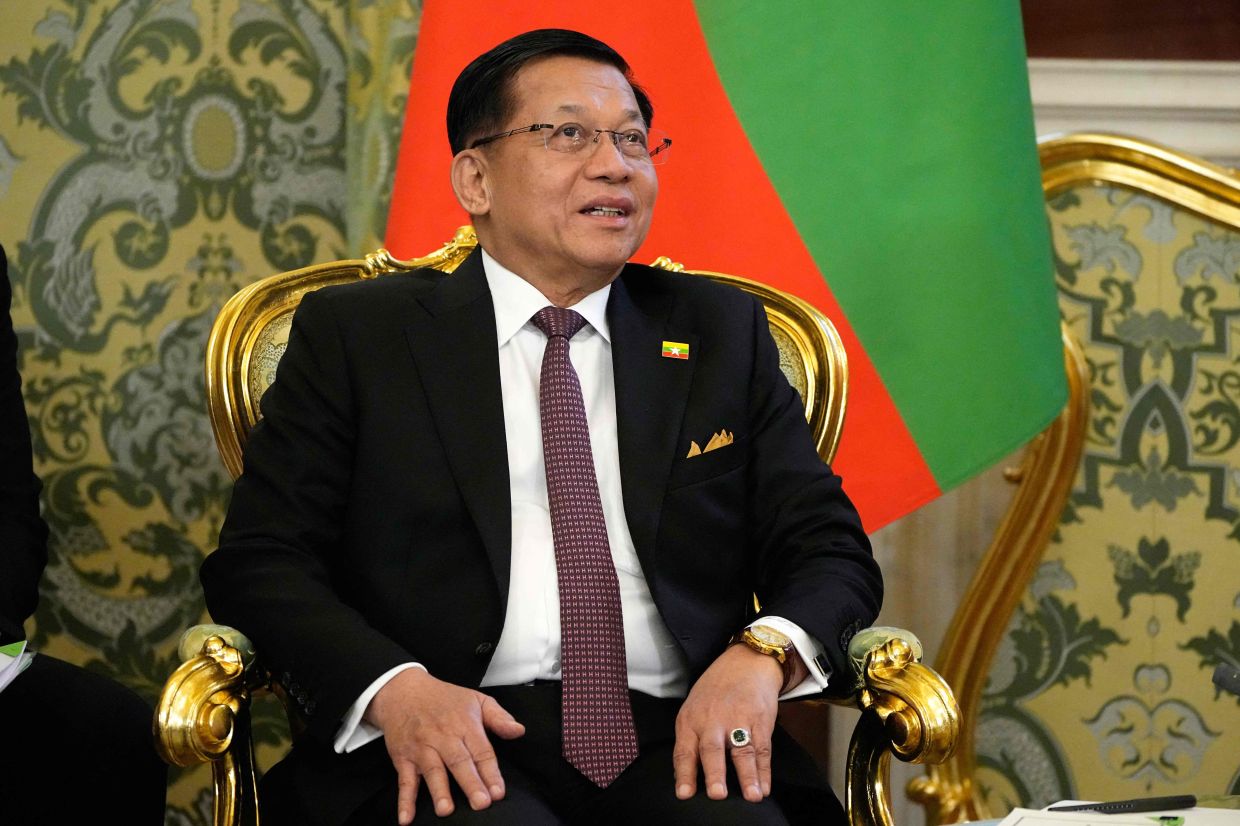
Myanmar's military leader Min Aung Hlaing is set to visit Cambodia in early September for an official state visit intended to reinforce cooperation between the neighbouring nations. The Cambodian Senate has confirmed the visit, with senior officials including Kuy Sophal, Minister of the Royal Palace, and Chin Ketna, permanent deputy chairman of the National Committee for Organising National and International Festivals, already inspecting venues to prepare for the Myanmar leader's arrival. Chea Thyrith, spokesperson for the Senate president, characterised the visit as part of Cambodia's commitment to strengthen bilateral friendship and describe two-way cooperation as both necessary and mutually advantageous for the two Southeast Asian countries.
The visit represents the latest stop in an expanding international tour by Min Aung Hlaing, who has already travelled to India, China, Laos, Thailand and Russia since his controversial election as president in April. This sequence of foreign engagements has drawn considerable scrutiny from international observers, human rights organisations and pro-democracy advocates, who view the diplomatic circuit as a deliberate strategy to enhance Min Aung Hlaing's standing on the world stage and secure recognition as Myanmar's legitimate civilian leader. The tours come at a moment when Myanmar remains isolated within regional structures due to the 2021 military coup that deposed Aung San Suu Kyi and the subsequent detention of the former democratic leader.
The backdrop to these visits is deeply troubling for advocates of democratic governance in Southeast Asia. Myanmar has faced sustained accusations of systematic human rights abuses under military rule, including widespread arbitrary detention of activists, dissidents and ordinary citizens who have expressed opposition to the junta's authority. The coup itself overturned democratic processes that had been established following decades of military rule, and the April election widely dismissed by international observers as lacking credibility has further consolidated military control over state institutions. Thousands of individuals seeking to resist the military regime or advocate for democratic restoration have reportedly been detained in prisons and detention centres across the country.
Within the Association of Southeast Asian Nations framework, Myanmar's regional standing has been substantially diminished. Asean has excluded Myanmar from its summit meetings in response to the junta's failure to comply with a five-point consensus agreement negotiated in 2021 that was intended to address the political crisis and establish pathways toward democratisation. This exclusion reflects the difficulty facing the bloc in balancing its commitment to non-interference with growing international pressure over the humanitarian situation in Myanmar. The consensus agreement, which stipulated specific benchmarks for political progress, remains largely unimplemented, creating a fundamental obstacle to Myanmar's reinstatement within Asean's regular leadership meetings.
Kin Phea, president of the International Relations Institute of Cambodia, offered a more nuanced perspective on the significance of the upcoming visit. While acknowledging that the trip undoubtedly serves to enhance Min Aung Hlaing's international profile and consolidate his position domestically, Phea suggested that Cambodia's willingness to host the Myanmar leader reflects the kingdom's independent foreign policy approach and its historical role as a bridge between various regional actors. He noted that Cambodia had attempted to mediate the Myanmar crisis during its 2022 Asean chairmanship, undertaking diplomatic efforts to ease tensions and foster dialogue among relevant stakeholders.
Phea further emphasised that Cambodia possesses considerable experience in navigating processes of national reconciliation, institution-building and peace consolidation following its own tumultuous history. This historical experience positions Cambodia as a potential source of insight and advice for Myanmar as the country grapples with political fragmentation and the challenge of rebuilding democratic institutions. However, Phea cautioned that external diplomatic engagement, while valuable, cannot substitute for genuine internal transformation and political reform. True progress toward national reconciliation and democratic restoration would require Myanmar's leadership to undertake substantive institutional and policy changes rather than relying primarily on international engagement and symbolic gestures.
A critical distinction that Phea highlighted concerns the formal classification of such visits within Asean's diplomatic protocols. Whether Cambodia or other nations formally recognise the Myanmar leader's tours as official state visits remains a matter of procedural importance but ultimately secondary significance compared to the broader question of Myanmar's political trajectory. The decisive factor determining whether Myanmar can restore its participation in Asean summits is not the bilateral relationships that Min Aung Hlaing cultivates through individual country visits, but rather the implementation of the five-point consensus agreement to which Myanmar committed in 2021. This agreement remains the benchmarking mechanism by which the entire bloc assesses Myanmar's progress and readiness to re-engage within Asean's collective structures.
For Malaysia and other Asean members, the Cambodia visit underscores the persistent challenge facing the regional bloc in responding to Myanmar's political crisis. The junta's continued diplomatic outreach, while individually directed toward sympathetic or pragmatic bilateral partners like Cambodia, Laos and Russia, collectively signals an unwillingness to comply with Asean's consensus demands. The military leadership in Naypyidaw appears to be pursuing a strategy of selective engagement with friendly nations while circumventing pressure from the broader regional community and international actors demanding democratic restoration and accountability for human rights violations.
The situation reflects broader tensions within Asean between the principle of non-interference in member states' internal affairs and the collective responsibility to address regional stability and humanitarian concerns. Cambodia's decision to host Min Aung Hlaing demonstrates that individual Asean members retain substantial autonomy in their bilateral foreign relations, even when those decisions may complicate the bloc's collective position on contentious issues. This autonomy, while consistent with Asean's founding principles, creates space for geopolitical maneuvering that can undermine coordinated responses to regional crises.
Looking ahead, the Myanmar situation remains one of the most significant tests of Asean's effectiveness as a regional organisation. The junta's continued defiance of the five-point consensus, combined with its diplomatic offensive to secure recognition and normalisation, suggests that military leaders in Myanmar have calculated they can pursue their preferred political trajectory despite regional isolation. Min Aung Hlaing's forthcoming visit to Cambodia should be understood not as a bilateral courtesy but as part of a sophisticated strategy to fragment Asean unity and create political space for Myanmar's military rulers to consolidate power without meaningful accountability.

