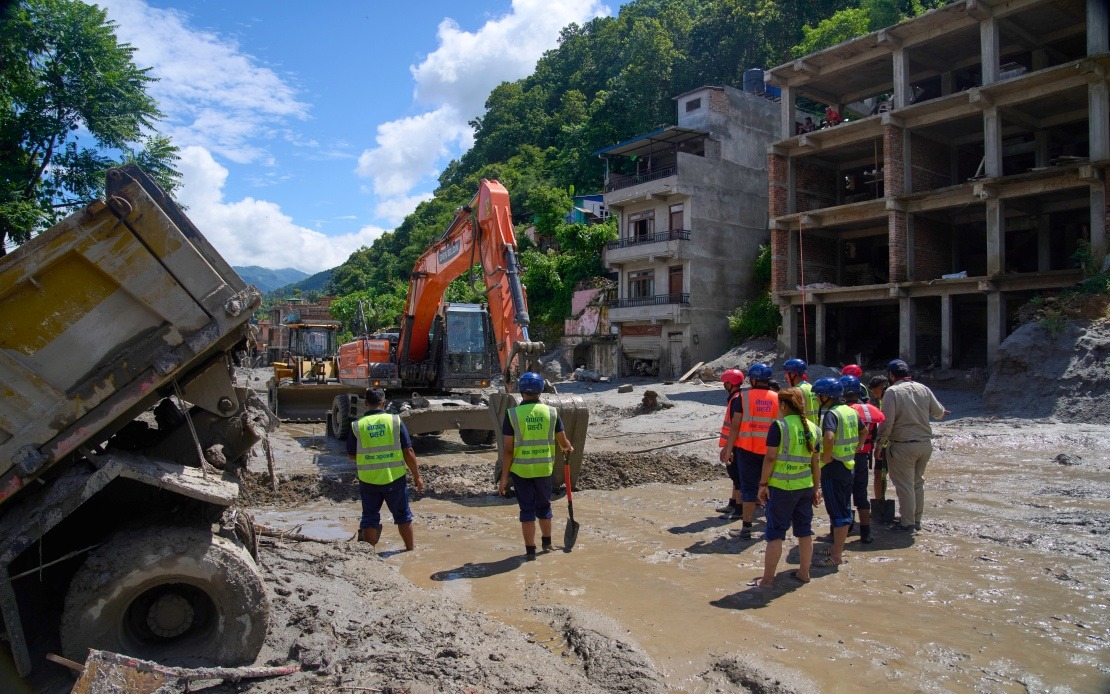
Nepal's Ministry of Foreign Affairs has established a dedicated Emergency Response Team to manage the complex coordination effort surrounding hundreds of missing foreign nationals caught in devastating flooding that struck the Rasuwa district. The formation of this specialized unit underscores the scale of the humanitarian crisis unfolding in the Himalayan nation, where the disaster has already claimed at least 359 lives and left rescue operations scrambling to locate over 800 people with no confirmed contact since the waters swept through on Wednesday morning.
The newly formed Emergency Response Team will function as the central hub through which all information verification, search coordination, and consular support flows. By consolidating these functions under a single authority rather than allowing them to disperse across multiple agencies, Nepal's Foreign Ministry aims to prevent duplicated efforts and ensure that critical details about missing persons reach relevant stakeholders without delay. This institutional approach reflects lessons learned from previous international disasters where communication gaps between government bodies and diplomatic missions caused unnecessary delays in locating and accounting for nationals abroad.
The immediate operational challenge facing the ERT involves gathering comprehensive data on foreign nationals affected by the Bhotekoshi River catastrophe. With the majority of unaccounted persons coming from India and Nepal, and hundreds of international tourists caught in the flooding zone during peak travel season, the team must navigate multiple nationalities, language barriers, and incomplete passenger manifests from hotels, trekking operators, and tour companies throughout the disaster region. This detective work runs parallel to active search and rescue operations, creating simultaneous demands on limited personnel and resources.
To facilitate information gathering, Nepal's Foreign Ministry has distributed multiple communication channels for urgent reporting: two WhatsApp and telephone numbers (+977-9744441227 and +977-9744441228) monitored continuously, and an email address ([email protected]) for more detailed submissions. This multi-channel approach recognizes that families, diplomatic missions, international organizations, and the general public may attempt to share information through different means, and maintaining accessibility across platforms increases the likelihood of critical details reaching responders.
The coordination function extends beyond mere information collection into the realm of diplomatic relations. By centralizing consular assistance through the ERT, Nepal's Foreign Ministry can ensure that embassy and high commission representatives from affected countries receive verified updates simultaneously, preventing confusion and conflicting accounts that could damage bilateral relations during an already sensitive period. This coordination prevents the frustrating scenario where an Australian embassy, for example, receives different information about missing Australian nationals than what their families hear through other channels.
From Malaysia's perspective, Foreign Minister Datuk Seri Mohamad Hasan has acknowledged that the number of Malaysian nationals unaccounted for remains unconfirmed pending official Nepali verification. This uncertainty reflects the broader challenge facing authorities: many missing persons may include undocumented travelers, individuals who were not registered with their embassies, or tourists whose presence in the region only became known through circumstantial reports. The official number of missing Malaysians will likely increase as the ERT's investigation proceeds and additional names surface through family inquiries and airline passenger data cross-referencing.
The timing of the crisis coincides with peak trekking season in Nepal's mountainous regions, meaning that many foreign nationals were engaged in remote hiking activities when the floods struck. Tour operators across Nepal are now attempting to account for clients and guides who were on various trekking routes throughout the affected zone. Some groups may be temporarily cut off from communication but safe, while others may have been swept away by the unexpectedly violent surge in water levels. This uncertainty means that the ERT's verification work must proceed methodically to distinguish between temporarily uncontactable persons and those truly unaccounted for.
The establishment of this response team also signals Nepal's recognition that managing foreign national disaster casualties requires different protocols than domestic victim support. International cases involve consular notification requirements, repatriation arrangements, insurance documentation, and diplomatic sensitivities that do not arise with local victims. By creating a specialized team, Nepal demonstrates institutional professionalism that can help maintain its reputation as a major trekking and tourism destination during a period when safety concerns might otherwise deter future visitors.
The 31 individuals rescued thus far represent only the initial wave of recovery efforts, as the Bhotekoshi River's destructive path extends across challenging terrain where conventional rescue vehicles cannot operate. The task of locating missing persons in mountainous, flood-damaged regions depends heavily on coordinated efforts between military personnel, local volunteers, and international rescue teams. The ERT's role in synthesizing information from these diverse sources into a coherent picture of who is missing and where search efforts should concentrate becomes critical to directing limited rescue resources efficiently.
For Malaysian travelers and their families, the experience underscores the importance of registering with their embassy when undertaking adventure activities abroad, maintaining regular contact with family members, and carrying copies of important documents. The Malaysian Foreign Ministry's eventual confirmation regarding missing nationals will require coordination with Nepal's ERT, highlighting why the establishment of such response mechanisms benefits all countries with nationals at risk. The coordination mechanisms being implemented will likely become standard practice for regional disaster response protocols going forward, improving outcomes not only in Nepal but across Southeast Asia when similar emergencies arise.

