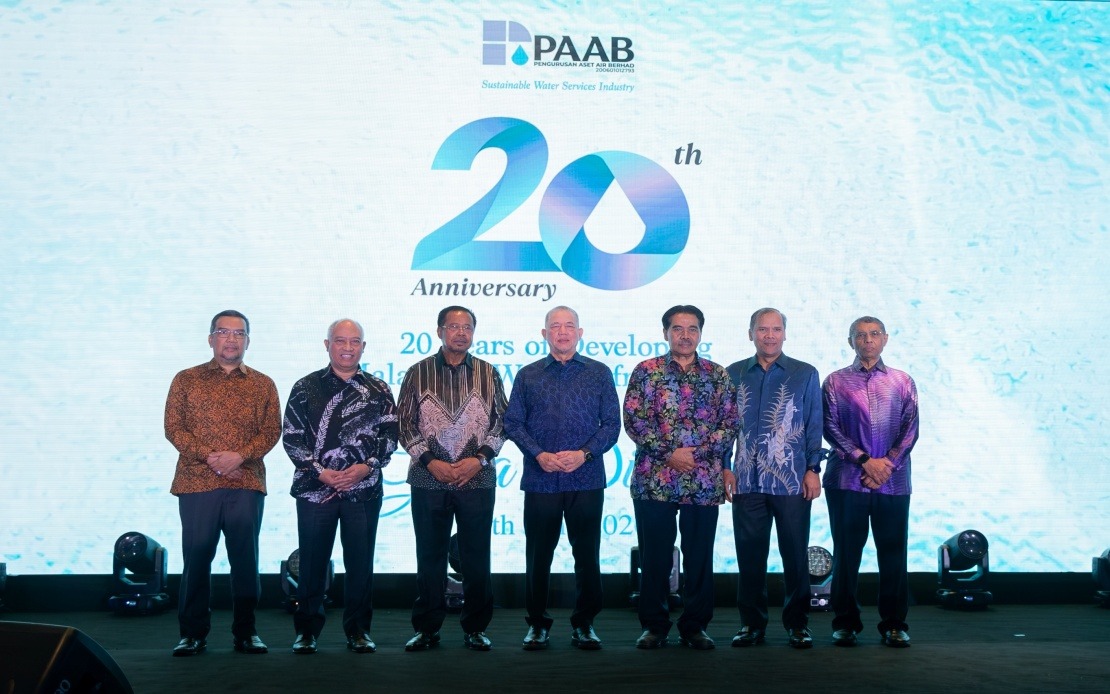
Pengurusan Aset Air Berhad (PAAB), the state-owned water infrastructure financing company, has marked two decades of strategic involvement in modernising Malaysia's water sector, a milestone that underscores the persistent complexity of transforming a fragmented national water services landscape. Since its formation on May 5, 2006, the entity has evolved into a cornerstone of public infrastructure development, channelling substantial capital into an industry that faces mounting pressures from rapid urbanisation, industrial demand, and aging pipeline networks.
The scale of PAAB's financial commitment reveals the magnitude of the restructuring challenge. Over two decades, the organisation has assumed responsibility for RM23.04 billion in water industry loans previously held across the sector, effectively consolidating legacy debt while simultaneously injecting RM23.84 billion into new infrastructure projects. This combined exposure of RM46.88 billion positions PAAB as one of Malaysia's most significant infrastructure investors, though the figures also illustrate the substantial resources required to overhaul systems that developed incrementally across multiple jurisdictions with varying regulatory frameworks.
Deputy Prime Minister Datuk Seri Fadillah Yusof, who doubles as Energy Transition and Water Transformation Minister, used the anniversary dinner to highlight an uncomfortable reality confronting Malaysia's water ambitions. With non-revenue water losses standing at approximately 40 per cent across the nation, the minister stressed that incremental planning extending to 2050 is inadequate for addressing what amounts to a persistent operational crisis. His remarks signal frustration within the federal administration that despite two decades of restructuring efforts, more than two-fifths of treated water continues to vanish through leaks, theft, and measurement inaccuracies before reaching consumers or industrial users.
The pressure driving this policy urgency has become economic. Malaysia's competitive positioning in attracting data centre investments and other water-intensive manufacturing increasingly depends on reliable water security. As regional competition intensifies, particularly from Singapore and other Southeast Asian manufacturing hubs, water supply disruptions represent a direct threat to foreign direct investment prospects. The government recognises that foreign investors evaluating Malaysia's infrastructure readiness view water reliability as fundamental to operational continuity, placing immediate remedial action ahead of longer-term strategic planning.
PAAB's infrastructure delivery record demonstrates tangible progress across specific domains. Through the National Water Services Industry Restructuring Plan, to which ten states have formally committed, the organisation has overseen the establishment of 21 water treatment plants collectively capable of producing 2,085 million litres daily. Additionally, the programme has delivered 42 storage tanks with combined capacity of 783 million litres and extended or upgraded 3,263 kilometres of distribution pipelines. These assets represent the physical backbone of improved water delivery, though their existence alongside persistent 40 per cent losses underscores that infrastructure expansion alone cannot resolve systemic inefficiencies.
The timeline and phasing strategy adopted by PAAB reveals the complexity of sectoral transformation. The Full Cost Recovery Roadmap divides the restructuring process into four distinct phases spanning 42 years: Migration from 2008 to 2020, focusing on initial reforms; Stabilisation from 2021 to 2030, targeting operational efficiency improvements; Consolidation from 2031 to 2040, consolidating gains and integrating systems; and Full Cost Recovery from 2041 to 2050, aiming for self-sustaining economic models. This extended timeline implicitly acknowledges that comprehensive sector restructuring cannot be hurried without disrupting service delivery to millions of citizens, yet it simultaneously frustrates those seeking immediate resolution of current deficiencies.
Capital allocation patterns within PAAB's RM23.84 billion expenditure programme reveal mixed implementation progress. Completed projects already handed to water operators account for RM8.33 billion, representing 35 per cent of total capital commitments. Projects currently under construction represent only RM1.84 billion, or roughly 8 per cent, while the substantial majority—RM13.67 billion or 57 per cent—remains in design and planning stages. This distribution suggests that while historical investments have concentrated on realising defined projects, the pipeline of future development remains dependent on continued planning and regulatory alignment, creating implementation risk if political priorities shift or budgetary constraints emerge.
The restructuring imperative encompasses not merely technical infrastructure but institutional coordination. Deputy Minister Datuk Seri Abdul Rahman Mohamad, ministry leadership including secretary-general Datuk Seri Mad Zaidi Mohd Karli, and National Water Services Commission (SPAN) representatives actively participated in the milestone celebration, signalling whole-of-government commitment to water transformation. However, the emphasis placed on the need for coordinated action involving federal agencies and state governments simultaneously reveals continuing challenges in achieving aligned implementation across Malaysia's federal structure, where water services remain partially devolved to state authorities with varying technical capacity and financial resources.
The non-revenue water challenge deserves particular analytical attention given its centrality to current policy discourse. A 40 per cent loss rate places Malaysia well above international benchmarks for efficient utilities, most of which operate at 15-25 per cent loss rates. These losses reflect aging infrastructure, inadequate metering systems, commercial losses including theft and unauthorised connections, and measurement inaccuracies. Addressing this gap requires simultaneous investment in pipe replacement, advanced leak detection technologies, meter networks, and enforcement capacity—each demanding sustained capital and expertise. The minister's insistence on accelerated action rather than leisurely progression toward 2050 targets reflects recognition that delay effectively institutionalises enormous waste of treated water at precisely the moment when competing demands from population growth and economic development intensify scarcity pressures.
For Malaysian businesses and consumers, PAAB's 20-year trajectory carries mixed implications. The substantial infrastructure investments have undoubtedly expanded treatment capacity and distribution reach, particularly benefiting urban and peri-urban populations. Yet the persistence of 40 per cent non-revenue losses means that available water supply remains artificially constrained, supporting the frequent supply disruptions experienced across peninsular Malaysia, particularly during dry seasons. Industrial operations requiring assured water access face uncertainty, while domestic consumers face periodic rationing. Addressing this requires not merely additional plants and pipelines but fundamental operational improvements and technology adoption within the water utilities themselves.
Looking forward, PAAB's role will likely intensify as Malaysia's water challenges deepen. Climate variability is rendering historical rainfall patterns less reliable, urbanisation continues concentrating demand, and industrial expansion amplifies needs. The organisation must simultaneously manage legacy infrastructure, integrate new assets, maintain service continuity across transitions, and drive efficiency improvements that reduce non-revenue losses. Success requires sustained political commitment, adequate financing capacity, and institutional coordination that transcends traditional bureaucratic silos. The 20th anniversary celebration, while acknowledging genuine progress, ultimately underscores that comprehensive water sector transformation remains substantially incomplete and increasingly urgent.

