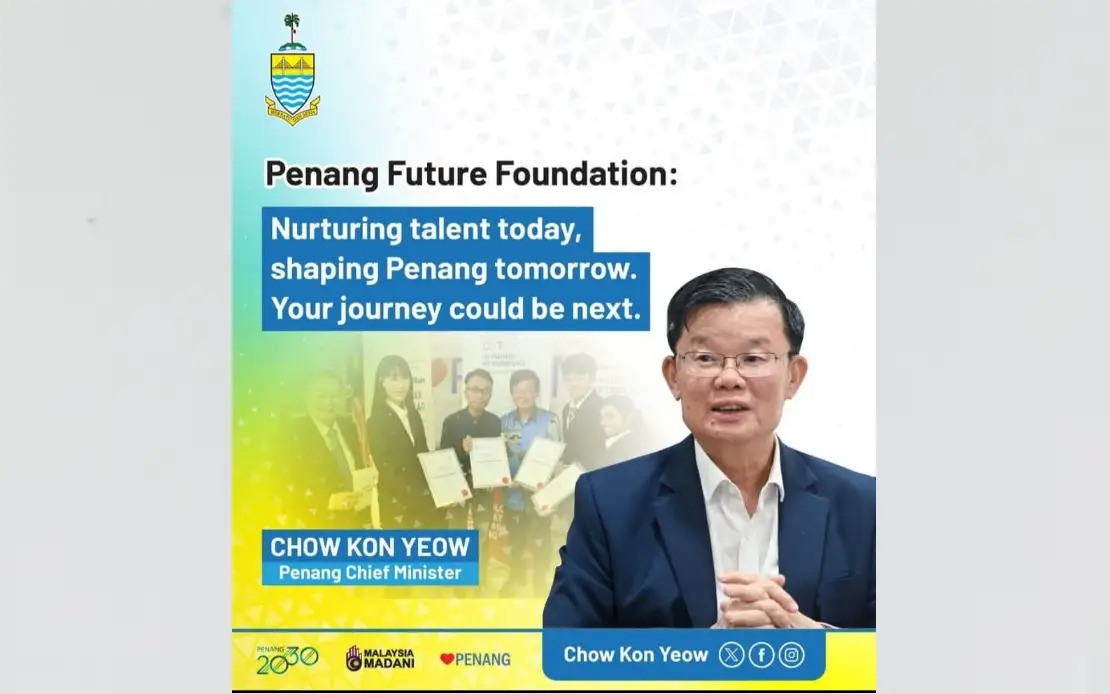
The Penang Future Foundation, a state-level scholarship programme launched over a decade ago, has channelled roughly RM47.7 million towards supporting 863 talented Malaysian students since its creation in 2015. Chief Minister Chow Kon Yeow highlighted the initiative's significance during an announcement in George Town, underscoring how the scheme continues to address Penang's critical workforce development challenges as the state positions itself for sustained economic expansion over the coming decades.
Operating through partnerships between government and private enterprise, the foundation has become instrumental in retaining skilled professionals within the state and across Malaysia. Chow emphasised that maintaining a robust pipeline of qualified graduates remains essential for industries competing in an increasingly competitive regional and global marketplace. The foundation's dual-track approach reflects Penang's recognition that talent retention directly influences foreign direct investment flows and the ability to attract multinational companies seeking centres of excellence in key sectors.
During the most recent scholarship cycle, 58 recipients from varied socioeconomic and geographic backgrounds received funding to pursue tertiary education in Science, Technology, Engineering, Mathematics, Accountancy and Finance. This sectoral focus aligns with Malaysia's broader economic transformation agenda, where STEM competencies and financial expertise represent critical skills gaps. By targeting these fields specifically, the foundation addresses immediate industry recruitment demands whilst building long-term competitive advantages for Penang's knowledge-based economy.
The Chief Minister positioned scholarship support as foundational infrastructure for Penang's next chapter of development. "In spearheading the state's growth for the next 50 years and to remain as a focal location for investments, attracting and retaining talents have become even more critical in ensuring a steady pipeline of talents to meet the growing demands by industry players," he remarked. This framing situates the scholarship programme within broader state development strategy rather than treating education funding as isolated social welfare.
For prospective applicants, the foundation operates two distinct scholarship categories with differentiated academic entry thresholds. The PFF Penang Scholar track targets high-achieving students maintaining cumulative grade point averages of 3.67 and above, while the PFF Mutiara Scholar programme accommodates applicants with GPAs between 3.00 and 3.66. This tiered structure expands access beyond elite performers, recognising that strong mid-range students also contribute meaningfully to workforce development and that socioeconomic background often constrains academic performance among capable candidates.
The foundation actively recruits nationally rather than limiting opportunities to Penang residents, reflecting the state's interest in importing talent from across Malaysia. This inclusive geographic approach acknowledges that talent disperses widely and that Penang benefits from attracting ambitious graduates regardless of origin. The open recruitment policy also enhances meritocratic principles by ensuring selection depends on academic credentials rather than local connections or family networks.
Applications for the 2026 scholarship intake will commence on July 15 and remain open until August 5, providing a three-week submission window. Candidates interested in applying should monitor announcements through the foundation's official website at www.penangfuturefoundation.my for detailed eligibility criteria, required documentation and specific application procedures. The compressed timeline demands that prospective scholars prepare materials promptly to ensure timely submission.
From a Malaysian and Southeast Asian perspective, the Penang Future Foundation exemplifies how subnational governments can implement targeted human capital investment strategies without depending entirely on federal funding allocations. The mixed public-private funding model demonstrates sustainable approaches to education financing that leverage corporate social responsibility commitments alongside government budget allocations. As other Malaysian states contemplate workforce development initiatives, Penang's documented success with RM47.7 million distributed across 863 beneficiaries provides a replicable template for outcomes measurement and impact assessment.
The foundation's emphasis on STEM and finance reflects regional patterns where developing Asian economies face intensifying competition for technical talent as higher-income neighbours offer superior salaries and working conditions. By investing in early-stage scholarship support, Penang attempts to cultivate emotional and professional attachments to the state among its scholarship recipients, increasing the likelihood that graduates subsequently seek employment locally rather than migrating internationally. This retention strategy proves particularly important given Malaysia's historical brain drain challenges, where many tertiary graduates emigrate seeking better career prospects and remuneration packages abroad.