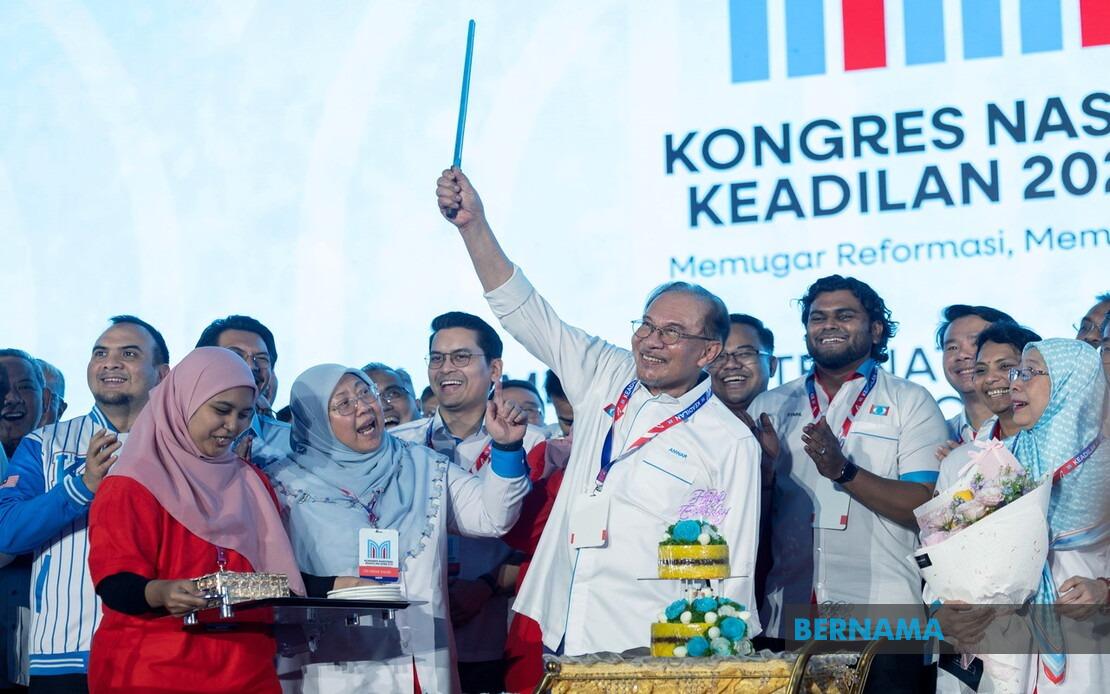
PKR concluded its National Congress 2026 in Melaka on August 16 by recommitting to a dual mandate: sustaining Malaysia's political equilibrium while advancing substantive reforms that defined the party's foundational principles. The two-day gathering underscored the party's determination to navigate the complex terrain of governing as part of a coalition without compromising its ideological identity or policy ambitions.
Party president and Prime Minister Datuk Seri Anwar Ibrahim used his closing address to reinforce PKR's backing for the Unity Government arrangement, framing it as essential to delivering economic stability and prosperity to ordinary Malaysians. Anwar contextualised the coalition's formation not as a pragmatic convenience but as a conscious political choice rooted in national interest, a distinction he emphasised to counter perceptions of unprincipled alliance-building. His remarks acknowledged, however, that the continuation of this arrangement ultimately rests with UMNO and Barisan Nasional, signalling PKR's recognition of its junior position within the governing coalition.
Anwar issued a cautionary note to all coalition partners, warning against unilateral actions that might destabilise the Unity Government's institutional frameworks. By framing stability as the prerequisite for economic benefits to reach citizens, he sought to position PKR as the responsible custodian of consensus politics—a strategic positioning important for a party that has historically been associated with challenge and dissent. This rhetorical shift reflects the complex balancing act PKR leadership must perform: maintaining credibility with a base expecting transformative change while serving as a stabilising force within government.
Deputy president Nurul Izzah Anwar articulated a central tension animating the congress: how can meaningful reform flourish within the constraints of coalition governance? She argued that abandoning the reform agenda simply because PKR holds ministerial office would constitute a betrayal of the movement's founding purpose. Izzah pointed to concrete achievements—notably the repeal of the Universities and University Colleges Act (AUKU) 1971—as evidence that substantive policy change remains possible even within a conservative-led coalition. The AUKU repeal carries particular symbolic weight for PKR, representing a victory for student freedoms and democratic space that resonates with the party's youth-oriented constituencies.
Anwar elaborated on the government's approach to student activism following AUKU's repeal, pledging that no replacement legislation would resurrect the restrictions the original law imposed. His commitment to address concerns at Cabinet level signals PKR's willingness to use its ministerial positions to push back against potential hardline positions from conservative coalition members. By emphasising that existing criminal law provisions suffice to manage genuine misconduct, Anwar sought to frame the government's stance as both protective of student rights and legally prudent—a delicate balance essential for maintaining PKR credibility among tertiary institutions and youth voters.
Education Minister Fadhlina Sidek, speaking as PKR's Wanita chief, widened the reform discourse to encompass internal party governance and administrative transparency. Her call for greater inclusion of women in leadership structures directly addresses demographic imbalances within Malaysian political parties, a persistent challenge that constrains the talent pool available for senior positions. Fadhlina's emphasis on openness to criticism within party and government hierarchies implicitly critiques the top-down, personality-driven decision-making that characterises much Malaysian politics, though implementing such cultural shifts in practice remains difficult.
The congress gave particular attention to youth concerns through the Angkatan Muda Keadilan (AMK) platform, which articulated priorities for Generation Z and early-career workers. The youth wing's focus on Bumiputera participation in high-technology sectors—artificial intelligence, semiconductors, biotechnology—reflects recognition that Malaysia's economic future depends on training bumiputera talent for sophisticated, well-remunerated employment. This represents a modernisation of bumiputera policy discourse, moving beyond traditional commerce and civil service into knowledge economy sectors where Malaysian competitiveness increasingly depends.
AMK's enumeration of gig economy workers' concerns—including social protection, skills development and mental health support—touches on vulnerabilities created by Malaysia's rapid transition toward non-traditional employment arrangements. The acknowledgment that gig workers merit recognition and security in law reflects evolving attitudes within PKR toward labour market transformation. Whether PKR can translate these youth priorities into legislative proposals and cabinet advocacy remains uncertain, particularly given coalition dynamics and UMNO's traditional reluctance toward expansive social welfare commitments.
The congress's emphasis on organisational preparedness for political contingencies suggests PKR leadership remains alert to the fragility underlying Unity Government cooperation. Calls for the party to strengthen structures and candidate pipelines without awaiting parliamentary dissolution or formal announcement timelines reflect institutional prudence—the recognition that coalitions in Malaysia have historically fractured with little warning. This preparedness stance, while practically sensible, tacitly acknowledges the temporary nature of current arrangements and the possibility of rapid political reconfiguration.
For Southeast Asian observers and Malaysian stakeholders, the PKR congress illustrated the constraints shaping reform-oriented parties operating within conservative-led coalitions. PKR's challenge mirrors dilemmas faced by progressive partners in coalition governments across the region: how to deliver material improvements to constituents while advancing institutional or policy reforms that may face resistance from dominant coalition members. The congress's outcomes suggest PKR is pursuing incremental, achievable reforms while building political capital for potentially more ambitious changes should coalition arithmetic or public mandates shift in future.
The congress ultimately projected an image of a party at peace with its governing role while determined to avoid becoming absorbed into the coalition's conservative consensus. Whether this balance proves sustainable through to the next general election—and whether it generates sufficient reform dividends to satisfy PKR's reform-minded base—will significantly influence Malaysian politics' trajectory. The party's success in navigating these competing pressures may determine not only PKR's own future relevance but also whether reformist agendas can advance within Malaysia's fragmented coalition framework.

