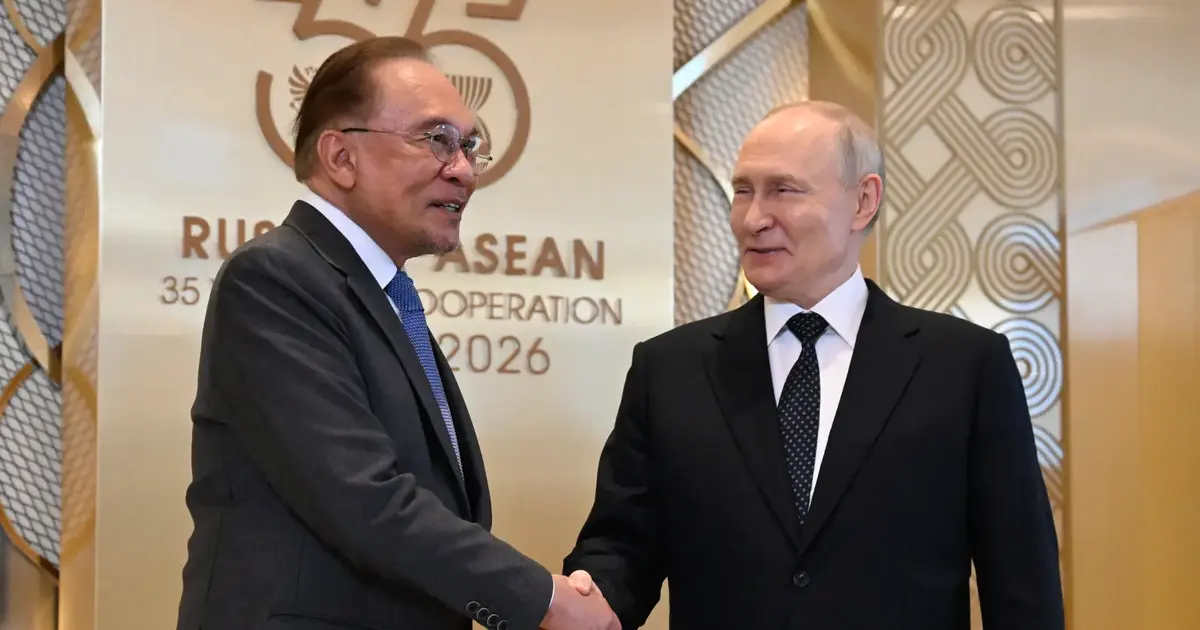
Prime Minister Anwar Ibrahim has announced that Russian President Vladimir Putin has given Malaysia assurances of steady oil and gas supplies extending over the next two decades, marking a significant development in bilateral energy cooperation between the two nations. The commitment comes at a time when Malaysia is actively diversifying its energy sources and strengthening partnerships with major global suppliers to ensure long-term economic stability and industrial competitiveness in the region.
The agreement represents a strategic move to secure Malaysia's energy needs during a period of global supply chain volatility and geopolitical uncertainty. By locking in supply commitments from Russia, Malaysia gains predictability in its energy procurement at a time when hydrocarbon prices and availability remain subject to international tensions and market fluctuations. This forward-looking arrangement allows Malaysian policymakers and businesses to plan infrastructure investments and industrial expansion with greater confidence in their energy foundations.
Beyond the energy dimension, Anwar's diplomatic engagement extends to broader economic objectives that reflect Malaysia's positioning within the complex web of Asian trade relationships. The Prime Minister has indicated that his concurrent visit to Turkmenistan forms part of a larger strategy to leverage energy cooperation as a gateway to expanded commercial opportunities with major regional economies. This approach recognises that energy partnerships often serve as anchors for deeper trade relationships and investment flows between nations.
Malaysia's outreach to China represents perhaps the most significant commercial opportunity among the markets Anwar has identified. As the world's second-largest economy and a voracious consumer of natural resources and manufactured goods, China offers Malaysian exporters access to a market of over 1.4 billion people. The timing is particularly relevant given Malaysia's efforts to position itself as a reliable supplier to Chinese manufacturers and consumers amid shifting global supply chain dynamics.
Japan constitutes another crucial export destination for Malaysian enterprises, particularly for refined petroleum products, chemicals, electrical components, and palm oil-related goods. Japan's mature economy and technological sophistication create opportunities for Malaysian companies offering competitive pricing and quality standards. The energy security discussions with Russia may inadvertently benefit Malaysian exporters by demonstrating the nation's ability to maintain stable production and exports even during periods when other suppliers face constraints.
South Korea completes the trinity of major Asian markets that Malaysia is targeting for export expansion. As a high-income, technologically advanced nation with significant manufacturing and consumer markets, South Korea has long been an important destination for Malaysian goods, from petrochemicals to agricultural products. Enhanced energy cooperation with Russia provides Malaysia with greater flexibility to allocate its own hydrocarbon resources toward higher-value processing and export activities rather than purely domestic consumption.
The diplomatic initiative also reflects Malaysia's pragmatic foreign policy approach, balancing relationships with major powers while pursuing national economic interests without ideological encumbrance. In an era when geopolitical alignments are increasingly fluid, Malaysia's willingness to engage substantively with Russia on energy matters demonstrates the primacy of economic considerations in Malaysian statecraft. This stance positions the nation as a reliable, non-aligned partner for multiple great powers, a position that generates tangible benefits in trade and investment negotiations.
For the broader Southeast Asian region, Malaysia's energy diplomacy carries implications for regional energy security and economic integration. As a significant oil and gas producer in its own right, Malaysia's ability to secure long-term supplies from external sources while maintaining productive capacity enhances the entire region's energy resilience. In an era when energy security increasingly defines geopolitical outcomes, Malaysia's proactive engagement in long-term supply arrangements sets a precedent for other regional economies seeking to diversify and secure their energy foundations.
The 20-year timeline attached to the Putin commitment deserves particular attention, as it reflects confidence in sustained bilateral relations despite the uncertain international environment. Such extended agreements typically incorporate price stabilisation mechanisms and volume commitments that benefit both supplier and consumer. For Malaysia, locking in supplies at predetermined terms provides budgetary predictability for energy-intensive industries such as petrochemicals, manufacturing, and power generation, ultimately enhancing competitiveness for Malaysian exports in global markets.
Moreover, the energy partnership creates opportunities for technology transfer and investment collaboration in sectors such as liquefied natural gas production, refining, and petrochemical manufacturing. As Russia possesses advanced expertise in Arctic energy extraction and processing, knowledge sharing could help Malaysian companies enhance operational efficiency and production capacity. Such industrial cooperation typically generates employment, skills development, and export opportunities that extend well beyond the energy sector itself.
The timing of these announcements also warrants consideration within the context of Malaysia's broader economic diversification strategies. While hydrocarbon revenues remain important, the nation has increasingly emphasised growth in technology, digital services, and high-value manufacturing. Secure energy supplies at competitive prices support these broader economic objectives by reducing industrial costs and improving the business environment for foreign investors seeking manufacturing hubs within Southeast Asia.
Looking forward, the Putin commitment may catalyse further energy cooperation initiatives across Southeast Asia, as other regional economies observe Malaysia's successful negotiation of long-term supply agreements. The precedent could encourage other nations to pursue similar arrangements, collectively enhancing regional energy security. Additionally, Malaysia's positioning at the nexus of these energy and export relationships positions the nation as an increasingly important player in Asian economic affairs, with implications for trade partnerships, investment flows, and regional influence that extend considerably beyond energy itself.
%22%2F%3E%3C%2Fpattern%3E%3C%2Fdefs%3E%3Crect%20width%3D%22100%25%22%20height%3D%22100%25%22%20fill%3D%22url(%23ph5iyptg)%22%2F%3E%3Crect%20width%3D%22100%25%22%20height%3D%22100%25%22%20fill%3D%22url(%23ph5iyptp)%22%2F%3E%3Ctext%20x%3D%2250%25%22%20y%3D%2250%25%22%20text-anchor%3D%22middle%22%20dominant-baseline%3D%22central%22%20fill%3D%22rgba(255%2C255%2C255%2C0.95)%22%20font-family%3D%22Georgia%2C%20'Times%20New%20Roman'%2C%20serif%22%20font-weight%3D%22700%22%20font-size%3D%22272%22%20letter-spacing%3D%22-0.02em%22%3EFahmi%3C%2Ftext%3E%3C%2Fsvg%3E)