The credibility of President Prabowo Subianto's centrepiece nutrition initiative is deteriorating as beneficiaries increasingly reject meals they deem unsuitable, raising fundamental questions about programme design and execution across Southeast Asia's largest economy. Some recipients have taken the extraordinary step of declaring they would rather forgo assistance than continue receiving substandard provisions, signalling deeper problems than simple operational hiccups. This pushback from the very populations the scheme aims to help represents a critical turning point for an initiative that consumed vast budgetary resources and shaped the government's fiscal priorities.
The controversy intensified when Nesti Nagari, a mother from Kediri in East Java, documented her eight-month-old child's allocated meal—a visibly unappetising clump of unidentifiable white paste. Her social media post rejecting the meal went viral with over 11,000 engagements, crystallising broader frustrations about food quality that had simmered beneath official narratives of programme success. Nagari's decision to redirect the meal to her chickens rather than her infant encapsulated parental concerns that transcend mere preference; mothers questioned whether the nutritional content matched the scheme's stated objectives. Upon reflection, Nagari articulated a perspective that cuts across ideological lines: she possessed sufficient resources to feed her child adequately and would support programme suspension if it meant reallocation toward education and health infrastructure—sectors facing genuine resource constraints.
Parallel concerns emerged from Diah Farika, a nursing mother in Semarang, Central Java, who endured months of deteriorating meal quality since enrolling in May. Her documented complaints about nutritionally imbalanced portions, unripe fruit, and inadequate quantities met dismissive responses from the Nutrition Fulfillment Service Units (SPPG) responsible for meal preparation. Rather than continue accepting substandard provisions, Farika declined further meals and advocated for temporary programme suspension to enable the National Nutrition Agency (BGN) to conduct comprehensive kitchen inspections. Her analysis identified the core issue: the programme itself possessed merit, but implementation through individual kitchens varied dramatically, creating a two-tier system where geography and management determined beneficiary experience.
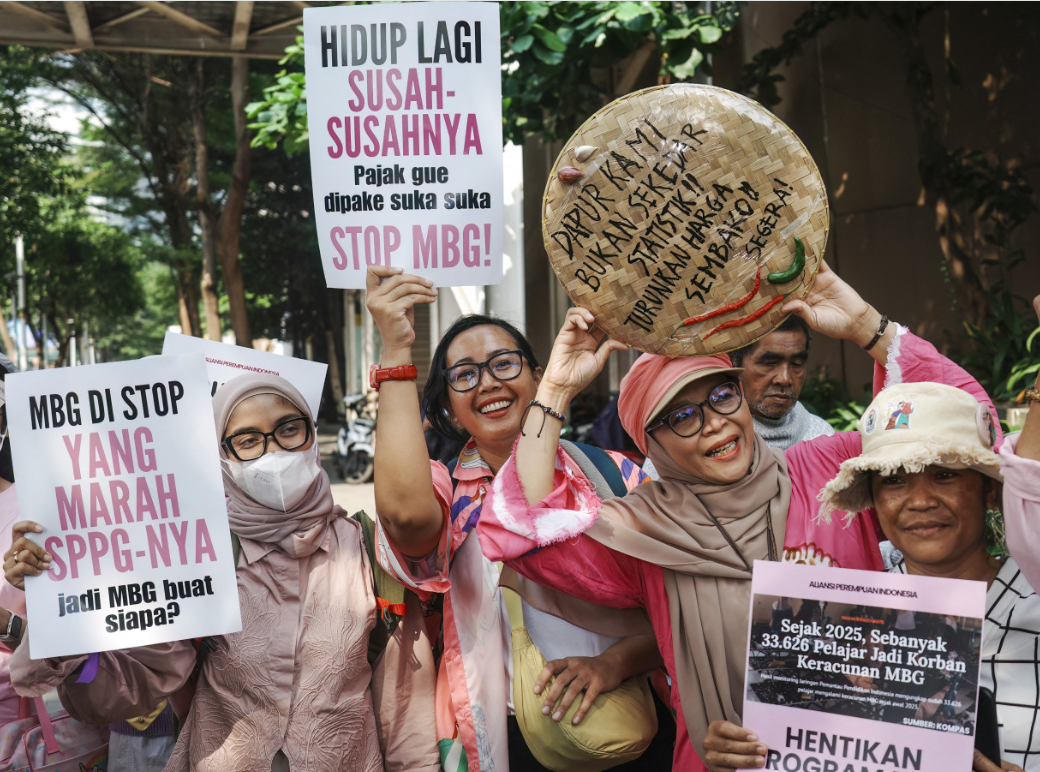
Activist organisations amplified these individual grievances into coordinated advocacy. The Indonesian Women's Alliance (API) mobilised dozens of women and rights campaigners for a Central Jakarta rally demanding programme suspension and comprehensive review. This convergence of beneficiary complaints and civil society pressure created political space for examining the initiative's fundamental premises. The coalition recognised that quantity without quality undermined nutritional objectives and that budget size bore no correlation to actual health outcomes if implementation mechanisms failed systematically.
The corruption scandal engulfing former BGN leadership complicated reform efforts. Investment groups who had poured hundreds of billions of rupiah into SPPG infrastructure now demanded assurances about financial viability, fearing asset stranding should the programme contract. This investor anxiety reflected deeper governance concerns—the initiative had created an ecosystem of contractors and operators whose interests diverged from beneficiary welfare. Several SPPGs reported temporary closures in early June following funding delays, suggesting fragile supply chains vulnerable to administrative disruption and revealing how financial stress cascaded from central government through service delivery networks.
MBG Watch, an independent civil society oversight platform, articulated the governance failure underpinning these crises. Researcher Isnawati Hidayah from the Center of Economic and Law Studies (CELIOS) posed a question that resonated beyond Indonesia: to whom did this multi-billion-dollar expenditure primarily benefit? The framing shifted from programme champions celebrating enrollment numbers toward interrogating whether resources actually reached vulnerable populations or enriched intermediaries. This analytical reorientation aligns with Southeast Asian development discourse increasingly focused on implementation fidelity rather than policy intentions.
Budgetary constraints forced painful programme rationalisation. The 2026 allocation was trimmed from Rp 335 trillion to Rp 268 trillion as public scrutiny mounted over the scheme's opportunity costs relative to education funding. This fiscal squeeze coincided with recognition that approximately 34 per cent of beneficiaries—roughly 61 million children and pregnant women—did not belong among the most vulnerable populations. Households with economic security had been enrolled through overly inclusive targeting criteria, a finding with significant implications for programme efficiency across the region.
Responding to accumulated pressure, BGN leadership initiated beneficiary rationalisation by removing recipients deemed capable of self-provision. By mid-June, the agency had dropped 76 schools across Java, affecting over 39,000 beneficiaries. Deputy head Agustina Arumsari characterised this narrowing as refocusing resources toward genuine need rather than universal provision. The reframing acknowledged implicit policy failure—that mass enrolment without quality controls represented poor stewardship of public resources and contradicted developmental outcomes the programme claimed to pursue.
Beyond beneficiary removal, the BGN instituted operational austerity measures targeting kitchen inefficiencies. Ending daily incentive payments for non-operational periods and conducting systematic performance reviews signalled recognition that the SPPG network's sprawling nature had created accountability gaps. The approximately 27,000 kitchens operating nationwide represented administrative complexity that exceeded monitoring capacity, particularly when corruption allegations had compromised institutional oversight mechanisms. This structural vulnerability extended lessons relevant to other Southeast Asian countries attempting large-scale nutrition programmes through distributed service delivery networks.
The programme's trajectory illustrates tensions endemic to flagship social initiatives in developing economies. Initial enthusiasm for comprehensive coverage collided with implementation realities—food quality deterioration, targeting inaccuracy, and governance failures that no policy design could fully anticipate. Beneficiaries' willingness to forgo assistance if it enabled systemic improvement suggested that populations valued institutional credibility and fair resource allocation over immediate consumption, a finding that challenged assumptions about beneficiary preferences in development discourse.
For Malaysia and other regional economies, the Indonesian experience offers cautionary insights about scaling nutrition programmes. The emphasis on headline numbers—billions allocated, millions enrolled—obscured whether actual nutritional improvement occurred. Without rigorous quality assurance, beneficiary feedback mechanisms, and realistic targeting based on need assessment, even well-funded initiatives produced minimal health impacts while consuming resources needed elsewhere. The mounting Malaysian interest in nutrition programmes for vulnerable populations should integrate Indonesia's hard-won lessons about implementation complexity and the necessity of quality over scale.
Looking ahead, Indonesia's programme faces strategic crossroads. Genuine reform requires confronting uncomfortable truths: that comprehensive universal provision exceeds implementation capacity, that beneficiary perspectives must inform design decisions, and that budget size indicates political commitment rather than guaranteed outcomes. Whether BGN leadership can rebuild institutional credibility through narrower, better-managed operations remains uncertain. What appears clear is that Indonesian mothers have set an implicit standard for acceptable assistance—quality provision or transparent acknowledgment of limitations. This beneficiary-driven accountability mechanism may ultimately prove more consequential than ministerial reform initiatives in determining the programme's ultimate trajectory and developmental impact.