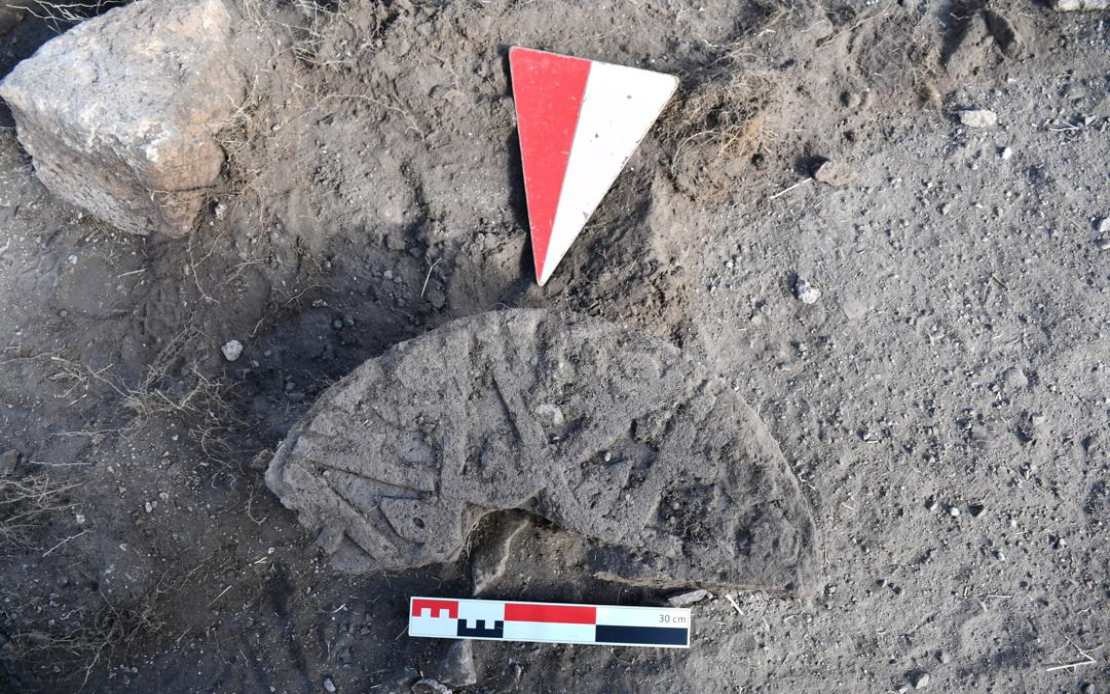
Archaeologists working at the historic Ani site in eastern Türkiye have made a significant discovery: a stone artefact inscribed with the name of Prophet Muhammad, providing fresh perspectives on the religious and cultural layers of this ancient settlement. Turkish Culture and Tourism Minister Mehmet Nuri Ersoy announced the find through social media on Monday, describing the inscriptions as appearing six times across the surface in Kufic script, an early Arabic calligraphic style that predates more modern forms of Islamic writing.
The stone's positioning within the excavation area suggests it originated from a Seljuk tomb tower, a structure type common to medieval Islamic burial practices. Minister Ersoy provided architectural details of the artefact, noting that three of the six inscriptions were meticulously carved into a decorative band that encircles an eight-pointed star motif. This geometric and epigraphic arrangement reflects characteristic design elements of Seljuk-era stonework, blending Islamic artistic traditions with local architectural vernaculars.
The discovery emerged during ongoing excavations at a Seljuk cemetery that has been systematically studied since 2021. This long-term research initiative has gradually revealed the layers of settlement and religious practice spanning centuries at this strategically important location. The methodical approach to excavation has allowed archaeologists to contextualise individual finds within broader patterns of burial customs and decorative conventions that prevailed during the Seljuk occupation of the region.
Ani's historical significance extends far beyond the Seljuk period represented by this latest find. Situated in Kars province on the Türkiye-Armenia border, this ancient city functioned as a crucial junction along the legendary Silk Road trade networks that connected Europe, the Middle East, and Asia. During the 10th and 11th centuries, Ani served as the capital of the Bagratid Armenian kingdom, a period that witnessed flourishing artistic and architectural achievement. The site subsequently transitioned through multiple imperial administrations, experiencing Byzantine, Seljuk, and Ottoman rule in succession, each era imprinting its own cultural and religious characteristics onto the urban landscape.
This succession of rulers and faiths has left Ani as a palimpsest of different civilisations and belief systems. The emergence of Islamic artefacts such as this newly discovered stone demonstrates how the religious transformation of the region during the medieval period left tangible archaeological evidence. The Seljuk cemetery itself represents the establishment of Muslim burial grounds within or adjacent to an already ancient city, illustrating the complex process of cultural transition that occurred across Anatolia during the 11th and 12th centuries.
The international recognition of Ani's importance came in 2016 when UNESCO inscribed the site as a World Heritage Site, acknowledging its outstanding universal value to human heritage. This designation reflects the site's role as a crossroads of civilisations and a repository of architectural innovation spanning multiple religious and ethnic traditions. For regional scholars and heritage professionals across Southeast Asia and the broader Muslim world, Ani represents a tangible example of how medieval Islamic societies integrated their faith traditions into existing urban and architectural frameworks, adapting rather than completely replacing earlier cultural expressions.
The discovery of inscribed stones bearing religious names and texts carries particular significance for understanding how the Seljuk Empire, which ruled much of Anatolia from the 11th century onward, consolidated its authority and expressed its Islamic identity through monumental art and funerary practices. Epigraphic evidence such as this stone provides direct testimony to the specific forms of Islamic devotion and commemoration that characterised Seljuk-era burial traditions. The Kufic script itself represents a deliberate choice to employ a prestigious, historically resonant writing system rather than contemporary cursive styles, suggesting the enduring reverence attached to this particular calligraphic mode.
For Malaysian readers and heritage professionals throughout Southeast Asia, the Ani excavations underscore broader patterns in how Islamic civilisations have historically approached the integration of faith expression into architectural and urban spaces. The methodical archaeological investigation of sites like Ani, spanning multiple years of systematic excavation, provides valuable comparative context for understanding the archaeological record of Islamic societies across different regions and periods. The careful documentation and analysis of artefacts like this inscribed stone contributes to the global scholarly understanding of how Islamic art, epigraphy, and religious practice evolved and diversified across the medieval world.
The continued revelations from Ani's Seljuk cemetery suggest that further discoveries likely remain beneath the surface, awaiting systematic excavation and analysis. Each artefact recovered contributes to a more nuanced and complete picture of how ordinary people and tomb builders in medieval Anatolia expressed their faith, commemorated their dead, and maintained connections to broader Islamic cultural traditions. The international attention garnered by such discoveries reinforces the value of long-term archaeological commitments to major heritage sites, where patience and methodology yield insights impossible to obtain through surface surveys alone.

