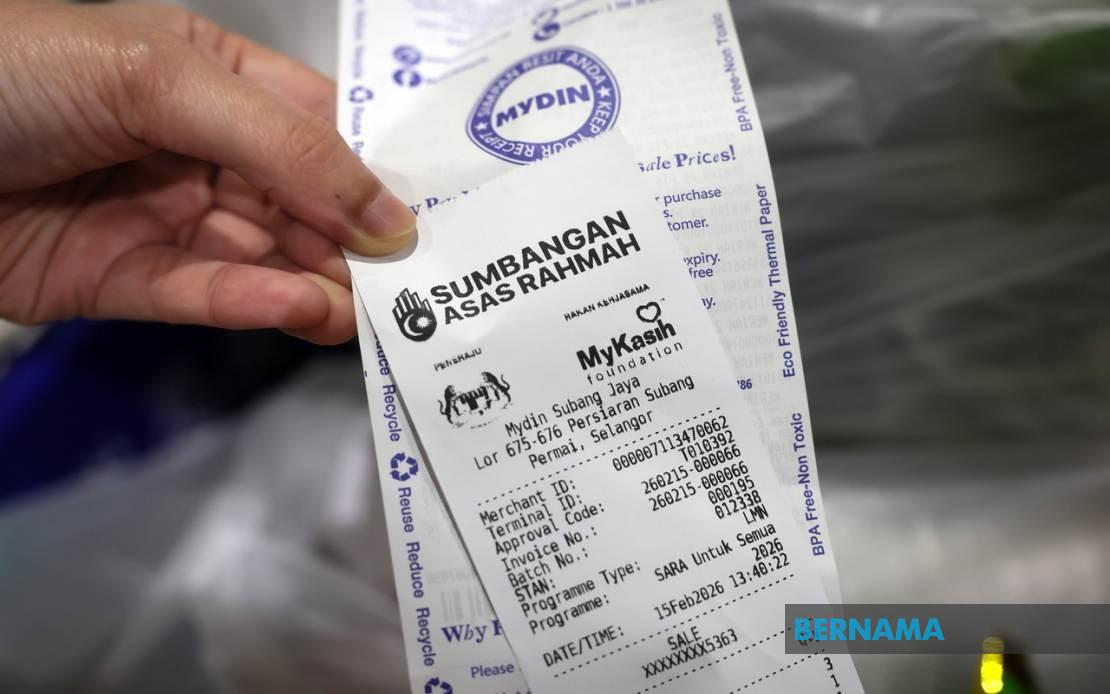
Malaysia's Sumbangan Asas Rahmah (SARA) programme has demonstrated remarkable penetration among its intended beneficiaries, recording a 99 per cent utilisation rate among the approximately nine million monthly Sumbangan Tunai Rahmah (STR) recipients. This strong engagement translates into tangible economic activity, with cumulative spending totalling RM3.45 billion thus far in 2024, according to data released by the Ministry of Finance in response to parliamentary questions.
The SARA initiative represents a strategic shift toward targeted social protection in Malaysia's evolving welfare architecture. Operating as a cashless subsidy scheme delivered through MyKad credits, SARA restricts redemptions to registered SARA Rakan Niaga merchants for 15 essential commodity categories, encompassing basic foodstuffs, personal hygiene products, household cleaning agents, and pharmaceutical items. This structural constraint serves a dual policy purpose: it ensures government resources are directed toward genuine necessities rather than discretionary consumption, while simultaneously providing authorities with granular transaction-level visibility that enables real-time monitoring and programme evaluation.
Beyond the core STR beneficiary pool, the broader SARA Untuk Semua initiative has achieved even more expansive reach, engaging 22 million recipients—representing 87 per cent of all eligible individuals. These participants have generated approximately RM1.77 billion in local market transactions, demonstrating how assistance programmes designed with multiplier effects in mind can stimulate grassroots economic circulation. The Ministry of Finance emphasised that this spending performance serves as a critical performance metric for assessing how effectively the cash transfer and SARA schemes alleviate inflationary pressures on low and middle-income households.
The economic multiplier dimension warrants particular scrutiny for Malaysian policymakers. When lower-income cohorts receive assistance, they spend proportionally more of that income within their immediate local economies compared to wealthier demographics, who tend to save or allocate funds toward imported goods and services. By ringfencing SARA credits to domestic merchants selling essential goods, the government effectively channels these multiplier effects through local supply chains, generating secondary income for small shopkeepers, traders, and their employees—a mechanism particularly valuable in rural and semi-urban contexts where alternative employment opportunities remain constrained.
The strong utilisation figures carry implications for Malaysia's inflation management strategy. As cost-of-living pressures intensified throughout 2023 and into 2024, policymakers faced pressure to expand social safety nets without triggering fiscal imbalances. SARA's design allows means-tested support to reach vulnerable populations while maintaining spending discipline through its restricted redemption framework. The fact that 99 per cent of eligible STR recipients actively utilise the scheme suggests minimal administrative friction and strong awareness among target communities—outcomes that contrast favourably with earlier universal subsidy approaches that often suffered from leakage to unintended beneficiaries.
The Ministry's response to Datuk Aminolhuda Hassan (PH-Sri Gading) explicitly acknowledged the programme's role in tracking delivery efficiency and preventing aid diversion. Crucially, the cashless mechanism enables authorities to verify that assistance reaches only registered recipients and supports only approved commodity categories, reducing opportunities for informal resale or goods smuggling that plagued cash-only transfer systems. This accountability framework becomes increasingly important as social expenditure grows within fiscal constraints.
Looking forward, the government's budgetary commitment to STR and SARA allocations has scaled significantly, rising to RM15 billion in the 2026 budget from RM10 billion in 2024—a 50 per cent increase over two years. This escalation reflects recognition that structural cost pressures, particularly in energy, food, and housing, require sustained policy intervention rather than temporary relief measures. The trajectory also suggests authorities anticipate continued inflationary headwinds and are pre-positioning social buffers to prevent the erosion of household purchasing power that typically precedes demand collapse and wage-price spiral dynamics.
For Malaysia's broader economic management, the SARA programme exemplifies the contemporary fusion of traditional welfare delivery with digital financial inclusion. By tethering assistance to MyKad verification, the government simultaneously achieves social protection, financial system inclusion, and administrative surveillance—outcomes that prove increasingly valuable as demographic transitions and labour market disruptions reshape income distribution patterns. The high uptake rate indicates that electronic delivery mechanisms no longer pose barriers to vulnerable populations in Malaysia, a significant marker of national digital maturity.
The implications extend into Southeast Asian comparative contexts. Neighbouring economies grappling with similar inflation and inequality challenges increasingly study Malaysia's targeted subsidy approaches as alternatives to blanket price controls or universal cash transfers. SARA's success in combining means-testing with transaction transparency offers a replicable model, particularly for middle-income economies where fiscal space constrains universal programmes but administrative capacity supports digital verification systems.
The Ministry's commitment to ongoing monitoring underscores that programme evaluation remains active rather than declarative. With nearly nine million monthly beneficiaries generating measurable transaction data, authorities possess unprecedented real-time intelligence on how assistance flows translate into consumption patterns, merchant performance variations, and regional economic activity. This information architecture positions government to adjust policy parameters rapidly if evidence suggests programmes are misfunctioning or if demographic shifts alter target population composition.
As Malaysia navigates the intersection of demographic ageing, economic diversification, and climate-related cost pressures, assistance programmes like SARA will likely expand further. The current 99 per cent uptake rate and RM3.45 billion in annual spending represent not a plateau but a baseline for anticipated expansion. Future policy development will likely emphasise deepening digital integration, refining commodity baskets to reflect evolving household needs, and potentially extending the model to address specific vulnerabilities beyond income poverty—considerations that ensure Malaysia's social protection architecture remains responsive to contemporary challenges rather than locked into historical precedent.

