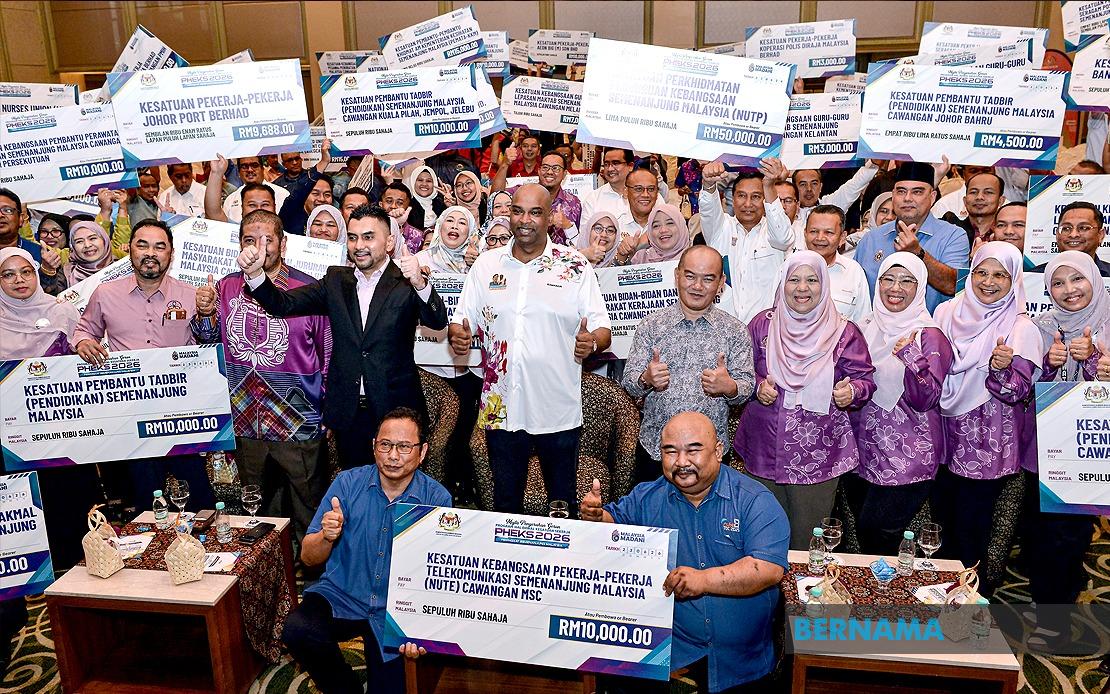
Malaysia's organised labour movement faces a participation challenge, with unions representing just six per cent of the country's total workforce, according to Human Resources Minister Datuk Seri R. Ramanan. Speaking at the Peninsular Malaysia Workers' Union Affairs Programme grant presentation in Kuala Lumpur on June 23, the minister identified insufficient worker awareness of union benefits as a key factor limiting membership growth across the nation's labour market.
Ramanan attributed the modest penetration rate to a widespread knowledge gap regarding the value proposition unions offer. Many workers remain unclear about what membership entails or how unions function beyond their visible crisis-intervention role. The minister emphasised that this represents an opportunity rather than a permanent ceiling, suggesting Malaysia's union movement retains considerable expansion potential across both traditional and emerging sectors of the economy.
The minister articulated a preventative rather than reactive vision for union engagement. Rather than workers turning to unions only when immediate workplace disputes arise, Ramanan advocated for a proactive relationship where unions help forestall problems before they materialise. This reframing positions unions as institutional safeguards embedded within the employment relationship rather than emergency responders mobilised during conflicts. Such an approach requires workers to develop a more sophisticated understanding of workplace rights and union capacity for early intervention.
Beyond their traditional representative function, Ramanan characterised unions as strategic partners in Malaysia's broader economic development framework. He positioned the tripartite relationship between government, employers and organised labour as fundamental to sustaining labour market stability and fostering equitable growth. This framing reflects the government's investment in institutional labour arrangements as critical infrastructure supporting Malaysia's competitive position in Southeast Asia and the wider global economy.
To strengthen union capacity and modernise the labour movement, the government allocated RM6.1 million under the PHEKS 2026 programme nationwide. The allocation splits into two components: RM3.5 million dedicated to training, research, digitalisation and governance enhancement for union organisations, alongside RM2.6 million for public outreach and corporate social responsibility activities. This dual investment signals recognition that unions require both internal capacity-building and external legitimacy to expand their relevance among Malaysia's workforce.
The minister stressed that future government funding would hinge on demonstrable governance improvements and effective utilisation of existing grants. This conditionality approach suggests the government intends to tie financial support to accountability metrics and performance outcomes. Union organisations seeking expanded allocations will need to demonstrate transparent financial management and strategic deployment of resources, creating incentives for institutional modernisation within the movement.
Technological disruption emerged as a central concern shaping union strategic priorities. Ramanan highlighted artificial intelligence and workplace automation as realities unions must navigate actively rather than resist passively. Workers increasingly need protective representation not against technology itself but in managing transitions to skills-intensive roles within AI-enabled environments. This positions unions as crucial intermediaries in Malaysia's digital transformation of labour markets.
The government's Jelajah AI MyMahir initiative, operating under TalenCorp, has mobilised RM110 million for workforce upskilling programmes. This substantial investment reflects acknowledgment that union efficacy increasingly depends on member access to reskilling opportunities aligned with technological change. Unions that position themselves as conduits connecting members to quality training programmes enhance their value proposition and membership appeal, particularly among younger workers facing rapid occupational change.
Current union registration data reveals 786 officially registered workers' unions with combined membership exceeding 1.06 million as of December 31, 2025. While these figures document Malaysia's institutional labour infrastructure, the six per cent workforce penetration rate highlights the gap between registered capacity and actual coverage. This disparity suggests significant untapped organising potential across sectors where union presence remains minimal, particularly among gig economy and informal economy workers who represent growing portions of Malaysia's labour force.
The challenge facing Malaysia's union movement extends beyond simple membership recruitment. Modernising union relevance for contemporary workplaces requires simultaneous investment in organisational capacity, technological capability and strategic communication about union value. Workers in competitive labour markets need convincing that union membership enhances rather than constrains their career prospects. For unions to expand beyond their current six per cent baseline, they must demonstrate tangible benefits—skills access, wage improvements, workplace dignity—that outweigh membership costs and time commitments.
Regional context amplifies Malaysia's union participation challenge. Across Southeast Asia, similar patterns of declining union density reflect broader shifts toward service economies, supply chain fragmentation and individualised employment relationships. Malaysia's government efforts to strengthen union infrastructure position the country as attempting to maintain institutionalised labour representation against these structural trends. Success requires not merely financial investment but genuine commitment from employers, government and workers themselves to regard collective representation as valuable rather than obsolete.
The six per cent figure also invites scrutiny regarding which workforce segments remain organised versus unrepresented. Public sector workers, manufacturing employees and formal economy workers likely account for disproportionate shares of union membership, while private service sector, small business and informal economy workers remain largely unrepresented. Any meaningful growth strategy requires targeted organising campaigns addressing sector-specific barriers to union participation, coupled with communications strategies demonstrating concrete value to workers in previously non-unionised categories.