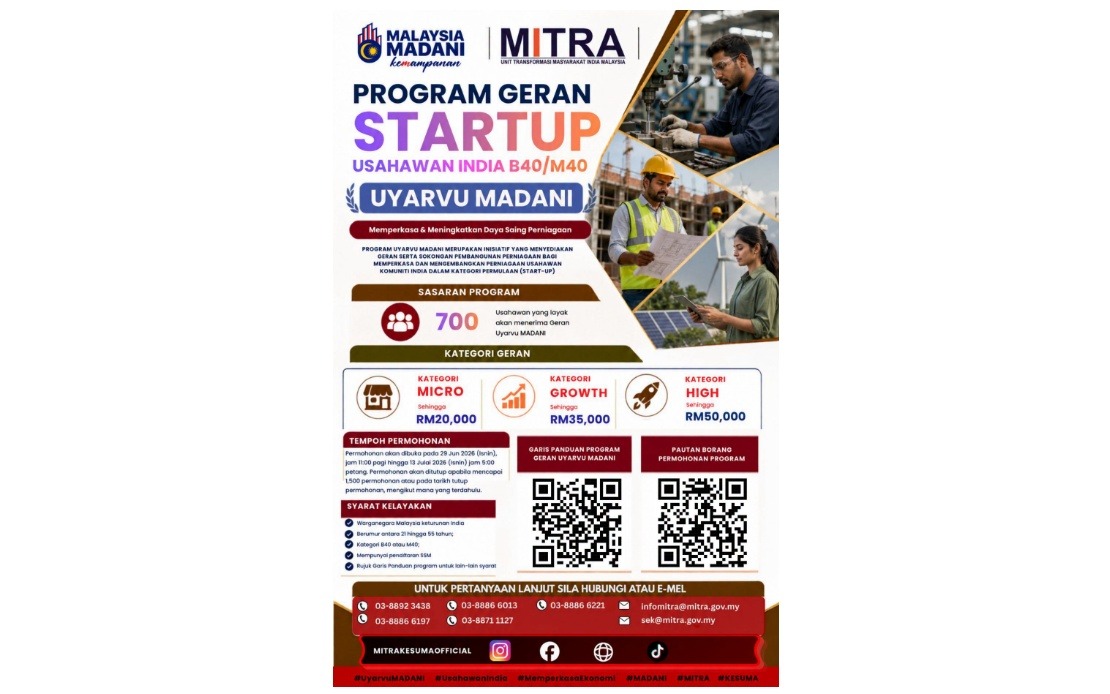
The Malaysian Indian Transformation Unit (MITRA) has opened the application window for the Startup Accelerator Grant Assistance Programme (Uyarvu MADANI), welcoming submissions from June 29 through 5 pm on July 13. The initiative represents a targeted approach to supporting business development within Malaysia's Indian community, focusing specifically on individuals and aspiring entrepreneurs whose household incomes fall within the B40 and M40 brackets.
Applicants approved through the programme will receive grants between RM20,000 and RM50,000, calibrated to provide meaningful capital for venture initiation and expansion. The grant structure recognises the varying scale of business proposals expected from first-time and early-stage entrepreneurs, allowing flexibility in funding allocation based on individual business plans and requirements. This tiered approach has become increasingly common in targeted entrepreneurship schemes across Southeast Asia, where customised funding levels improve uptake and success rates among diverse applicant pools.
MITRA has established an ambitious target of 700 successful recipients for the Uyarvu MADANI initiative. Beyond the monetary grants themselves, selected entrepreneurs will gain access to structured business development support services designed to strengthen competitive positioning and facilitate business scaling. This combined offering—capital plus technical assistance—acknowledges that funding alone frequently proves insufficient for sustainable business growth, particularly among first-time venture founders without established commercial networks or operational experience.
The application process incorporates an efficiency mechanism whereby the submission deadline may be triggered earlier if demand reaches critical mass. Should MITRA receive 1,500 applications before July 13, the window will close immediately. This approach serves dual purposes: it signals strong entrepreneurial interest to policymakers whilst ensuring the programme administration remains manageable and grant evaluation proceeds at optimal pace. Early closure incentivises rapid application submission among interested parties.
Uyarvu MADANI constitutes one component of a broader 2026 expansion strategy announced by MITRA, involving six new initiatives supported by a combined budgetary allocation of RM65.5 million. This substantial investment reflects government commitment to addressing economic disparities and promoting business ownership within the Indian community demographic. Positioned within Malaysia's wider inclusive growth agenda, these programmes attempt to narrow wealth gaps and create entrepreneurial pathways for communities experiencing structural economic disadvantages.
The timing of this grant opening coincides with broader Malaysian policy emphasis on small and medium enterprise (SME) development and community-specific economic empowerment. For regional observers, the Uyarvu MADANI model illustrates how targeted subsidies and business support can be mobilised to support underrepresented entrepreneurial populations. Similar programmes exist across Southeast Asia, though implementation quality and accessibility vary considerably depending on institutional capacity and funding sustainability.
Indian-Malaysian entrepreneurs historically have faced certain barriers accessing conventional venture capital and banking credit, partly reflecting information asymmetries and collateral requirements that disadvantage early-stage founders without property assets. Government-backed grant schemes bypass these constraints by deploying direct public funding, reducing reliance on traditional financial intermediation. This democratisation of venture capital represents a significant shift in how emerging markets approach inclusive entrepreneurship.
The B40 and M40 income targeting narrows focus to households earning below median national income levels, concentrating resources where economic need typically translates into greatest developmental impact. This segmentation strategy prevents subsidy leakage toward already-privileged beneficiaries and aligns with progressive targeting principles advocated by development economists. For Malaysian readers assessing application eligibility, income verification will likely form a critical component of the vetting process.
Successful applicants will join a growing cohort of government-supported Indian entrepreneurs, building momentum toward institutionalised community economic participation. Each grant deployed represents not merely a financial transfer but an expression of policy confidence in community entrepreneurial capacity. Over time, visible success stories from Uyarvu MADANI recipients could generate positive reputational effects, encouraging further business formation and risk-taking within peer networks.
Beyond individual entrepreneur benefits, the programme generates broader economic spillovers through job creation, local procurement activity, and increased commercial dynamism within Indian-Malaysian communities. These multiplier effects extend beyond direct grant recipients to encompassing families, employees, and supplier networks. For policymakers evaluating the initiative's impact, tracking employment generation and business survival rates over three to five-year horizons will prove essential to understanding true programme effectiveness.

