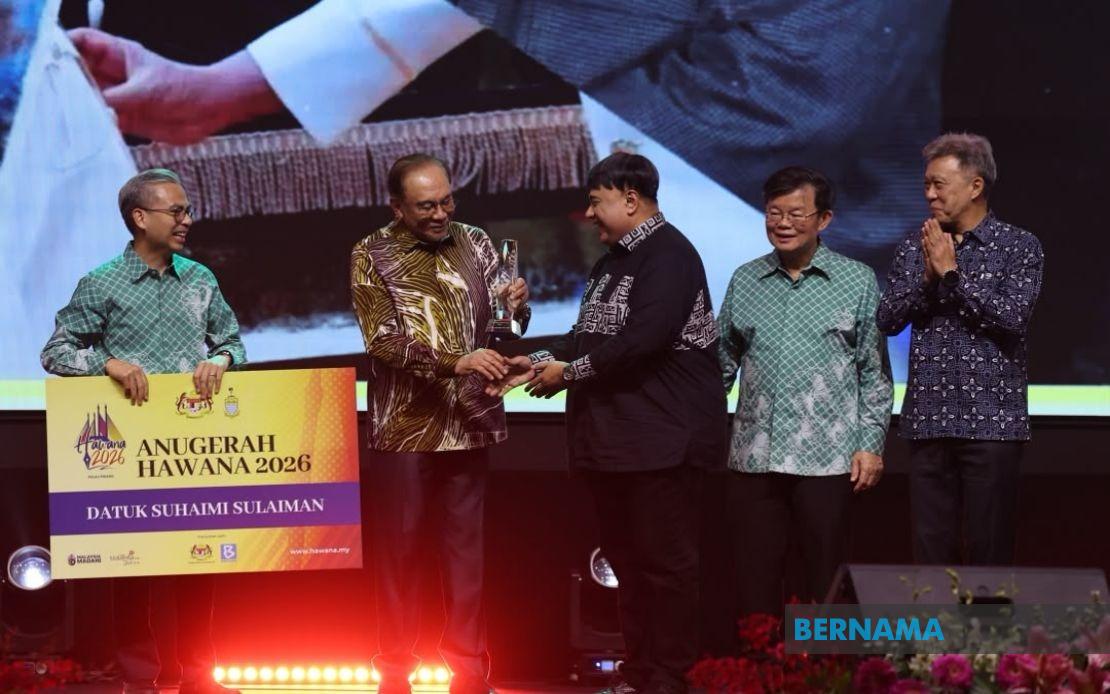
Datuk Suhaimi Sulaiman, a broadcasting stalwart who has spent more than thirty years shaping Malaysia's media landscape, was presented with the National Journalists' Day (HAWANA) 2026 Award on June 20 in recognition of his enduring impact on the country's journalism profession. The honour, conferred at the HAWANA 2026 Grand Finale held at PICCA @ Arena Butterworth Convention Centre in Butterworth, underscores the media industry's acknowledgement of his sustained commitment to fostering quality broadcasting and journalistic standards.
Prime Minister Datuk Seri Anwar Ibrahim personally presented the award to Suhaimi, whose professional journey includes serving as director-general of Broadcasting Malaysia (RTM), the nation's public broadcaster. The presentation ceremony drew attendance from high-ranking government and media officials, including Penang Chief Minister Chow Kon Yeow, Communications Minister Datuk Fahmi Fadzil, and Malaysian National News Agency (Bernama) chairman Datuk Seri Wong Chun Wai, signalling the considerable esteem in which Suhaimi is held across both political and media establishment circles.
Also witnessing the award presentation were Bernama chief executive officer and HAWANA 2026 Working Committee chairman Datin Paduka Nur-ul Afida Kamaludin, and Bernama editor-in-chief Arul Rajoo Durar Raj. The convergence of these senior figures underscores how the media industry and government view Suhaimi's contributions as significant not merely to journalism itself, but to Malaysia's broader information and communications infrastructure. His tenure at RTM, in particular, positioned him at the forefront of Malaysia's public broadcasting agenda during a period of considerable technological and regulatory change.
In remarks following the recognition, Suhaimi characterised the award as both a privilege and a solemn obligation to continue advancing the profession. He emphasised that the honour would fuel his determination to remain engaged in learning and imparting knowledge to the next generation of media practitioners, a stance that reflects the evolutionary nature of journalism in the contemporary era. His perspective on the award highlighted his philosophy that professional recognition carries with it an implicit commitment to ongoing development and mentorship.
A central theme in Suhaimi's commentary was the transformative impact of artificial intelligence on media practice and the necessity for journalists and broadcasters to evolve alongside technological change. He acknowledged that the AI era presents both challenges and opportunities for the profession, requiring practitioners to develop fresh competencies and adapt their approaches to information gathering, verification, and dissemination. This forward-looking perspective demonstrates that despite his decades in the field, Suhaimi remains attuned to the digital disruption reshaping global and regional journalism.
The HAWANA award system recognises outstanding contributions to Malaysian journalism and broadcasting, serving as an annual occasion for the industry to celebrate excellence and encourage continued professional development. By honouring practitioners like Suhaimi, HAWANA reinforces the value that Malaysia's media sector places on experience, institutional knowledge, and principled commitment to the profession's standards and ethics. The award also functions as a form of cultural capital within Malaysian media, elevating those recognised and signalling to emerging journalists the kinds of careers and contributions the industry values most highly.
Suhaimi's background in public broadcasting and his leadership at RTM position him as a figure who has navigated the transition from analogue to digital media environments, making his reflections on AI integration particularly relevant. His experience spans a period during which Malaysian broadcasting adapted to multichannel competition, technological convergence, and shifting audience expectations. This trajectory provides valuable perspective for younger journalists entering a profession that is fragmenting across multiple platforms and facing sustained pressure from alternative information sources and social media.
The recognition of Suhaimi at a moment when Malaysian journalism faces questions about its role and sustainability in the digital age carries symbolic weight beyond the individual honour. It affirms that institutional experience and dedication to professional principles remain valued, even as the industry undergoes profound structural change. For Malaysian media practitioners, Suhaimi's example and his award serve as a reminder that journalistic careers built on continuous learning and ethical practice can achieve meaningful recognition within their own professional communities.
Looking forward, Suhaimi's elevation through this award may encourage greater dialogue within Malaysian media about succession planning, knowledge transfer, and the mentoring of emerging voices. In an industry where technological disruption often dominates discussions, the HAWANA recognition of a veteran figure emphasises the human dimensions of journalism—judgment, experience, institutional memory, and ethical commitment. These elements remain essential even in an AI-inflected media landscape, where algorithmic processes handle certain functions but editorial responsibility and journalistic values ultimately rest with practitioners.
%22%2F%3E%3C%2Fpattern%3E%3C%2Fdefs%3E%3Crect%20width%3D%22100%25%22%20height%3D%22100%25%22%20fill%3D%22url(%23ph2vha0g)%22%2F%3E%3Crect%20width%3D%22100%25%22%20height%3D%22100%25%22%20fill%3D%22url(%23ph2vha0p)%22%2F%3E%3Ctext%20x%3D%2250%25%22%20y%3D%2250%25%22%20text-anchor%3D%22middle%22%20dominant-baseline%3D%22central%22%20fill%3D%22rgba(255%2C255%2C255%2C0.95)%22%20font-family%3D%22Georgia%2C%20'Times%20New%20Roman'%2C%20serif%22%20font-weight%3D%22700%22%20font-size%3D%22320%22%20letter-spacing%3D%22-0.02em%22%3EPM%3C%2Ftext%3E%3C%2Fsvg%3E)