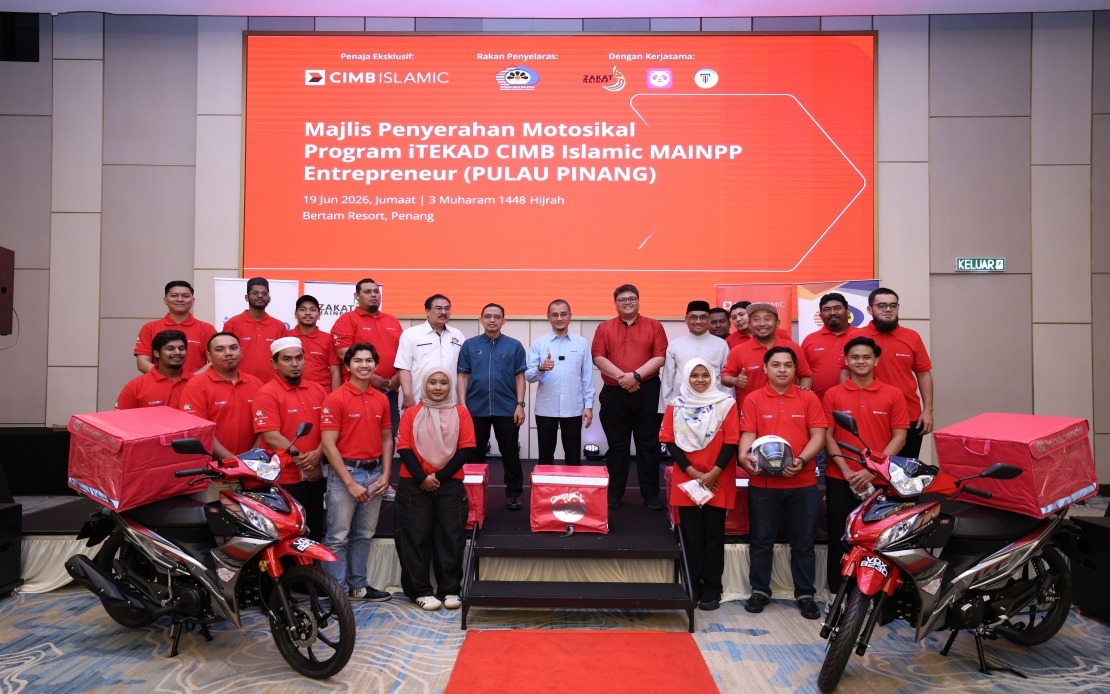
Twenty entrepreneurs have been awarded motorcycles as the centrepiece of an ambitious poverty-alleviation initiative launched jointly by CIMB Islamic Bank and Penang's Islamic religious authorities. The handover ceremony, held in Kepala Batas, marks a significant milestone in efforts to channel zakat funds toward sustainable livelihoods for vulnerable communities through structured entrepreneurship support.
The iTEKAD CIMB Islamic-MAINPP Entrepreneur programme represents a collaborative approach to asnaf empowerment that extends well beyond the simple provision of assets. Penang Deputy Chief Minister I Datuk Dr Mohamad Abdul Hamid, who presided over the ceremony, emphasised that the initiative combines resources and expertise from multiple stakeholders, including CIMB Islamic Bank Berhad, the Penang Islamic Religious Council (MAINPP), the Malaysian Youth Foundation (YBM), Taylor's Community, and foodpanda Malaysia. This multi-party structure underscores a broader recognition within Malaysia's Islamic finance sector that addressing poverty requires coordinated effort rather than isolated interventions.
The programme's financial architecture reflects both private sector commitment and regulatory support. The initiative operates on a seed fund of RM400,000 structured as a matching grant, with CIMB Islamic Bank contributing RM200,000 from its Wakalah Zakat fund and Bank Negara Malaysia providing an equivalent amount. This public-private partnership model demonstrates how Malaysia's central bank is actively encouraging financial institutions to deploy zakat resources toward productive outcomes, aligning with national economic inclusion objectives.
What distinguishes this programme from conventional asset-distribution schemes is its emphasis on human capital development alongside material support. Participants receive not only motorcycles and delivery equipment but also comprehensive training modules covering financial management basics, workplace discipline, and entrepreneurial fundamentals. This holistic curriculum reflects lessons learned from previous poverty-reduction efforts, where asset provision without accompanying skills development frequently failed to generate sustained income improvements. By bundling equipment with structured training, the programme aims to equip beneficiaries with both tools and knowledge necessary for success.
The selection process itself demonstrates institutional commitment to identifying genuinely viable candidates. From an initial pool of 151 applications, Zakat MAINPP implemented a rigorous evaluation framework encompassing formal interviews and a residential Entrepreneurship Camp conducted from May 31 to June 3, 2026. This intensive bootcamp approach allows assessors to evaluate not only applicant credentials but also motivational factors, interpersonal capabilities, and resilience—attributes often poorly captured by paper-based applications alone. The outcome was a cohort of twenty participants deemed most likely to translate programme support into sustainable business outcomes.
The motorcycle component carries particular significance within the Malaysian context. Two-wheeled vehicles serve multiple functions beyond personal transportation, enabling delivery services, small-scale trading, and service provision while requiring substantially lower capital investment than four-wheeled alternatives. The integration with foodpanda Malaysia positions participants to immediately access gig-economy employment opportunities, providing predictable income pathways during their initial entrepreneurial phases. This pragmatic linkage between asset provision and actual market demand distinguishes the iTEKAD approach from programmes that equip participants without securing realistic income channels.
Zakat deployment through structured entrepreneurship initiatives represents an evolving interpretation of Islamic finance principles within Malaysian policymaking. Traditionally, zakat distribution concentrated on direct poverty relief and welfare provision. Contemporary approaches increasingly treat zakat as development capital, channeling it toward productive enterprise that creates lasting economic mobility rather than temporary consumption smoothing. The RM400,000 commitment here signals institutional recognition that asnaf communities require investment-grade support to achieve durable prosperity.
The programme's alignment with the Penang Islamic Religious Development Agenda 2030 (APAI2030) reflects how state governments are integrating Islamic finance instruments into broader development frameworks. By positioning zakat-funded entrepreneurship within multi-dimensional development agendas encompassing education, economic advancement, family strengthening, and youth engagement, Penang authorities are creating ecosystems where individual enterprise success reinforces broader community development. This systemic perspective contrasts with isolated poverty-reduction initiatives that address economic dimensions without considering social and institutional contexts.
For participants, the motorcycle grant represents both immediate economic access and symbolic validation of capability. Datuk Dr Mohamad Abdul Hamid characterised the asset transfer as institutional confidence in beneficiaries' potential to succeed, acknowledging that asnaf status often involves psychological dimensions alongside material disadvantage. Recognition by established institutions can catalyse the self-belief necessary for entrepreneurial persistence through inevitable early setbacks. This psychological dimension remains largely invisible in conventional programme evaluation frameworks yet profoundly influences real-world success rates.
The programme's implications extend beyond individual beneficiary outcomes to broader questions about Islamic finance's role in inclusive economic development. As Malaysia positions itself as a global Islamic finance hub, programmes like iTEKAD demonstrate how Shariah-compliant financial instruments can directly address poverty and inequality. This functional linking of Islamic banking to tangible social welfare outcomes strengthens the sector's legitimacy and provides evidence that Shariah finance serves meaningful developmental purposes rather than existing primarily for wealth preservation among affluent communities.
Monitoring and support mechanisms will determine whether the programme achieves its ambitions of creating sustainable livelihoods. Beyond the initial training and asset provision, participants require ongoing mentoring, market access facilitation, and potentially refinancing support as businesses mature. The involvement of implementation partners including YBM and Taylor's Community suggests some institutional commitment to post-handover engagement, though programme documentation remains limited regarding specific long-term support frameworks.
The twenty selected participants represent diverse segments of Penang's asnaf community, each bringing different circumstances and aspirations. Their collective journey through the programme will generate valuable evidence regarding which interventions most effectively catalyse sustainable income generation among vulnerable populations. As Malaysian state governments and Islamic financial institutions develop similar initiatives, learnings from iTEKAD will inform programme design across the region, potentially influencing how zakat funds are deployed throughout Southeast Asia's growing Islamic finance ecosystems.