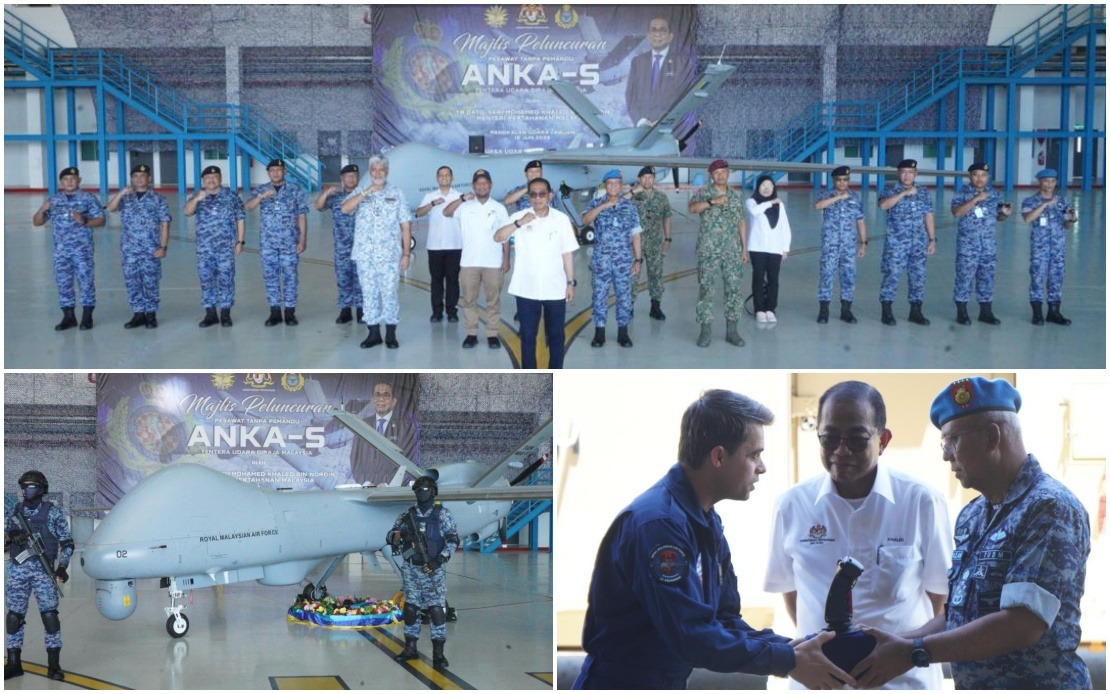
Malaysia has taken a significant step in modernising its maritime surveillance capabilities with the operational deployment of the ANKA-S Unmanned Aircraft System by the Royal Malaysian Air Force. Defence Minister Datuk Seri Mohamed Khaled Nordin, speaking at the official launch of the system at RMAF Labuan Air Base, characterised the development as a watershed moment for the nation's ability to monitor and protect its vast territorial waters and interests in one of the world's most strategically important ocean regions.
The timing of this capability enhancement carries particular weight given Malaysia's position in Southeast Asia. The South China Sea has emerged as a zone of intense strategic competition, with overlapping maritime claims and increasing naval activity from multiple regional and extra-regional powers. For a maritime nation like Malaysia with extensive Economic Exclusive Zone rights and significant shipping lanes passing through its waters, the ability to maintain persistent surveillance without constant deployment of expensive manned aircraft represents a genuine operational and financial advantage. The ANKA-S platform addresses longstanding gaps in Malaysia's real-time situational awareness over contested waters.
Under the first acquisition phase, Malaysia procured three ANKA-S aircraft at a combined cost of RM423.8 million, a figure that encompasses not only the aircraft themselves but also ground control stations and comprehensive personnel training extending across two years. This investment reflects the complexity and sophistication of modern unmanned systems, which require substantial supporting infrastructure and skilled operators to function effectively. The medium-altitude long-endurance designation of the ANKA-S indicates its design parameters: the aircraft can sustain flight for more than 24 hours while maintaining operational altitudes reaching 30,000 feet, capabilities that transform Malaysia's surveillance reach compared with conventional patrol approaches.
The operational advantages of deploying unmanned systems for maritime surveillance extend well beyond raw endurance metrics. The aircraft's sophisticated sensors enable precise identification and tracking of vessel profiles, allowing the RMAF to correlate observed maritime activity with known shipping patterns and flag suspicious movements for deeper investigation. This capability to distinguish between routine commercial traffic and potential intrusions or unauthorised activities fundamentally changes how Malaysia can allocate its defence resources. Rather than conducting broad-area patrols that consume fuel and personnel time without necessarily detecting violations, the RMAF can now direct assets strategically to specific locations where the unmanned system has already gathered intelligence.
Cost efficiency represents another compelling dimension of this acquisition. Traditional maritime patrol approaches rely on deploying fighter aircraft or large naval vessels, both of which incur substantial operational expenses per flight hour. The ANKA-S, by contrast, offers persistent surveillance at a fraction of those costs, enabling Malaysia to extend its monitoring footprint across larger areas without proportional increases in defence spending. For a government balancing multiple budgetary pressures, this efficiency gain allows enhanced security outcomes within constrained fiscal parameters—a reality that resonates across Southeast Asia where many nations face similar resource allocation challenges.
The demonstrated commitment to defensive positioning, evidenced by the deliberate decision not to arm the ANKA-S aircraft despite their technical capability to carry weapons, carries important diplomatic implications. Defence Minister Khaled explicitly framed this choice as a signal to the international community that Malaysia's defence posture remains fundamentally protective rather than provocative. In a region where military expansion and capability development are frequently scrutinised for evidence of aggressive intent, this restraint sends a measured message about Malaysia's strategic intentions while still advancing genuine security interests.
The government has signalled intentions to expand this capability through a proposed second phase acquisition of three additional ANKA-S aircraft, with formal proposals to be submitted within the existing national development planning framework. Such an expansion would roughly double Malaysia's unmanned maritime surveillance capacity, extending coverage possibilities across wider geographic areas and enabling greater operational flexibility through redundancy and simultaneous multi-area monitoring. The deliberate staging of acquisitions—rather than attempting a larger single purchase—also reflects prudent fiscal management and allows operational lessons from the initial deployment to inform subsequent procurement decisions.
The Labuan Air Base location for No 11 Squadron's ANKA-S operations carries strategic significance beyond administrative convenience. Labuan's position in the federal territory, situated in the northern waters of Malaysian Borneo, provides optimal positioning for South China Sea surveillance operations. The air base functions as a forward operating location that reduces transit times to contested maritime zones and enables more efficient patrol coverage of Malaysia's extensive maritime claims in the region. This geographic advantage amplifies the operational value of the unmanned systems by minimising the distance between launch points and operational areas.
The Intelligence, Surveillance and Reconnaissance mission demonstration conducted at the Data Exploitation Centre underscored the sophisticated analytical infrastructure supporting the ANKA-S operations. Modern unmanned aircraft systems generate enormous volumes of sensor data that require specialist analysis to convert raw imagery and electronic information into actionable intelligence. Malaysia's investment extends beyond aircraft procurement to encompassing the complete analytical ecosystem necessary for effective intelligence exploitation—a recognition that operational capability depends on the entire system architecture from sensors through to end-users making security decisions.
For Malaysia's regional security posture, the ANKA-S deployment addresses vulnerabilities that have constrained the nation's ability to respond effectively to maritime challenges. Whether confronting unauthorised fishing incursions, monitoring suspicious vessel movements, or tracking smuggling operations, Malaysian authorities have historically struggled to maintain sufficient awareness across vast maritime areas. The unmanned system's persistent surveillance capability fills this critical gap, enabling authorities to develop more sophisticated maritime domain awareness and respond more effectively to genuine security threats with appropriate force and diplomatic responses.
The broader implications for Southeast Asian security architecture merit consideration. As maritime challenges—from piracy to environmental monitoring to transnational crime—intensify across the region, individual nations increasingly recognise that advanced surveillance systems represent essential baseline capabilities. Malaysia's ANKA-S deployment may catalyse similar acquisitions among neighbouring countries, potentially leading to improved regional maritime awareness overall. However, the simultaneous expansion of surveillance capabilities also raises questions about maritime transparency and the management of information asymmetries between nations with advanced systems and those with more limited surveillance reach.
The operational deployment of the ANKA-S represents more than merely acquiring new equipment; it embodies Malaysia's commitment to modernising defence structures and maintaining credible sovereignty over its maritime domain. The system's integration into RMAF operations signals recognition that contemporary maritime security depends on persistent monitoring, rapid intelligence processing, and efficient resource allocation—capabilities that unmanned systems uniquely provide. As the first phase of operations unfolds and the RMAF develops operational expertise with the platform, the foundation is being laid for potential expansion that could substantially reshape Malaysia's security capabilities across Southeast Asia's contested waters.