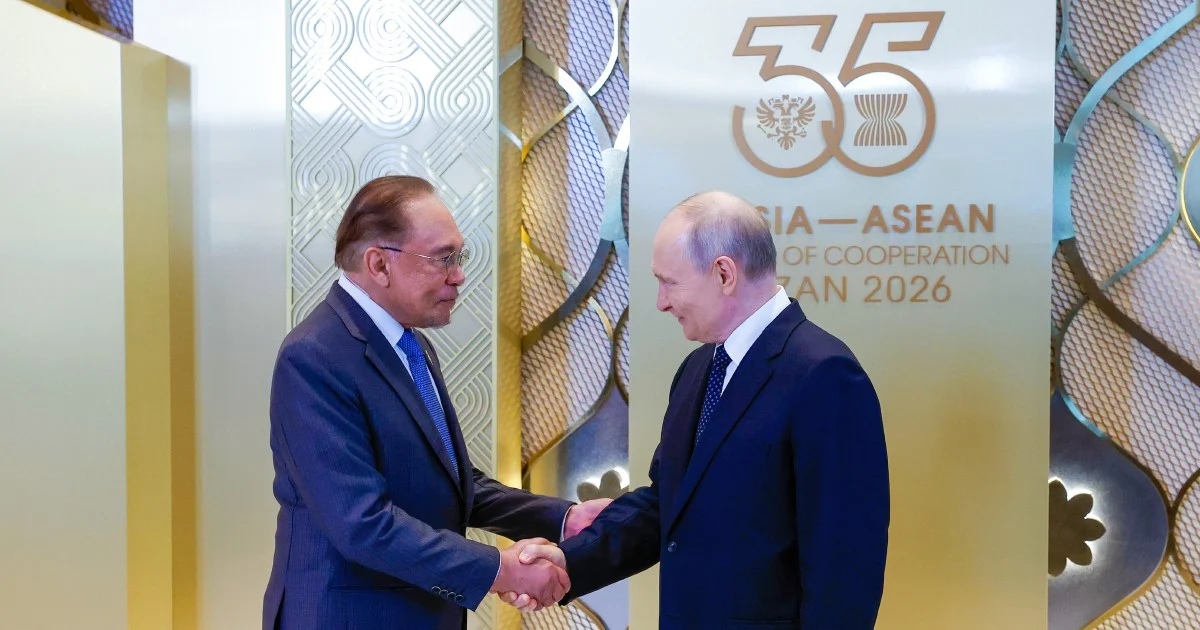
During his engagement in Kazan, Prime Minister Datuk Seri Anwar Ibrahim held substantive talks with Russian President Vladimir Putin, signalling Malaysia's intent to deepen economic and strategic partnerships with Moscow at a time when regional geopolitics remain fluid and energy security concerns occupy policymakers across Asia. The bilateral meeting underscored the growing importance both nations place on strengthening cooperation across multiple sectors, reflecting broader shifts in Southeast Asia's approach to diversifying international partnerships beyond traditional Western alliances.
The discussions centred on energy security, a critical concern for Malaysia given its position as both an energy producer and consumer in a region increasingly dependent on stable commodity supplies. Energy cooperation represents one of the most tangible areas where Malaysia and Russia can create mutual benefit, as Russia remains one of the world's largest energy exporters whilst Malaysia seeks to secure long-term supply agreements and develop alternative energy sourcing strategies. For a nation navigating the complexities of transitioning towards renewable energy whilst maintaining reliable baseload power, partnerships with established energy producers offer both immediate stability and opportunities to study advanced energy technologies.
Beyond conventional energy, the two leaders discussed a framework for trade that moves away from traditional currency arrangements. The emphasis on conducting transactions in local currencies reflects a broader global trend towards reducing reliance on the United States dollar, particularly among nations seeking to insulate their economies from currency volatility and geopolitical sanctions regimes. For Malaysia, such arrangements could provide greater financial autonomy whilst strengthening economic ties with Russia, a nation that has faced significant international financial constraints in recent years and actively seeks alternative trade mechanisms with willing partners.
The timing of Anwar's engagement with Putin carries significance for Malaysia's regional positioning. As the government continues to articulate a foreign policy emphasising strategic autonomy and non-alignment, bilateral relationships with major global powers—whether Russia, China, or India—demonstrate that Malaysia refuses to be confined to any single sphere of influence. This approach allows Malaysia to extract maximum diplomatic and economic value whilst maintaining the flexibility necessary to navigate great power competition without incurring the costs of formal alignment.
Energy security discourse has intensified throughout Southeast Asia following global supply disruptions and geopolitical tensions affecting commodity markets. Malaysia's oil and liquefied natural gas sectors, though significant, cannot fully satisfy domestic and regional demand, necessitating diversified import relationships. Russian energy resources, including oil, natural gas, and potentially advanced nuclear technology, present options that complement Malaysia's existing partnerships with Middle Eastern suppliers and growing ties with Central Asian energy producers. Such diversification insulates Malaysia from overdependence on any single source whilst creating resilience in its energy infrastructure.
The local currency trade mechanism discussed between Anwar and Putin addresses a practical challenge in bilateral commerce: the dominance of the US dollar in international transactions has imposed costs on Malaysian businesses engaging with Russia, particularly since international sanctions have complicated dollar-based settlement systems. By developing ringgit-ruble trade corridors, both nations can reduce transaction costs, accelerate commerce, and create practical incentives for expanding business engagement between their private sectors. This approach parallels similar initiatives undertaken by China, India, and other major trading partners seeking to build alternative financial infrastructure.
Malaysia's approach to Russia reflects pragmatic policymaking unconstrained by the ideological frameworks that govern some Western nations' engagement with Moscow. Rather than viewing the relationship through a Cold War lens, Malaysian leadership evaluates cooperation based on national interests—energy security, economic opportunity, and strategic autonomy. This realism positions Malaysia advantageously in an increasingly multipolar world where nations must maintain relationships across ideological and geopolitical divides to protect their interests.
The discussion also implicitly acknowledges Russia's enduring economic importance despite international pressures. Whilst sanctions have redirected Russian trade towards Asia, they have not eliminated Russia's capacity to supply energy and technology to willing partners. Southeast Asia, lacking the unified foreign policy framework of Europe, has generally maintained pragmatic engagement with Russia, recognising that sustainable regional stability requires inclusivity rather than exclusion. Malaysia's continued dialogue with Putin reflects this principle.
Moving forward, concrete follow-up mechanisms will determine whether these discussions translate into expanded partnership. Areas requiring attention include negotiating specific energy supply contracts, establishing institutional frameworks for currency trade, and identifying sectoral collaboration opportunities in technology and infrastructure. The private sectors in both nations will play crucial roles in translating government-level goodwill into commercial reality, requiring regulatory alignment and risk mitigation strategies that facilitate business expansion.
Malaysia's bilateral engagement with Russia also signals to other regional actors that Southeast Asia will not allow external powers to dictate its relationships. Countries like Singapore and Indonesia similarly maintain ties with Moscow, indicating that pragmatic engagement transcends Malaysia's specific circumstances. As great power competition intensifies in Asia-Pacific, Malaysia's ability to maintain beneficial relationships across multiple poles of power—whilst advancing concrete national interests in energy and trade—represents effective statecraft in an era of strategic uncertainty and competing influence.