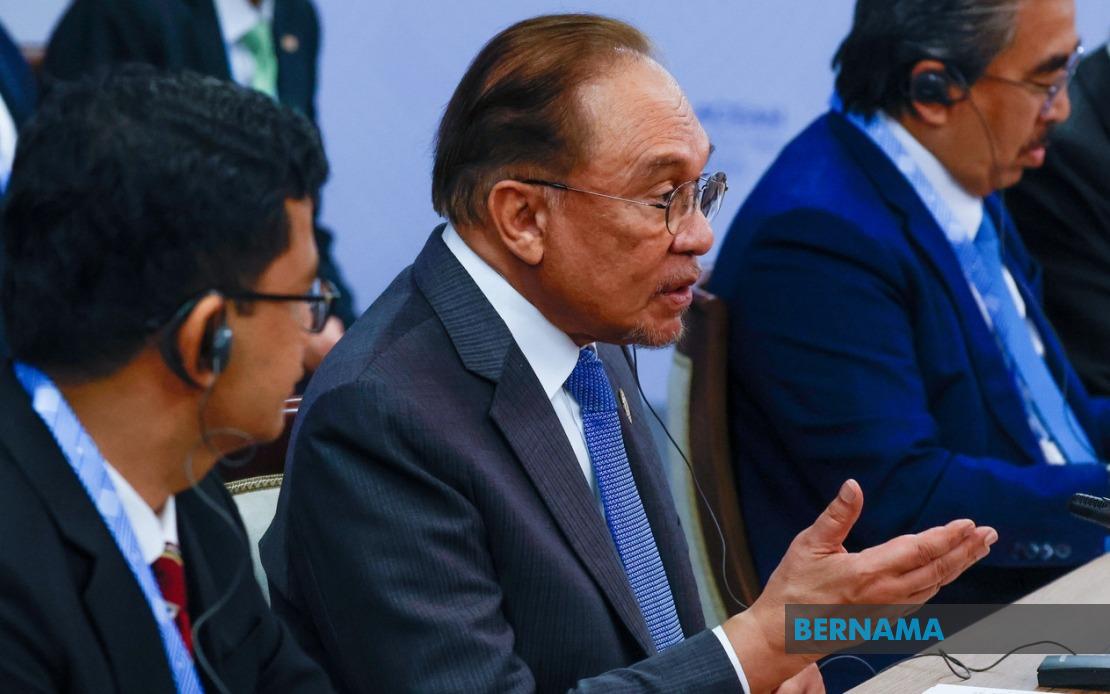
Malaysian Prime Minister Datuk Seri Anwar Ibrahim seized a bilateral meeting with Russian President Vladimir Putin in Kazan on Wednesday evening to publicly affirm Malaysia's appreciation for Russia's foreign policy approach toward two of the Middle East's most pressing contemporary challenges: the Gaza conflict and the broader geopolitical tensions involving Iran. Speaking during his opening remarks, Anwar specifically highlighted what he characterised as Moscow's unwavering commitment to principled stances on these matters, framing such consistency as worthy of international recognition and respect.
The timing and tone of Anwar's comments reveal Malaysia's deliberate effort to reinforce its diplomatic alignment with Russia on Middle Eastern affairs at a moment when regional tensions remain elevated. By publicly commending Putin's steadfastness, Anwar signalled that Malaysia views Russia's diplomatic approach as constructive and worthy of emulation within the broader developing world. The Prime Minister's reference to "many others" who share Malaysia's admiration suggests an attempt to position Malaysia as part of a growing coalition of nations that value Russia's principled engagement with these issues, rather than portraying the stance as idiosyncratic or isolated.
Russia's position on Gaza has centred on consistent advocacy for an immediate ceasefire, humanitarian corridor access for Palestinian civilians, and the delivery of essential aid to affected populations. This approach contrasts with the diplomatic positions adopted by Western nations, where policy responses have been more complicated by alliance considerations and domestic political pressures. Moscow has framed its Gaza stance within a broader commitment to international law and the rights of civilian populations, principles that resonate strongly within Malaysia and across the Islamic world, where public sentiment regarding Palestinian suffering runs particularly deep.
Beyond Gaza, Russia's relationship with Iran represents another critical dimension of its Middle Eastern strategy that Malaysia appears keen to validate through Anwar's remarks. Moscow has maintained robust diplomatic and economic ties with Tehran while consistently advocating for negotiated settlements to regional disputes rather than military intervention. This position holds particular significance for Malaysia, given the country's own strategic interests in maintaining stability across the Arabian Gulf and broader Indian Ocean region, where military escalation could have immediate implications for regional trade, energy security, and maritime safety.
The geopolitical landscape of the Middle East has become increasingly multipolar, with the United States, Russia, and China all competing for influence while regional actors pursue their own strategic objectives. Malaysia, as a significant Southeast Asian nation with substantial Muslim population and considerable economic interests throughout the Middle East, must navigate this complex terrain carefully. By publicly endorsing Russia's principled approach, Anwar positions Malaysia as a nation that values consistency in foreign policy over expedient alignment with transient power blocs.
Anwar's characterisation of Russian policy as embodying "tenacity and conviction" carries specific weight given Malaysia's own foreign policy history. The country has positioned itself as a principled non-aligned nation, maintaining relationships with diverse powers while refusing to be drawn into zero-sum competitions. By praising Russia's consistency, Anwar effectively argues that maintaining principled positions on issues of fundamental importance—such as civilian protection and diplomatic resolution of conflicts—constitutes genuine moral leadership in international affairs, regardless of geopolitical pressures.
The bilateral meeting between Anwar and Putin occurs within a broader context of Malaysia-Russia relations that extend across trade, defence cooperation, and educational exchanges. However, the Prime Minister's public remarks on Gaza and Iran suggest that Malaysia views its relationship with Russia as encompassing not merely transactional economic or security arrangements, but also alignment on fundamental questions of international justice and conflict resolution. This framing elevates the relationship beyond typical bilateral mechanics into the realm of shared values and strategic vision.
For Malaysian audiences and broader Southeast Asian observers, Anwar's comments carry implications for how Malaysia intends to navigate its foreign policy during a period of intensifying great power competition. The explicit praise for Russia's Middle Eastern positions suggests that Malaysia will continue prioritising consistency and principle over alignment with any particular power bloc. This approach reflects Malaysia's historical self-conception as an independent actor capable of maintaining relationships with multiple powers while preserving strategic autonomy.
The domestic Malaysian context also matters. With a Muslim-majority population deeply concerned about Palestinian rights and regional stability, Anwar's public commendation of Russia's Gaza stance carries resonance beyond diplomatic circles. By articulating Malaysia's appreciation for Russia's position in formal bilateral settings, Anwar addresses domestic constituencies who view Palestinian rights as a matter of religious and moral principle rather than merely geopolitical calculation.
Russia's diplomatic activism in the Middle East, including its support for humanitarian access to Gaza and its maintenance of dialogue channels with Iran, reflects Moscow's effort to position itself as a power genuinely committed to international stability and civilian protection. Anwar's endorsement of these positions suggests Malaysia sees value in supporting diplomatic approaches that privilege humanitarian concerns and negotiated settlements, even when such approaches conflict with positions advanced by other major powers or Western-aligned nations.