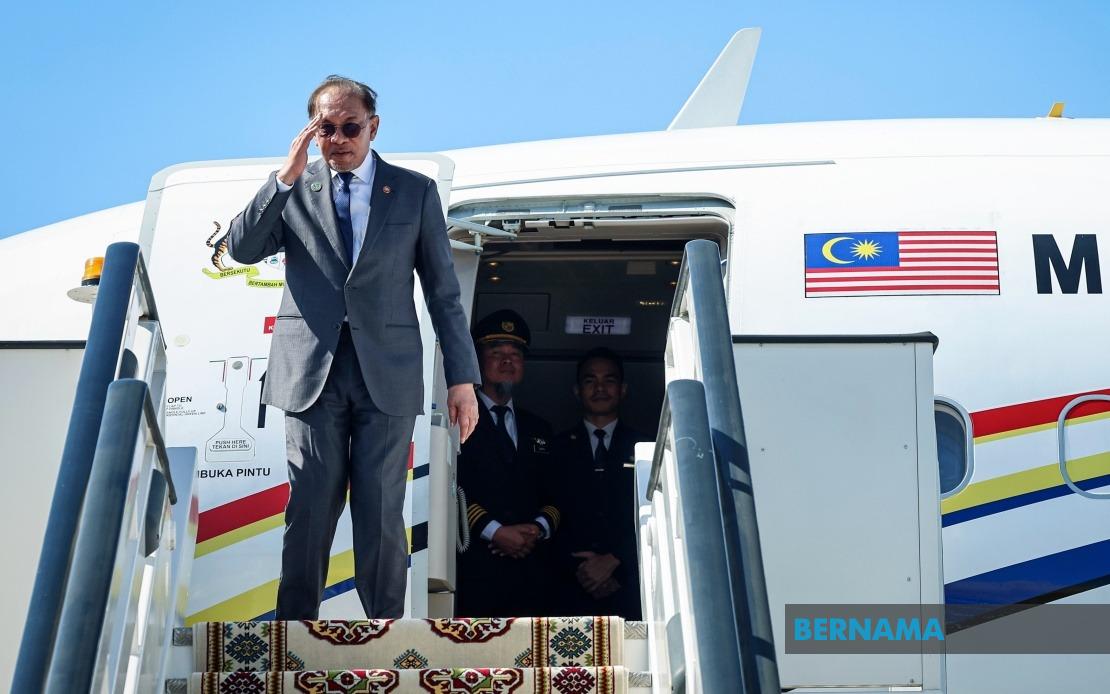
Prime Minister Datuk Seri Anwar Ibrahim returned to Malaysia on June 20 with barely a pause between engagements, arriving in Penang immediately after completing a two-day state visit to Turkmenistan. The Prime Minister, who also holds the Finance portfolio, arrived with his delegation after departing Ashgabat International Airport at 4.45 pm local time, landing with a full day of commitments already mapped out. His whirlwind 24-hour engagement in Penang underscores the administrative demands facing Malaysia's 10th Prime Minister, who since taking office in November 2022 has maintained an aggressive schedule balancing international diplomacy with domestic economic priorities.
The Turkmenistan visit itself carried strategic significance for Malaysia's foreign relations, marking Anwar's inaugural trip to the Central Asian nation since his appointment. President Serdar Berdimuhamedov extended the original invitation, signalling both countries' interest in deepening bilateral engagement. The timing of this visit reflected Malaysia's broader positioning within emerging geopolitical frameworks, coming just after Anwar's participation in the 35th ASEAN-Russia Commemorative Summit in Kazan alongside Investment, Trade and Industry Minister Datuk Seri Johari Abdul Ghani and Economy Minister Akmal Nasrullah Mohd Nasir. This diplomatic sequence illustrates how Malaysia is cultivating relationships across multiple regions simultaneously, from Central Asia to Russia to its immediate Southeast Asian neighbourhood.
Upon landing in Penang, Anwar's itinerary reflected the state's importance as an industrial and technology hub. At 11 am, he officially opened MKS Instruments Malaysia Sdn Bhd at Bandar Cassia Technology Park in Batu Kawan. The facility represents continued foreign investment confidence in Malaysia's manufacturing and technology sectors, with MKS Instruments being a global supplier of critical equipment and control solutions. The opening signals the government's commitment to attracting and facilitating multinational corporations in establishing their regional operations on Malaysian soil, a cornerstone of the nation's economic development strategy.
Following the manufacturing sector opening, Anwar proceeded to Bandar Setia Fontaines in Kepala Batas for the groundbreaking ceremony of the Setia Fontaines Industrial Park at 1 pm. This development project carries implications beyond mere commercial expansion, representing developer Setia's strategic vision for catalysing economic activity in the Northern Corridor—a geographical zone designated for accelerated development. The industrial park's launch reflects confidence in Penang's continued transformation as a manufacturing and logistics centre, with particular relevance to companies seeking proximity to the Strait of Malacca and ASEAN markets. During the ceremony, Setia announced two additional strategic collaborations within the township, multiplying the event's significance for the northern region's economic trajectory.
The afternoon brought Anwar to what many viewed as the day's most symbolically significant engagement: the National Journalists' Day (HAWANA) 2026 Grand Finale at PICCA Convention Centre at Butterworth Arena. Approximately 1,000 media practitioners gathered from across Malaysia and internationally, assembling for an event organised by the Communications Ministry with the Malaysian National News Agency (Bernama) as the implementing body. HAWANA serves as Malaysia's premier recognition platform for journalism contributions, celebrating the professionalism and dedication that shape public discourse across the nation.
At the ceremony, Anwar presented the HAWANA Award and Special HAWANA Award to individuals judged to have made outstanding contributions to journalism and the development of informed public thought. These awards carry particular weight in a media landscape grappling with misinformation and the challenge of maintaining professional standards amid digital transformation. Beyond individual recognition, Anwar also distributed contributions from Tabung Kasih@HAWANA, a support fund for media practitioners facing financial hardship. This dual approach—celebrating excellence while supporting vulnerability—demonstrates governmental acknowledgment of journalism's multifaceted challenges in contemporary Malaysia.
The timing of HAWANA 2026's grand finale underscores the government's messaging priorities regarding press freedom and professional media development. By placing his presence and highest ceremonial endorsement behind the event, Anwar conveyed the administration's investment in a functioning fourth estate. For media practitioners, particularly those working in regional publications and smaller outlets, such governmental recognition carries tangible implications for industry morale and professional validation. The gathering of 1,000 journalists also created opportunity for informal networking and professional exchange, strengthening the sectoral bonds that underpin media ecosystem resilience.
Geographically, Penang's selection as the venue for this convergence reflects the state's status as more than a manufacturing centre. As the Pearl of the Orient, Penang represents cosmopolitan Malaysia, historically a nexus of intellectual and commercial exchange. Hosting HAWANA's finale there projected an image of inclusive, distributed media recognition rather than concentrating all such ceremonies in the capital. This geographical distribution carries symbolic weight for regional journalists who might otherwise perceive all significant national events as Kuala Lumpur-centric.
Anwar's abbreviated Penang sojourn also foreshadowed his subsequent commitment that evening: attendance at the Himpunan Pertubuhan Lima Generasi (PLG) Malaysia dinner in Negeri Sembilan. This multi-state engagement within a 24-hour window underscores the physical and mental stamina required of Malaysia's chief executive. The PLG event suggested continued focus on generational politics and youth mobilisation—constituencies increasingly critical to electoral outcomes and social policy formation. The sequential nature of these engagements—from industrial opening to journalism recognition to youth-focused gatherings—sketched a portrait of a Prime Minister attempting to address simultaneously the economic, informational, and demographic dimensions of national governance.
For Southeast Asian observers, Anwar's diplomatic engagement with Turkmenistan followed by urgent domestic economic and symbolic commitments illustrated the balancing act required of contemporary Malaysian leadership. The Central Asian visit established or reinforced bilateral channels relevant to Malaysia's position within broader Asian geopolitical calculations, particularly as nations recalibrate relationships across the Eurasian landmass. Simultaneously, the Penang engagement demonstrated continued investment in domestic economic development and media sector health—ultimately the foundations upon which international credibility rests. The compressed timeline reflected not merely scheduling exigency but rather a governing philosophy that integrates external relations with internal legitimacy-building in a singular strategic vision.