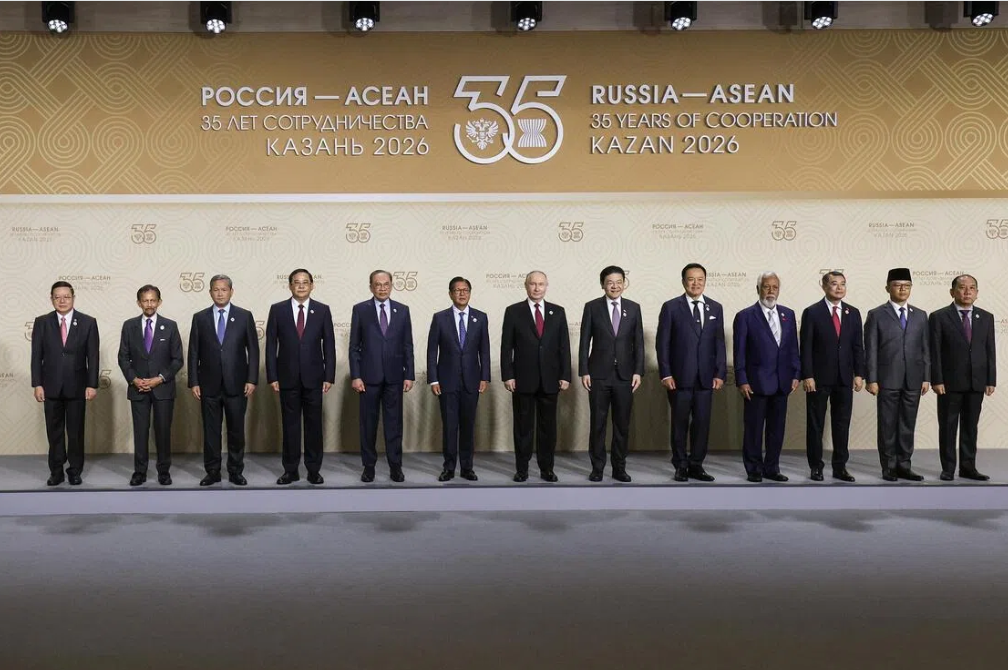
The ASEAN-Russia relationship entered a new chapter at the Commemorative Summit held in Kazan on June 17 and 18, where both sides formally renewed their commitment to expanding collaboration across a broad spectrum of shared interests. The gathering represented a significant milestone, marking three and a half decades of diplomatic engagement between the 10-member Southeast Asian bloc and Moscow, alongside three decades of formal dialogue partnership structures. Hosted by Russian President Vladimir Putin, the summit produced several binding agreements that will guide bilateral relations through the remainder of this decade and establish concrete mechanisms for practical cooperation.
Three principal documents emerged from the two-day gathering, each designed to deepen institutional ties and expand the scope of engagement. The Kazan Declaration provides a comprehensive review of how ASEAN-Russia relations have evolved since the late 1980s, while simultaneously outlining strategic priorities for the foreseeable future. Crucially, the Asean-Russia Comprehensive Plan of Action for 2026-2030 moves beyond symbolic commitment to establish concrete timelines and deliverables for cooperation. The third instrument, a Joint Statement on Cultural Cooperation, underscores the belief that sustained people-to-people connections form the bedrock of enduring international relationships and must be actively cultivated through targeted exchange programmes.
Prime Minister Lawrence Wong's address at the summit articulated Singapore's position that meaningful collaboration should centre on areas of genuine convergence rather than attempting to paper over fundamental disagreements. This pragmatic framing acknowledges that ASEAN nations, whilst maintaining their principle of non-alignment, recognise legitimate interests that align with Russia's own strategic objectives. Wong specifically highlighted maritime security, trade and investment flows, energy cooperation, infrastructure connectivity, security cooperation, educational initiatives, and cultural exchanges as domains where substantive progress remains achievable. His remarks reflected a broader ASEAN strategic calculation that engagement, even with states on different sides of global divisions, serves the region's stability better than isolation or confrontation.
The conversation around ASEAN Centrality represented a notable aspect of the summit, with Wong explicitly welcoming Russia's continued endorsement of ASEAN's role as the driving force in regional architecture. This acknowledgement holds particular significance in Southeast Asia's increasingly complicated geopolitical environment, where larger powers often attempt to marginalise smaller nations or bypass regional institutions in pursuit of bilateral interests. Russia's stated support for ASEAN-led mechanisms such as the ASEAN Regional Forum and the East Asia Summit signals a degree of respect for the institutional frameworks through which the region collectively manages its international relations, even when individual member states pursue varied foreign policies.
Wong's references to Singapore's upcoming assumption of the ASEAN Chairmanship in 2027 carried strategic weight, as he sought advance assurances of Russian participation in key regional forums during that period. The East Asia Summit, which provides a platform for dialogue among ASEAN members and major regional and global powers, represents a crucial venue for managing great power competition in Southeast Asia. Singapore's effort to secure Putin's commitment to participate in such forums during its chairmanship reflects an attempt to ensure that Russia remains engaged with ASEAN's agenda-setting processes rather than retreating into alternative groupings or bilateral arrangements that might circumvent ASEAN's convening role.
Beyond the ceremonial and diplomatic aspects, the summit identified practical areas where ASEAN-Russia cooperation can deliver tangible benefits to Southeast Asian populations. Disaster management cooperation carries obvious relevance to a region frequently affected by typhoons, floods, and other natural calamities, whilst collaborative efforts to counter transnational drug trafficking address a persistent security challenge that affects multiple ASEAN member states. These functional cooperation domains potentially offer less controversial terrain than security partnerships or military alignments, allowing both sides to demonstrate commitment to shared problem-solving whilst navigating the broader geopolitical tensions that complicate relations between Russia and various Western-aligned nations.
Educational and cultural exchanges featured prominently in Wong's remarks, reflecting the recognition that sustained engagement across generations creates durable foundations for bilateral relations. The participation of Russian officials in civil service training programmes across ASEAN member states, including Singapore, represents a form of capacity-building exchange that builds mutual understanding and creates networks of officials with direct experience of one another's governance systems and priorities. Such initiatives, whilst less visible than high-level diplomatic summits, often prove more effective at creating the interpersonal relationships and shared professional vocabularies that facilitate cooperation when political circumstances permit.
Wong's bilateral meeting with Putin during the summit, arranged at the Russian president's specific request, provided an opportunity for candid discussion beyond the formal summit programme. Their conversation touched on bilateral relations and broader regional and international developments, with Wong subsequently emphasising that meaningful dialogue remains valuable even when countries hold divergent positions on critical issues. This framing attempts to navigate the delicate balance ASEAN nations maintain regarding Russia, particularly given their condemnation of the Ukraine invasion, Singapore's ongoing sanctions regime against Moscow, and their simultaneous desire to preserve engagement channels that might contribute to eventual conflict resolution.
Singapore's consistent positioning on Ukraine, as articulated by Wong, rests explicitly on principles of sovereignty and territorial integrity rather than alignment with any particular geopolitical bloc. This principled stance allows Singapore to maintain its non-aligned posture whilst clearly signalling opposition to territorial conquest in violation of international law. The framework also creates space for Singapore to welcome developments that might reduce tensions, such as the recently announced peace agreement between the United States and Iran, which Wong hoped would lead to a permanent ceasefire and reopening of the Strait of Hormuz—a crucial waterway for global maritime commerce and particularly significant for Southeast Asian trading nations.
Wong's emphasis on the rules-based global order and the centrality of international law in resolving disputes reflects ASEAN's broader vulnerability to great power conflicts that might disrupt regional stability and maritime commerce. A region dependent on freedom of navigation through strategic waterways and sustained access to global markets has strong incentives to champion institutional frameworks and legal principles that protect smaller nations from arbitrary exercises of power by stronger states. Russia's role in the international system, and its relationship with frameworks such as the UN Convention on the Law of the Sea, therefore carries direct implications for ASEAN's own security and prosperity.
Wong's separate engagement with Rustam Minnikhanov, the Rais of Tatarstan, acknowledged the significant relationship that has developed between Singapore and this Russian federal subject. The visit by then-Minister Mentor Lee Kuan Yew to Tatarstan in 2007 established a precedent for subnational engagement that has evolved into substantive cooperation on cultural, educational, and people-to-people dimensions. This multilayered approach to Russia—combining federal-level diplomatic engagement with cultivation of relationships with significant regions—reflects ASEAN's broader understanding that sustained engagement operates most effectively when pursued through multiple channels and institutional levels.
The comprehensive action plan for 2026-2030 signals that both ASEAN and Russia view their partnership as sufficiently important to warrant medium-term strategic planning rather than ad hoc cooperation. This planning horizon extends beyond immediate political cycles and suggests shared recognition that stable, cooperative relations serve both parties' long-term interests. For ASEAN, such planning provides a mechanism for anchoring Russia's engagement with the region's institutions and priorities, whilst for Russia, it demonstrates commitment to Southeast Asian partnerships at a moment when its relationship with Western nations remains severely strained.
As geopolitical volatility increases and the regional environment becomes more unpredictable, ASEAN's determination to maintain multiple partnerships and engagement channels with major powers reflects a sophisticated understanding of survival strategy for smaller nations. The Kazan summit demonstrated that ASEAN can simultaneously condemn Russian actions that violate international law, maintain active sanctions regimes, and pursue genuine cooperation in areas of shared interest. This nuanced approach, articulated most clearly through Singapore's positioning, suggests that ASEAN nations view the international system not as divided into permanently hostile camps but as a complex landscape where selective cooperation remains possible and desirable even amid broader disagreements.