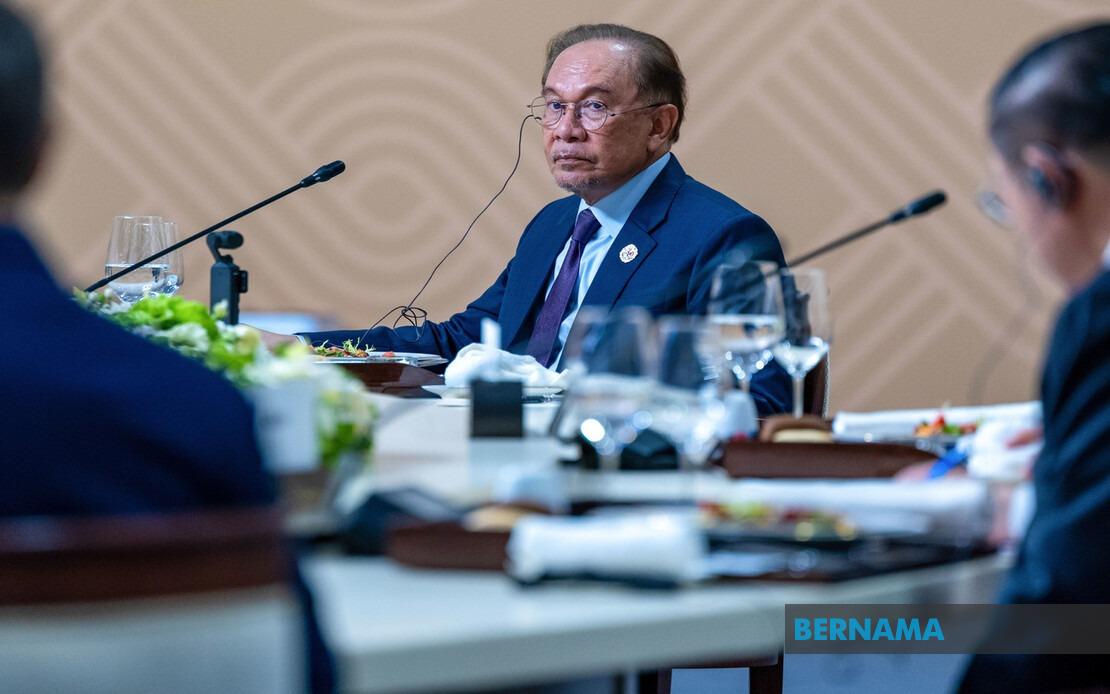
Prime Minister Datuk Seri Anwar Ibrahim has called for closer collaboration between the Association of Southeast Asian Nations and the Shanghai Cooperation Organisation in tackling transnational crime and advancing energy security, emphasising that neither challenge can be addressed effectively without coordinated regional effort. Speaking at an ASEAN-Russia working lunch in Kazan on June 18, the Prime Minister stressed that both organisations possess established mechanisms for cooperation that remain underutilised and could be meaningfully strengthened through strategic focus.
The foundation for enhanced cooperation already exists through the 2005 memorandum of understanding between the two blocs, which encompasses counter-terrorism, narcotic control, money laundering suppression, and economic collaboration alongside energy initiatives. However, Anwar argued that simply maintaining these frameworks is insufficient; the two organisations must now concentrate resources on specific, achievable objectives within realistic timeframes to demonstrate tangible progress to their constituent nations and publics.
The transnational nature of contemporary criminal activity presents an urgent case for pooled intelligence and capacity-building efforts. Online fraud schemes, sophisticated money laundering networks, and human trafficking operations frequently transcend borders faster than individual nations can respond, exploiting the gaps between national law enforcement systems. By establishing systematic information-sharing protocols and joint training programmes, ASEAN and the SCO could dramatically improve response times and intercept criminals before they exploit jurisdictional boundaries. Anwar emphasised that mutual learning across borders would strengthen each member state's ability to combat these evolving threats, particularly given that criminal organisations adapt rapidly to exploit regulatory differences across regions.
On the energy dimension, the SCO membership structure offers unique advantages that align closely with both regional and global concerns. The organisation brings together major energy producers alongside nations with significant technical expertise in energy infrastructure and transition technologies. This combination creates opportunities for practical collaboration on energy security—a paramount concern for Southeast Asia given the region's growing demand and dependence on reliable supply chains. The SCO's representation of energy-rich economies presents Malaysia and other ASEAN members with potential partners for addressing supply vulnerabilities and diversifying sources.
Anwar highlighted that energy cooperation should extend beyond traditional hydroelectric and fossil fuel frameworks toward cleaner transition pathways. The Prime Minister outlined several priority areas: improving energy efficiency across both regions' power systems, strengthening grid reliability and resilience, expanding liquefied natural gas and conventional gas infrastructure, integrating renewable energy sources at scale, and sharing technical knowledge on safety standards and operational resilience. This multifaceted approach recognises that energy security encompasses not merely availability but also technological modernisation and the ability to transition toward lower-carbon sources without compromising reliability or economic competitiveness.
Parallel to these bilateral ASEAN-SCO initiatives, Anwar advocated for strengthened cooperation between ASEAN and the Eurasian Economic Union, which similarly possesses dormant frameworks awaiting activation. He argued that existing agreements should be leveraged to rebuild business confidence and expand commercial linkages between the regions, addressing three strategic pillars that would unlock meaningful growth. The first involves regularising and deepening private sector engagement through expanded participation in major economic forums, allowing Malaysian and Southeast Asian businesses to cultivate long-term partnerships and understand market opportunities within the EAEU jurisdiction.
Smaller enterprises across ASEAN face particular challenges in accessing and competing within EAEU markets due to informational asymmetries, technological gaps, and skill deficiencies in market entry strategies. Anwar identified this as a second critical priority, arguing that targeted assistance programmes addressing market access barriers, technology transfer mechanisms, and skills development would enable medium and small enterprises to participate more effectively in cross-regional trade. Such support could yield significant multiplier effects throughout ASEAN economies by broadening the base of companies engaged in external commerce beyond the multinational and large domestic corporations that traditionally dominate bilateral trade flows.
A third dimension involves emerging sectors where ASEAN and EAEU interests increasingly converge but remain under-explored institutionally. The digital economy, artificial intelligence applications, cybersecurity frameworks, and food security initiatives present substantial collaborative potential given complementary strengths and shared vulnerabilities. Southeast Asia's rapid digital adoption and technology entrepreneurship coupled with the EAEU's technical and institutional capabilities in cybersecurity and food production systems could generate innovations benefiting both regions. However, realising these opportunities requires deliberate institutional mechanisms and political commitment to move beyond general declarations toward concrete joint projects with measurable deliverables.
The Prime Minister's remarks emerge against the backdrop of the ASEAN-Russia Commemorative Summit in Kazan, where Malaysia and Russia are marking their bilateral relationship within the broader framework of Southeast Asian engagement with Russia and its allied organisations. This summit represents an important touchpoint for regional powers to articulate their vision for transnational cooperation and to signal priorities to institutional players. Anwar's emphasis on resource pooling and practical outcomes reflects Malaysia's pragmatic approach to multilateral diplomacy, prioritising implementable agreements over rhetorical commitments.
For Malaysian policymakers and businesses, the implications of these cooperation frameworks are substantial. Enhanced security collaboration could improve Malaysia's capacity to combat transnational organised crime networks that exploit maritime routes and financial systems in Southeast Asia. Greater energy cooperation offers potential partners for diversifying Malaysia's energy sources and acquiring cleaner technology, supporting the nation's net-zero commitments while ensuring supply stability. Moreover, expanded ASEAN-EAEU commercial engagement creates opportunities for Malaysian enterprises to access vast Eurasian markets and for Malaysian technology companies to participate in digital and AI initiatives alongside established players.
The success of these proposed initiatives ultimately depends on translating diplomatic statements into functioning mechanisms with adequate budgeting, personnel, and political accountability. Previous ASEAN multilateral arrangements have sometimes languished due to weak implementation capacity and competing national priorities. Anwar's emphasis on focusing on achievable goals within defined timeframes suggests awareness of these implementation challenges and a desire to avoid the overly ambitious agendas that have sometimes diluted ASEAN's effectiveness. Whether the SCO, EAEU, and ASEAN can mobilise sufficient political will and technical resources to operationalise these enhanced cooperation frameworks remains to be tested in coming years, but the articulated commitment at the highest levels establishes a foundation upon which practical progress might be built.