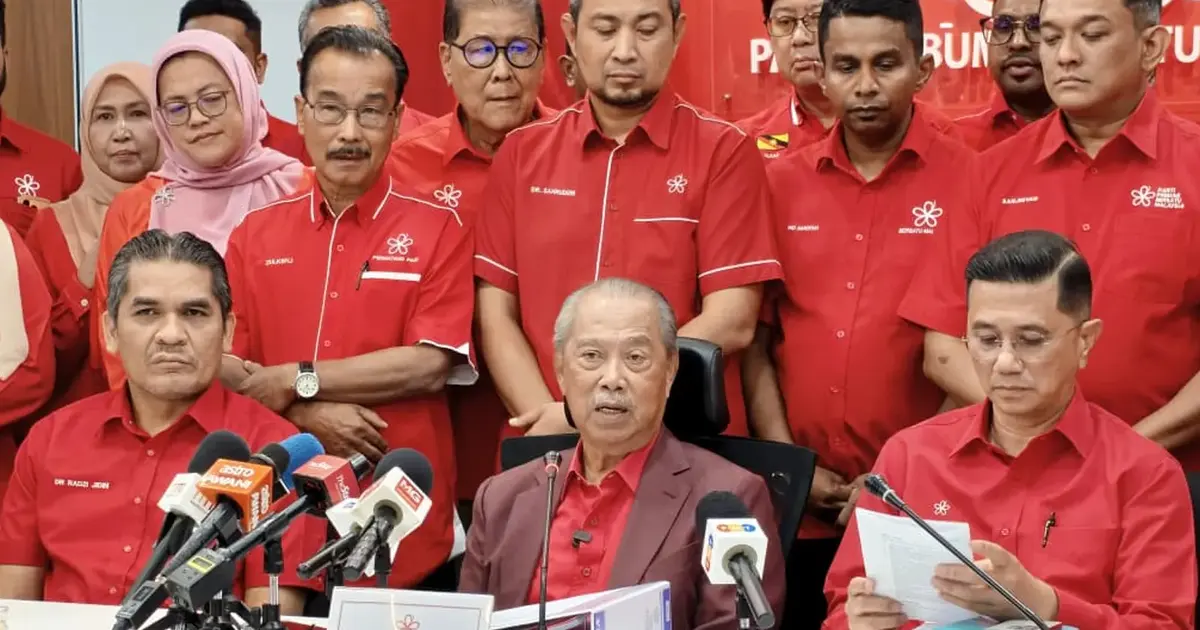
Bersatu is not abandoning the Perikatan Nasional coalition, party president Muhyiddin Yassin declared, signalling the Bumiputera-focused political force intends to maintain its alliance despite internal pressures and shifting parliamentary dynamics in Malaysian politics.
Muhyiddin's statement reflects growing speculation about the stability of Perikatan Nasional, which has faced mounting scrutiny since the formation of the current federal administration. The coalition, which includes Bersatu, PAS, and other component parties, has been the subject of periodic conjecture about potential realignments or party defections. By publicly reaffirming Bersatu's allegiance, Muhyiddin appears to be anchoring the partnership and signalling political continuity to party members and supporters.
The Bersatu president based his assertion on what he characterises as the general public's acceptance of the Perikatan Nasional framework. This framing suggests that beyond parliamentary mathematics and internal party calculations, Muhyiddin believes the coalition has gained sufficient grassroots legitimacy and popular endorsement to justify its continuation. For Malaysian voters accustomed to coalition volatility and party-hopping, such appeals to public endorsement carry political weight, even as they remain somewhat difficult to quantify objectively.
For Bersatu specifically, maintaining Perikatan Nasional membership provides strategic advantages. The party, which emerged from the 2020 political crisis and the collapse of the Pakatan Harapan government, has used its position within the coalition to secure ministerial posts and influence national policy. Any departure would risk marginalising Bersatu from executive power and reducing its bargaining leverage within parliament. Muhyiddin's continued emphasis on coalition loyalty thus serves the party's institutional interests.
The timing of Muhyiddin's comments is particularly significant given the broader realignment occurring across Malaysian politics. The federal government's composition has evolved considerably since 2021, with various agreements and understandings reshaping parliamentary alignments. Perikatan Nasional's stability has therefore become a touchstone for political observers seeking to understand whether Malaysia's governing arrangements have reached a period of relative equilibrium or remain susceptible to further upheaval.
Within Perikatan Nasional itself, Bersatu's position differs markedly from that of PAS, the Islamic party that holds considerable grassroots support particularly in the northern and east coast states. While PAS has deepened its organisational presence and pursued its own political agenda, Bersatu has relied more heavily on its coalition partnership and federal patronage. Muhyiddin's statement implicitly acknowledges that Bersatu's electoral viability is increasingly intertwined with the broader coalition's performance and public perception.
The emphasis on public acceptance also reflects Bersatu's awareness that coalition membership carries reputational considerations. Some Bersatu supporters and observers view the party's alignment with PAS as potentially constraining its ability to pursue inclusive, multi-communal politics. By invoking public support, Muhyiddin attempts to legitimise the partnership beyond narrow elite or factional endorsements, suggesting that ordinary Malaysians comprehend and accept the coalition's necessity and value.
Looking ahead, Muhyiddin's reaffirmation suggests Bersatu intends to contest future elections under the Perikatan Nasional banner rather than pursuing solo efforts or alternative alliances. This has implications for the broader opposition landscape, where PKR, DAP, and Amanah continue to operate within Pakatan Harapan. The two competing coalitions now appear more clearly defined, providing Malaysian voters with relatively distinct political choices, though individual seats and regional variations remain fluid.
For Southeast Asian observers, Bersatu's commitment to Perikatan Nasional also signals continuity in Malaysia's foreign policy and regional alignment. Muhyiddin, as a former prime minister, carries considerable weight in international forums. His coalition's stability thus bears implications beyond domestic politics, touching on Malaysia's engagement with ASEAN, China, and other major powers.
The statement does not entirely eliminate speculation about potential internal tensions within Perikatan Nasional or the possibility of individual party movements at the grassroots level. Political coalitions in Malaysia have historically demonstrated remarkable capacity for sudden transformation. However, Muhyiddin's public commitment represents an important assertion of Bersatu's continued investment in the current coalition framework, rejecting any notion that the party is preparing for an imminent departure or realignment with rivals.