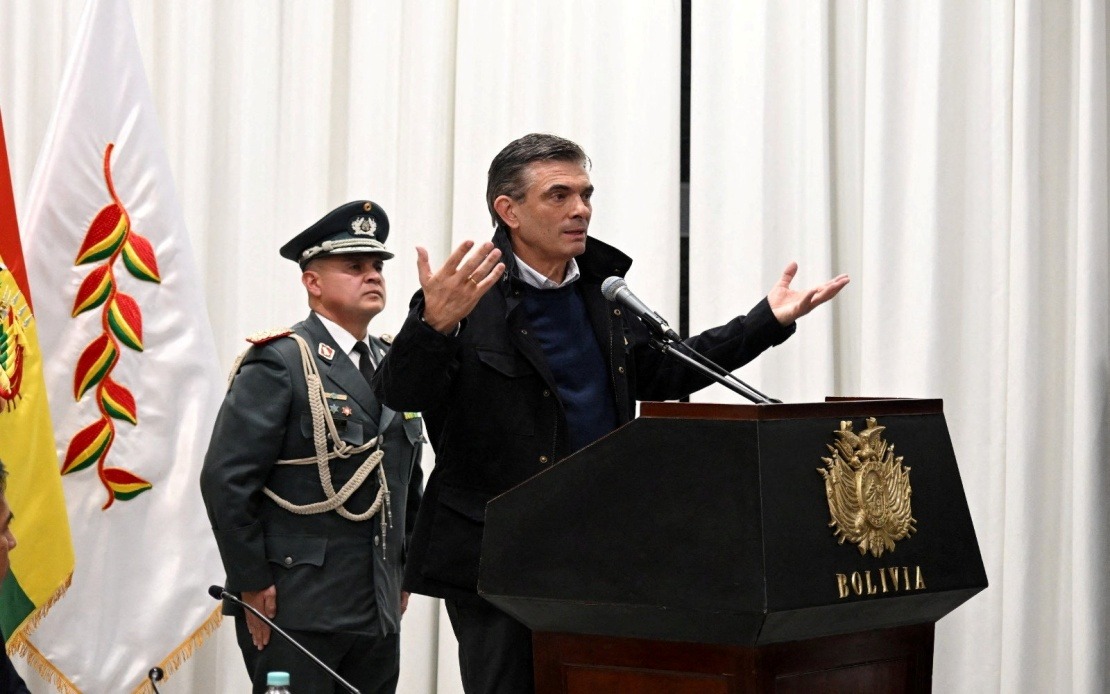
Bolivian President Rodrigo Paz has invoked emergency powers to confront an escalating political and economic crisis triggered by weeks of coordinated protests and strategic roadblocks that have paralysed large swaths of the country. The declaration, made during a televised address, signals a decisive shift in government strategy as officials grapple with the most serious challenge to Paz's administration in recent months. The move represents a significant escalation in the government's response to civil unrest that has gradually metastasised from isolated grievances into a nationwide movement threatening Bolivia's economic functioning and social stability.
The blockades, primarily orchestrated by labour unions and agricultural associations, have persisted for roughly 50 days and reflect deepening discontent with Paz's economic policies and governance approach. These organisations have systematised their opposition through strategic road closures designed to inflict maximum economic pressure on the government whilst constraining its capacity to deliver essential services. The protesters specifically demand Paz's immediate resignation, framing their campaign as a necessary response to what they characterise as governmental mismanagement of inflation and living standards that have steadily eroded household purchasing power across Bolivia.
The humanitarian dimension of the crisis has become increasingly acute as the blockades extend their reach into essential supply chains. Food distribution networks have fractured in several regions, creating localised scarcities of perishable goods and staple items. Fuel supplies have grown critically low in areas dependent on trucked deliveries, threatening transportation networks and industrial operations. Medical facilities face dangerous shortages of pharmaceutical supplies and equipment, potentially compromising patient care in a country where healthcare infrastructure already operates under significant constraints. These cascading supply disruptions represent a fundamental threat to public welfare that transcends ordinary political disagreement.
In his televised statement, Paz articulated the government's rationale for the emergency declaration by emphasising the incompatibility between functioning democratic society and indefinite blockade conditions. His remarks underscored the paradox confronting residents who cannot access employment, educational opportunities, healthcare services, or adequate provisions for household sustenance. This framing presents the emergency declaration not as authoritarian overreach but as a defensive measure necessary to restore baseline functionality to the national infrastructure that citizens depend upon for fundamental wellbeing. The president's language attempted to reposition the government as defending ordinary Bolivians against disruption rather than suppressing legitimate political expression.
The emergency decree simultaneously authorises military deployment across Bolivia's road networks and strategic locations, granting armed forces authority to clear blockades and restore transportation corridors. This militarisation of the crisis introduces profound complexity to an already volatile situation, as it transforms what began as labour-union-organised civil protest into a confrontation between organised workers and the machinery of state force. Historical precedents from Bolivia's turbulent political past demonstrate the risks inherent in such militarisation, particularly in contexts where deep social divisions already exist and trust between government and civil society has substantially deteriorated. The military's involvement necessarily changes the character and potential consequences of the ongoing standoff.
Understanding the origins of discontent requires examining Bolivia's macroeconomic environment and the distributional pressures affecting ordinary households. Rising inflation has outpaced wage growth across multiple sectors, effectively reducing real incomes for workers already operating within constrained margins. Farmers have faced deteriorating terms of trade as input costs have accelerated whilst commodity prices remain volatile. These conditions create objective grievances that transcend partisan political affiliation and reflect genuine economic hardship. The government's previous policy responses, whatever their intentions, have apparently failed to ameliorate these pressures sufficiently to prevent organised resistance from developing.
The blockade strategy itself warrants analytical attention as an instrument of political pressure in contexts where electoral processes or formal institutional channels may appear insufficient or unresponsive. By targeting the physical infrastructure of economic activity rather than symbolic targets, the protesters have chosen a mechanism that imposes costs broadly across society rather than concentrated on government officials. This approach generates pressure on the government through affecting the broader population, a tactic that simultaneously creates civilian suffering and demonstrates the protesters' willingness to bear costs associated with their campaign. The strategy's effectiveness depends upon maintaining coalition cohesion and preventing the accumulation of public frustration with blockade impacts from exceeding frustration with the government itself.
For Southeast Asian observers, Bolivia's predicament offers instructive parallels regarding the vulnerability of democratic institutions to breakdown when economic management fails and organised interests mobilise collectively. Malaysia and neighbouring economies have experienced episodes of civil unrest rooted in economic grievance, though typically channelled through electoral processes and formal institutions rather than sustained infrastructure blockades. The Bolivian case demonstrates how economic deterioration can gradually erode institutional legitimacy and push political competition into extra-institutional domains where risks of escalation increase substantially. The stakes in maintaining inclusive economic governance and responsive policymaking extend beyond immediate political considerations to the preservation of institutional stability itself.
The declaration of the state of emergency necessarily raises international attention, particularly from regional organisations and trading partners concerned about Bolivia's stability. The country's position within South American trade networks and its resource economy means that prolonged crisis could generate spillover effects affecting neighbouring economies. Investors monitor the situation closely, as military involvement in civil disputes introduces uncertainty regarding the trajectory of institutional development and property security. The international dimension adds pressure on all parties to seek resolution before the crisis deepens further or triggers broader regional economic disruption.
Resolving Bolivia's current impasse will require more than military deployment of blockade clearance. Sustainable stabilisation demands substantive engagement between government and organised labour regarding the economic grievances driving protest. The emergency declaration buys time and restores immediate supply functionality but does not address the underlying distributive conflicts generating demands for Paz's resignation. Successful crisis management in this context necessitates parallel movement toward negotiated settlement that acknowledges legitimate economic concerns whilst establishing frameworks for future policy coordination. Without such political resolution, military suppression of blockades may restore temporary order whilst allowing resentment and discontent to fester, potentially generating future instability.