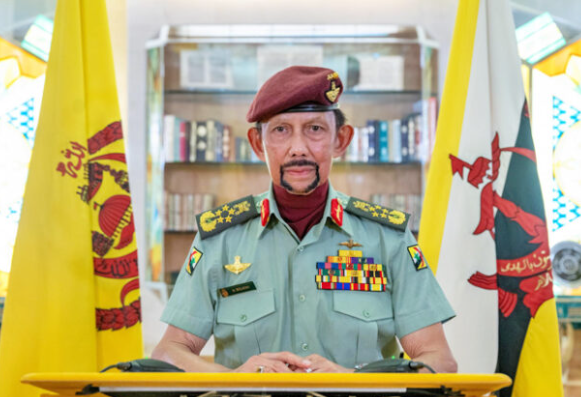
Brunei's Sultan Hassanal Bolkiah has used his address marking the arrival of the Islamic New Year 1448 Hijrah to rally his nation around shared values of unity, perseverance and continuous self-improvement. The monarch's message, delivered from Bandar Seri Begawan, framed the milestone not as a moment to commence fresh endeavours, but rather as an opportunity to reaffirm commitment to ambitious goals already set in motion. This distinction reflects the Sultan's pragmatic approach to national development—viewing annual transitions as occasions for recommitment rather than starting afresh, a philosophy that carries implications for how Brunei manages its long-term strategic objectives across multiple fronts.
Central to the Sultan's vision is the pursuit of advancement in both tangible and intangible domains. The material sphere, as he outlined, encompasses economic performance and infrastructure development—the visible metrics by which nations measure progress and citizens assess quality of life. Equally vital, however, are the spiritual and intellectual dimensions: knowledge acquisition, educational systems and dakwah, the Islamic practice of outreach and community strengthening. By framing these as inseparable components of national progress rather than competing priorities, the Sultan articulated a comprehensive development philosophy that Southeast Asian leaders frequently espouse but struggle to balance in practice. For Malaysia and other Muslim-majority nations in the region, this integrated approach offers a template for discussing how religious and secular governance can complement rather than contradict one another.
The monarch's invocation of gratitude and prayer reveals deeper anxieties beneath Brunei's surface stability. In explicitly acknowledging the world's persistent wars and conflicts, Sultan Hassanal Bolkiah positioned his nation as an island of relative safety—a blessing he attributed not to military might or economic power, but to spiritual devotion and the prayers of its people. This framing resonates powerfully in a region accustomed to religious explanations for geopolitical fortune. By contrast to neighbouring countries grappling with insurgency, terrorism or natural disasters, Brunei's freedom from such calamities is positioned as divine favour requiring continued piety to maintain. This narrative serves multiple functions: it reinforces social cohesion by suggesting shared spiritual vulnerability, justifies the government's paternalistic approach to governance and creates implicit expectations of obedience as the price of continued security.
Yet the Sultan's address reveals tensions lurking within this otherwise harmonious picture. Crime, particularly drug trafficking and theft, emerged as his primary domestic concern—a candid acknowledgment that prosperity and peace alone do not guarantee social order or national reputation. His criticism that such offences "tarnish the nation's image" indicates awareness that Brunei's international standing depends not merely on economic metrics or political stability, but on perceptions of safety and social cohesion. For Malaysia and the broader region, Brunei's articulation of this challenge mirrors concerns voiced by governments across Southeast Asia, where rising drug abuse and property crime threaten to undermine the narrative of successful development and modernisation.
The Sultan's solution to these problems combines institutional coordination with spiritual intervention. By calling on security agencies and religious bodies to work in tandem—with the latter strengthening educational programmes and dakwah to build social awareness—he advocated for an approach that positions religious institutions as partners in law enforcement rather than separate spheres of authority. This model differs markedly from Western security frameworks that maintain strict separation between religious and state institutions. For Malaysian policymakers and those throughout the region navigating similar challenges, the Brunei example demonstrates how religious legitimacy can be leveraged to enhance governmental capacity, provided that religious authorities maintain sufficient moral credibility and institutional independence to influence public behaviour.
The emphasis on religious education and dakwah as tools for crime prevention reveals a particular understanding of causation: that criminal behaviour stems partly from spiritual deficit or insufficient religious consciousness. By investing in religious knowledge and community outreach, the government believes, citizens will internalise moral constraints that deter criminal conduct. This approach implicitly critiques individualistic explanations of crime, suggesting instead that social pathology reflects communal spiritual weakness. While such reasoning can mobilise resources and community participation, it also risks oversimplifying complex causes of criminal behaviour—poverty, addiction, social alienation—that require multifaceted responses beyond religious messaging.
The Sultan's call for collective vigilance carries particular weight in Brunei's governance context. His insistence that protecting the ummah and nation represents a "shared responsibility" suggests that security cannot be delegated entirely to state institutions but requires active participation and constant awareness from ordinary citizens. This mobilisation of public consciousness around security concerns represents a form of what scholars term "responsibilisation"—the transfer of governance tasks to individual citizens and communities. For Malaysian readers, this echoes familiar patterns in this country's own security discourse, where public vigilance campaigns and community watch initiatives are regularly invoked as supplements to formal law enforcement. The underlying assumption is that engaged, spiritually conscious populations prove more resistant to criminal infiltration and exploitation.
The Sultan's closing invocation of divine protection through prayer and remembrance—balanced against his call for vigilance and activism—resolves potential tensions between fatalism and agency. Muslims are not enjoined to passively await Allah's protection, but rather to combine spiritual practice with practical vigilance. This synthesis of religious devotion and governmental responsibility reflects Islamic political theology as practised across Southeast Asia, where political leaders routinely appeal to divine sanction while maintaining active state apparatus. For Brunei specifically, this message reinforces the legitimacy of monarchical rule by suggesting that the Sultan's authority itself flows from divine favour, contingent on his and his subjects' continued piety and effort.
The broader significance of the Sultan's address extends beyond Brunei's borders. As a small, wealthy nation with significant energy resources and considerable geopolitical importance to larger regional powers, Brunei's emphasis on stability and spiritual cohesion reflects strategic positioning in an increasingly competitive region. By publicly stressing unity, religious consciousness and governmental effectiveness, Sultan Hassanal Bolkiah signals to both his population and external observers that Brunei remains committed to the developmental and security frameworks that have underwritten its prosperity. For Malaysian observers particularly, the Brunei model of Islamic governance combined with economic pragmatism offers a contrasting approach to managing plural societies and balancing modernisation with religious identity, inviting comparison and reflection on alternative policy approaches.