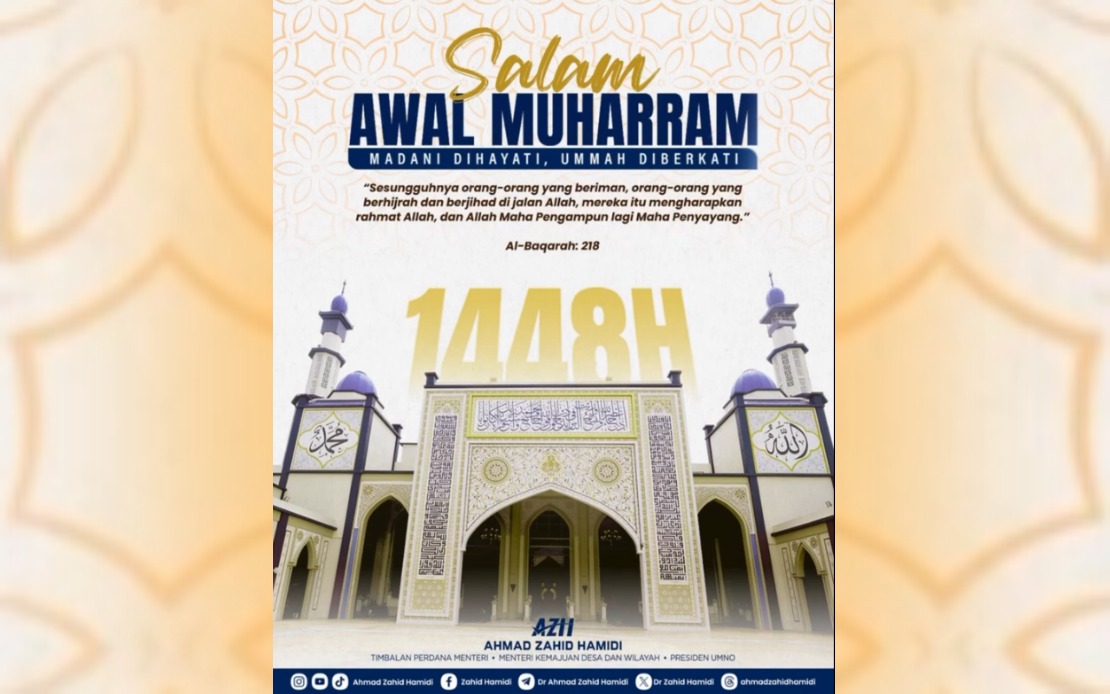
Malaysia's senior government leadership has launched a unified appeal for citizens to embrace the deeper spiritual and philosophical dimensions of Hijrah as the Islamic calendar transitions into 1448H, framing the occasion as far more than a routine date change but rather a pivotal moment for personal and collective transformation. The message, delivered across multiple platforms by Deputy Prime Ministers and numerous cabinet ministers on June 16, reflects an official push to connect religious observance with governance priorities and national resilience during a period of considerable global uncertainty.
Deputy Prime Minister Datuk Seri Dr Ahmad Zahid Hamidi articulated the core administrative philosophy undergirding the appeal, emphasising that meaningful change requires more than rhetoric alone. His statement stressed that substantive transformation demands commitment to discipline, determination and continuous self-improvement. By positioning Hijrah as a framework encompassing sacrifice and perseverance, the Deputy Prime Minister sought to align Islamic principles with expectations of civic responsibility and institutional effectiveness. The message carries particular resonance for a government seeking to demonstrate that its leadership understands the intersection between faith-based values and contemporary governance challenges.
The theme of reform and institutional weakness resonates throughout the messaging, with Datuk Seri Dr Ahmad Zahid Hamidi explicitly calling for courage in addressing systemic deficiencies and embracing necessary reforms. This framing suggests that government officials are attempting to use the religious occasion as a vehicle for legitimising reform agendas that might otherwise attract political resistance. By invoking Hijrah's historical significance as a moment of deliberate migration towards a better future, ministers implicitly position their policy initiatives as aligned with core Islamic values rather than purely technocratic interventions.
Deputy Prime Minister Datuk Seri Fadillah Yusof expanded the conversation toward practical household and community economics, linking Hijrah philosophy to contemporary survival strategies amid global supply chain disruptions and economic uncertainty. His emphasis on prudent consumption, resource conservation and prioritising necessities over luxuries reflects official concern about household vulnerability during inflationary periods. By connecting Islamic teachings about moderation and avoiding waste to specific behaviours like energy conservation and food security, Fadillah positioned the religious obligation as directly addressing the cost-of-living anxieties that have registered prominently in public discourse and opinion polling across Malaysia.
The integration of economic messaging within religious framing reveals sophisticated communications strategy, as the government seeks to establish moral legitimacy for austerity-adjacent policies that might otherwise face public pushback. When framed as Islamic principle rather than economic necessity, restraint becomes a virtue to be cultivated rather than a constraint imposed by external circumstances. This rhetorical move holds particular significance for lower-income Malaysian households navigating tighter budgets, as it attempts to reframe sacrifice as spiritual advancement rather than material deprivation.
Unity messaging constituted a consistent theme across ministerial statements, with multiple officials emphasising that national strength depends upon transcending differences and maintaining social cohesion. For a multicultural democracy managing significant political and social divisions, this emphasis on unity carries strategic importance. By linking national unity to Islamic principles during a period when communal tensions have occasionally surfaced in public discourse, officials attempted to position interfaith and intercommunal harmony as religiously mandated rather than politically convenient. Datuk Seri Fadillah Yusof specifically cautioned against allowing differences to fracture society, implicitly acknowledging that divisive pressures exist and require conscious mitigation.
Communications Minister Datuk Fahmi Fadzil's contribution centred on introspection and renewed determination, emphasising Hijrah's connection to personal courage and authentic commitment. His framing of the occasion as an opportunity for faith renewal and reflective reassessment complements the broader administrative narrative while adding an individual spiritual dimension to collectively-oriented messaging. This balance between personal transformation and national resilience reflects recognition that meaningful social change requires both individual commitment and institutional action.
Minister Zulkifli Hasan in the Prime Minister's Department (Religious Affairs) provided guidance on specific spiritual practices, including prayers at defined moments during the transitional period between Islamic years. His detailed instructions regarding end-of-year and beginning-of-year prayers, particularly the recommendation to perform them with family members, reinforces the integration of household worship practices with the broader national messaging campaign. This personalisation of religious observance within family contexts reflects understanding that sustained behavioural change operates most effectively through intimate social units rather than purely top-down directives.
The breadth of ministerial participation, encompassing Agriculture, Science and Technology, Women and Family Development, Law, Education, Health and other portfolios, demonstrates intentional cross-government coordination in communicating the Hijrah message. This comprehensive ministerial engagement suggests that officials recognise religious occasions as opportune moments for projecting unified leadership messaging and establishing coherence across disparate policy domains. Each minister's participation lends credibility to the campaign while signalling that Hijrah principles transcend narrow religious boundaries and intersect with secular governance concerns.
For Malaysia's diverse population and significant non-Muslim communities, the government's emphasis on Hijrah's universal principles of reform, perseverance and community resilience attempts to frame Islamic religious observance in inclusive language accessible across faith boundaries. By highlighting values like integrity, hard work and mutual respect rather than exclusively theological content, officials endeavour to position Maal Hijrah observance as having national rather than narrowly sectarian significance. This rhetorical strategy acknowledges Malaysia's plural society while maintaining the occasion's authentic Islamic moorings.
The timing of this coordinated messaging during a period of global economic stress and domestic cost-of-living pressures suggests strategic calculation regarding when citizens are most receptive to messages about sacrifice, resilience and collective responsibility. By anchoring such messaging within religious obligation and spiritual aspiration rather than pure economic necessity, the government attempts to shift the narrative frame from deprivation to purpose. Whether such messaging successfully translates into sustained behavioural change or merely represents ceremonial political communication remains an open question that will become clearer through subsequent policy implementation and public reception.


