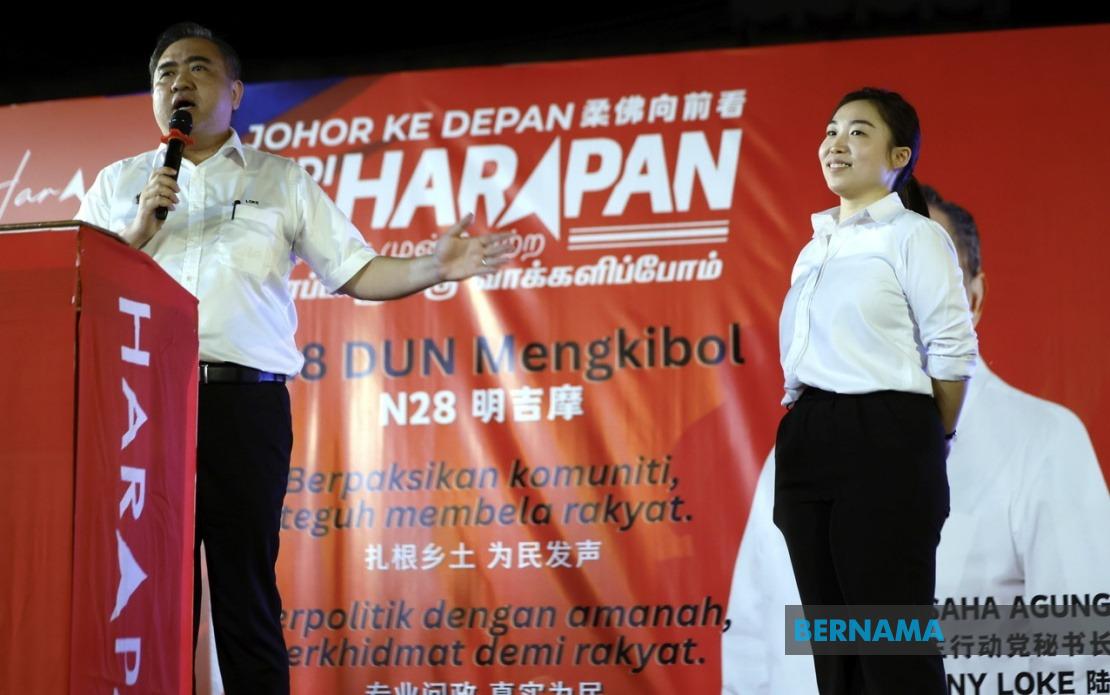
The Democratic Action Party moved to strengthen its representation in Johor with the announcement of 33-year-old lawyer Chu Poh Yee as its first candidate for the upcoming state election, positioning her to contest the Mengkibol seat in what marks a significant generational shift for the constituency. The decision reflects the party's broader strategy to bring new talent into the electoral arena while maintaining strongholds in key urban and semi-urban areas across the state.
Party secretary-general Anthony Loke unveiled the nomination at a ceremony in Kluang on June 18, signalling that two-term incumbent Chew Chong Sin would step aside to pursue opportunities at the federal level. This transition demonstrates how DAP manages succession planning within its ranks, balancing the retention of experienced legislators with the advancement of promising newcomers. Chew's departure from the state assembly follows a strategic decision by party leadership to redirect his talents toward parliamentary politics.
Loke explained that Chew is being positioned as DAP's parliamentary candidate for the Labis seat in the next General Election, a move made possible after the current Member of Parliament Pang Hok Liong decided against contesting for another term. This succession arrangement illustrates how opposition parties in Malaysia often coordinate candidate placement across different electoral levels, ensuring that experienced representatives move upward rather than being displaced entirely. For Chew, who has completed two full terms representing Mengkibol at the state level, the shift to parliament represents a natural career progression within the party hierarchy.
Chu Poh Yee's candidacy reflects DAP's commitment to increasing female representation in electoral politics, a principle the party has repeatedly emphasised in recent years. The 33-year-old lawyer brings credentials beyond mere age and gender diversity, however. Her professional background in legal aid assistance has given her direct exposure to constituent concerns, particularly the complex legal issues that affect working-class and lower-income residents. This practical experience in handling legal aid cases positions her as someone who understands the bread-and-butter concerns of Mengkibol voters.
Loke highlighted Chu's multilingual abilities and strong educational qualifications as additional strengths, noting that she possesses deep roots within the Mengkibol constituency itself. Her familiarity with the area gives her a foundation that many newly-minted candidates lack, reducing the learning curve that typically confronts newcomers unfamiliar with local dynamics, community leaders, and pressing neighbourhood issues. The combination of professional expertise, language skills, and local knowledge addresses common vulnerabilities of fresh political entrants.
The nomination process underscores how DAP's selection machinery operates within the larger Pakatan Harapan alliance. Party leadership moved swiftly to identify replacement candidates, with Loke confirming that the party had completed its full slate of nominations across all 17 state seats it intends to contest in Johor. This decisive action reflects DAP's role as one of the more organised and administratively coherent components of the opposition coalition, capable of fielding candidates across multiple constituencies without the protracted internal wrangling that sometimes paralyses less disciplined parties.
The broader candidate announcement strategy reveals carefully-orchestrated coordination across the Pakatan Harapan alliance structure. DAP planned to reveal four additional candidates for Tiram, Johor Jaya, Senai, and Bukit Permai on the following Saturday, while reserving the remaining nominee unveilings for a consolidated announcement alongside other coalition partners. This staged approach allows each component party to claim attention for its own endorsements while maintaining the impression of unified alliance planning. The Prime Minister's participation in the final candidate announcement ceremony signals that the Pakatan Harapan coalition treats the Johor state election as a significant test of its electoral machinery.
For Malaysian political observers, the election assumes particular importance given Johor's economic weight, demographic diversity, and historical significance as a Barisan Nasional stronghold. The state has traditionally been more conservative than Selangor or Penang, making DAP's ambitions to retain and expand its footprint there strategically meaningful. Chu's candidacy in Mengkibol represents one component of DAP's effort to consolidate middle-class urban support while simultaneously broadening its appeal among professional and semi-professional constituencies.
The nomination of Chu Poh Yee also reflects broader regional trends within Southeast Asian opposition politics, where centre-left and left-leaning parties increasingly prioritise female candidacy as both a matter of principle and electoral strategy. The gender dimension carries particular weight in Malaysian politics, where women's participation in electoral politics remains markedly lower than in several neighbouring democracies. By placing Chu in a winnable constituency, DAP signals commitment to translating its stated principles regarding gender representation into concrete electoral outcomes rather than token gestures.
The timing of the announcement, occurring during the traditional pre-election period when parties activate grassroots machinery, reflected DAP's confidence in its organisational readiness for the forthcoming campaign. The party's ability to move decisively through its candidate selection process, while coordinating with larger alliance partners, demonstrates the institutional maturity it has developed across nearly two decades of electoral competition in Malaysia. For Chu Poh Yee specifically, the nomination represents validation of her professional achievements and party service, though it also exposes her to intense scrutiny from political opponents during the campaign season ahead.