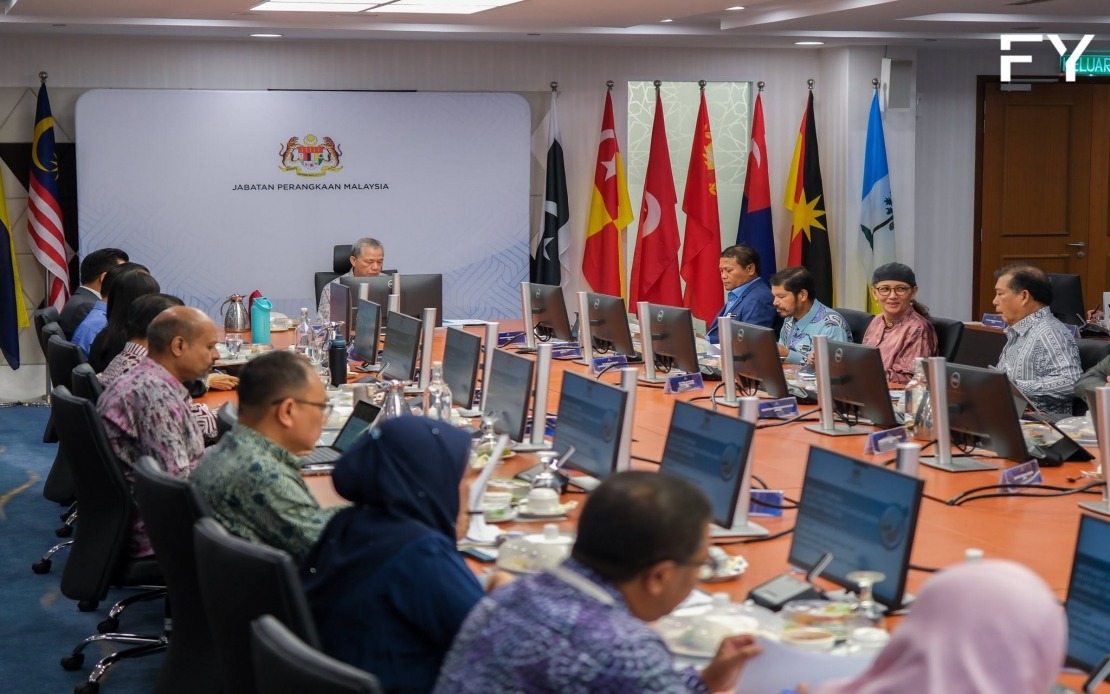
Deputy Prime Minister Datuk Seri Fadillah Yusof has identified data analytics and artificial intelligence as foundational elements that will determine whether Malaysia achieves its objectives under the 13th Malaysia Plan spanning 2026 to 2030. Speaking after chairing the National Statistics and Data Council, Fadillah outlined a comprehensive vision for transforming how government agencies formulate policy and monitor outcomes, placing statistical rigour at the centre of decision-making across all levels of administration.
Fadillah's remarks reflect a broader recognition within government that Malaysia must adapt its governance apparatus to address contemporary challenges that demand real-time insights and sophisticated analysis. The Deputy Prime Minister highlighted how global pressures—ranging from economic volatility and geopolitical tensions to climate disruption and the accelerating pace of technological change—require policymakers to move beyond intuition-based decisions toward evidence-centred approaches grounded in authoritative data. This shift carries particular significance for a middle-income nation navigating the competing demands of sustaining growth while managing structural economic transformation.
The government has repositioned official statistics as strategic national assets rather than administrative afterthoughts. Under this reconceptualisation, the integrity, timeliness and quality of data directly influences the efficacy of public service delivery while contributing to national resilience—a concept increasingly understood as the capacity to absorb shocks and maintain trajectory toward development goals. The 13th Malaysia Plan's success will hinge partly on whether planners have access to granular, current information that illuminates sectoral performance, emerging bottlenecks and unintended consequences of earlier policy interventions.
Fadillah pointed to encouraging economic signals as validation of the data-driven methodology already in motion. Malaysia's gross domestic product expanded at 5.4 per cent during the first quarter of 2026, a performance that officials attribute partly to development strategies designed on the foundation of solid statistical evidence. This linkage between analytics and outcomes provides a practical case study for other Southeast Asian governments similarly grappling with how to harness information technology to improve policy quality.
Meanwhile, the Strengthening of the National Statistical System initiative requires a substantial recalibration of institutional relationships. Rather than operating as isolated silos, ministries, federal agencies, state administrations, commercial enterprises, universities and research organisations must establish mechanisms for seamless data exchange while maintaining security and ethical standards. The integration challenge is not merely technical but political and cultural, requiring participants to relinquish proprietary control over information assets in service of collective understanding. For Malaysia's diverse governance landscape, such coordination represents a significant undertaking that will test inter-agency commitment to shared objectives.
The digital era presents both opportunity and complexity. Fadillah emphasised that consolidating information streams from disparate sources—municipal records, commercial transactions, utility consumption patterns, health encounters—can furnish government with panoramic views of problems previously visible only through fragmented lenses. However, realising this potential demands sophistication in data architecture, cybersecurity protocols and ethical frameworks that protect citizen privacy while enabling analytical work. The Malaysian context, with its federal structure and multi-ethnic composition, adds layers of complexity to data standardisation efforts.
Enhancing big data analytics and deploying artificial intelligence technologies figure prominently in Fadillah's strategic roadmap. These computational tools can identify correlations, forecast trends and simulate policy scenarios far beyond human capacity, accelerating the transition from diagnosis to response. However, the technology is only as powerful as the quality of input data and the wisdom applied in interpreting algorithmic outputs. Fadillah's emphasis on capability development across the statistical system acknowledges that hardware and software alone cannot deliver the promised dividends without corresponding investment in human expertise.
Sector-specific applications merit particular attention given Malaysia's structural priorities. Energy transition, climate action, water infrastructure modernisation and sustainable development initiatives all require comprehensive data ecosystems tailored to their unique information demands. The Deputy Prime Minister's naming of these domains signals government recognition that cross-cutting national challenges cannot be addressed through generic statistical frameworks but instead need bespoke analytical architectures. This recognition has implications for resource allocation and technical specialisation within the statistical service.
The meeting also reviewed initiatives spanning official statistical standards harmonisation, data governance strengthening, administrative data integration, talent database development in science and technology fields, youth development analytics and national road asset management systems. This breadth of focus underscores an expansive interpretation of the statistical system's remit—one that extends well beyond traditional census and survey operations into operationalised data infrastructure supporting real-time management of critical national assets and human capital. Each component contributes to the overarching objective of constructing an integrated, high-integrity ecosystem oriented toward measurable development outcomes.
For Malaysian policymakers and administrators, Fadillah's pronouncements carry immediate implications. Budgets will need to reflect elevated investment in statistical capacity, data infrastructure and AI capability development. Career pathways in the statistical service require recalibration to attract talent capable of navigating complex technical and analytical landscapes. Inter-ministerial coordination mechanisms must graduate from informal consultation toward institutionalised structures ensuring systematic data sharing. The question facing implementation is whether Malaysia's bureaucratic systems can adapt with sufficient velocity to realise the vision articulated at the strategic apex of government.