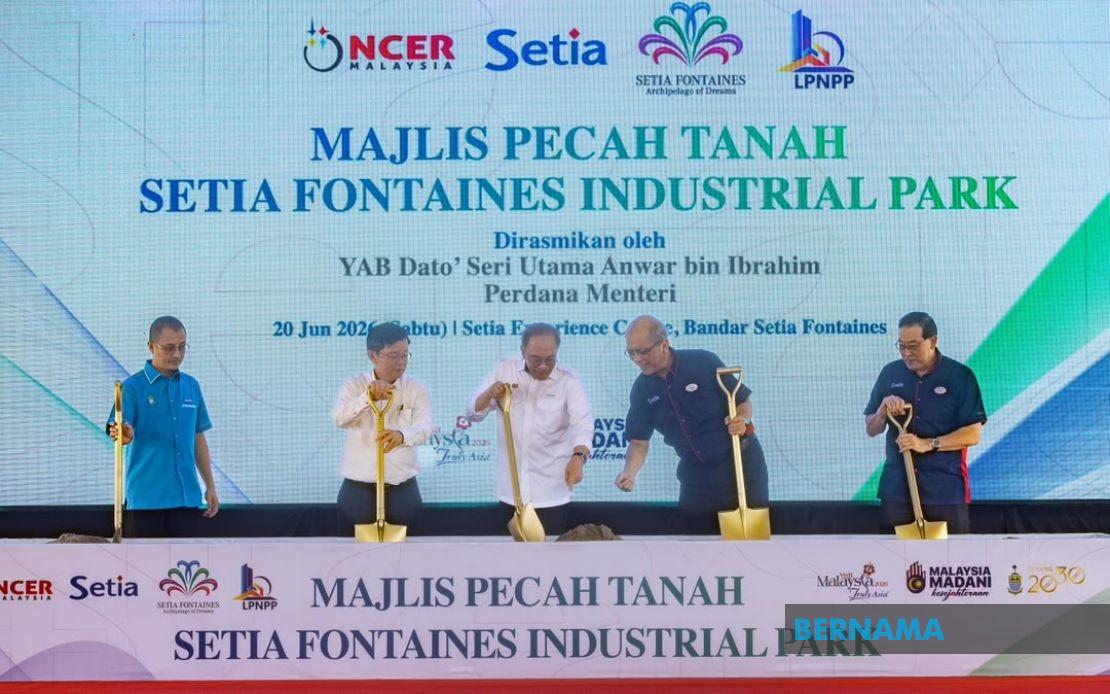
Prime Minister Datuk Seri Anwar Ibrahim has called on government-linked companies and private enterprises to make deliberate provisions for middle and lower-income Malaysians when planning major development projects, arguing that inclusive growth is essential to maintaining social cohesion. Speaking at the groundbreaking ceremony for the Setia Fontaines Industrial Park in Bandar Setia Fontaines today, Anwar emphasized that rapid economic expansion and fresh investment must be measured not merely by encouraging headlines but by tangible improvements in living standards across all socioeconomic strata.
The Prime Minister's remarks underscore growing concerns within government circles about the widening gap between different income segments despite Malaysia's continued economic development. When approving ventures by major institutional investors such as Khazanah Nasional Berhad, Permodalan Nasional Berhad, the Employees Provident Fund, or private developers, authorities must embed mechanisms that allow ordinary Malaysians to participate in and benefit from these opportunities. Without such safeguards, Anwar cautioned, the country risks entrenching inequality while simultaneously restricting pathways for lower-income households to improve their circumstances.
This positioning represents a significant policy emphasis for the current administration, which has made inclusive development a cornerstone of its economic messaging. The concern reflects broader regional trends where economic growth has not uniformly lifted all segments of the population. By framing equity as a precondition for approval rather than an afterthought, Anwar is signalling that private and state-owned investors must integrate poverty alleviation and middle-class development into their project design from inception. This approach shifts responsibility from government alone to the entire ecosystem of capital allocators.
The Setia Fontaines Industrial Park exemplifies the type of venture the government believes can address regional economic imbalances. Located in Seberang Perai, the facility is designed to accelerate industrial activity on the mainland while the island and southern portions of Penang have historically concentrated development. By dispersing investment geographically, authorities aim to create employment and economic dynamism in areas that have lagged, thereby naturally extending prosperity to residents previously distant from high-growth zones. The industrial park thus serves both economic and social redistribution objectives simultaneously.
Anwar outlined a critical skill-building imperative as Malaysia transitions away from basic manufacturing towards sophisticated technology sectors. The nation's competitive advantage rests not merely on attracting foreign investment or deploying capital, but on ensuring the workforce possesses competencies aligned with emerging industry demands. This recognition prompted the Prime Minister to stress enhanced collaboration between private industry, vocational and technical training providers, and universities including Universiti Sains Malaysia. Without coordinated effort across these sectors, infrastructure investment risks remaining underutilized if suitable talent cannot be readily mobilised.
The technological dimension of his remarks highlights an often-overlooked challenge for middle and lower-income workers in developing economies. As sectors modernise rapidly, skills become obsolete within short timeframes, potentially rendering previously stable employment unviable. Anwar's insistence that training curricula remain synchronized with actual industry evolution addresses this vulnerability. Workers requiring continuous upskilling cannot afford prolonged periods of unemployment or underemployment while retraining; institutions must anticipate sectoral shifts and prepare populations proactively rather than reactively.
For Malaysia's lower-income households, the implications are substantial. Industrial parks generating professional-grade employment represent genuine pathways toward middle-class status, provided workers have accessible routes to acquire necessary qualifications. The Setia Fontaines project thus embodies potential for intergenerational mobility if implementation aligns with stated principles. Young Malaysians in less-developed regions would gain exposure to high-value industries previously concentrated in established economic centres, potentially reversing migration trends that have drained talent and demographics from peripheral areas.
Anwar's emphasis on deliberate inclusivity mechanisms also reflects implicit criticism of development patterns that enriched connected elites while marginalizing ordinary citizens. By publicly insisting that every government approval incorporate provisions for lower-income participation, he creates accountability frameworks and normalizes equity considerations within boardrooms and investment committees. This rhetorical positioning legitimizes demands from civil society and affected communities for demonstrable benefit-sharing rather than merely hoping trickle-down effects materialise.
The practical implementation of such principles remains challenging. How companies operationalize "opportunities for lower-income groups" varies widely—from employment quotas and training subsidies to procurement preferences for small businesses and community shareholding structures. The Prime Minister's remarks do not specify mechanisms, leaving considerable discretion to implementing entities. This ambiguity creates both flexibility and risk; without clearer guidelines, companies may claim compliance through minimal gestures while structural inequality persists.
Regionally, Malaysia's approach to inclusive development carries relevance for Southeast Asian peers navigating similar tensions between growth and equity. Countries like Indonesia, the Philippines, and Vietnam grapple with comparable challenges of ensuring rapid industrialisation benefits broad populations rather than concentrated elites. Anwar's framing—that investors have obligations to serve diverse income groups—challenges the conventional development model often imposed by international financial institutions emphasising efficiency and growth above distributive concerns.
The Seberang Perai context specifically matters given historical disparities between the island and mainland components of Penang state. Economic concentration has traditionally favoured the island's developed infrastructure and agglomeration economies. Deliberately channelling substantial projects to the mainland represents intentional geographic redistribution, addressing not merely income inequality but spatial disparities. Workers in Seberang Perai gain access to premium employment without necessitating costly migration, preserving social fabric and community stability.
Looking forward, the success of initiatives like Setia Fontaines will significantly influence whether Anwar's inclusivity rhetoric translates into measurable improvements in lower-income household welfare. Close monitoring of employment outcomes, wages offered, skill acquisition rates, and whether recruitment genuinely prioritises local residents or imports talent from elsewhere will determine whether this project model proves replicable. The industrial park thus represents both symbolic commitment to equitable development and practical test of whether Malaysia can reconcile growth imperatives with distributive justice.
%22%2F%3E%3C%2Fpattern%3E%3C%2Fdefs%3E%3Crect%20width%3D%22100%25%22%20height%3D%22100%25%22%20fill%3D%22url(%23ph2vha0g)%22%2F%3E%3Crect%20width%3D%22100%25%22%20height%3D%22100%25%22%20fill%3D%22url(%23ph2vha0p)%22%2F%3E%3Ctext%20x%3D%2250%25%22%20y%3D%2250%25%22%20text-anchor%3D%22middle%22%20dominant-baseline%3D%22central%22%20fill%3D%22rgba(255%2C255%2C255%2C0.95)%22%20font-family%3D%22Georgia%2C%20'Times%20New%20Roman'%2C%20serif%22%20font-weight%3D%22700%22%20font-size%3D%22320%22%20letter-spacing%3D%22-0.02em%22%3EPM%3C%2Ftext%3E%3C%2Fsvg%3E)