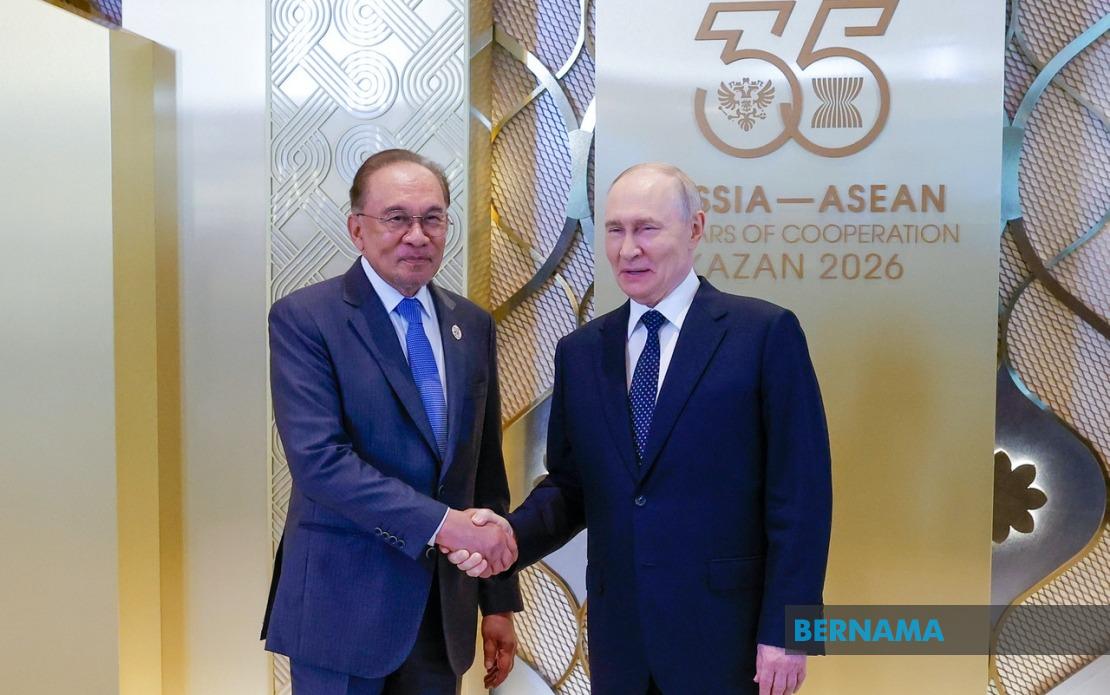
Prime Minister Datuk Seri Anwar Ibrahim has stressed that structured dialogue between nations serves as an essential counterbalance to the mounting complexities and uncertainties characterizing contemporary international relations. Speaking after a state gala dinner hosted by President Vladimir Putin at the ASEAN-Russia Commemorative Summit in Kazan on June 18, Anwar articulated a vision of diplomacy centred on building institutional frameworks that enable sustained engagement among participating states.
The summit, held in Tatarstan's capital city from June 17 to 18, represents one of several high-level forums designed to bridge geographical and strategic distances between Southeast Asia's major bloc and Moscow. For Malaysia, participation in such gatherings carries particular weight given its simultaneous commitments to maintaining balanced relationships with major powers whilst navigating regional dynamics. Anwar's presence as both Premier and Finance Minister underscores the multifaceted nature of ASEAN-Russia engagement, extending beyond security and political considerations to encompass economic partnerships and financial cooperation.
According to the Prime Minister, these diplomatic platforms transcend ceremonial functions by serving as genuine venues for trust-building amongst leaders. The gala dinner format, whilst traditionally associated with protocol and courtesy, provided what Anwar characterized as substantive opportunities for bilateral and multilateral discussions. This approach reflects an evolving understanding within Malaysian foreign policy circles that personal relationships and informal dialogue often prove as consequential as formal negotiation sessions in securing mutual understanding.
Anwar highlighted that such summits facilitate the identification of shared interests and complementary objectives between ASEAN member states and Russia. The emphasis on exploring cooperation areas that yield mutual benefits suggests recognition that sustainable international partnerships cannot be zero-sum arrangements but must create value for all participating parties. For a region like Southeast Asia, which has historically sought to maintain equidistance from major power rivalries, this framework proves particularly valuable.
The Prime Minister noted that the summit effectively showcased Russia's cultural, historical, and heritage dimensions to the ASEAN delegations present. This cultural diplomacy component serves an often-underestimated function in international relations—humanizing distant powers and creating softer foundations upon which more formal agreements can be constructed. By presenting Russia beyond its geopolitical dimensions, the event aimed to cultivate appreciation for Russian civilisation amongst Southeast Asian leaders whose populations and governments might otherwise relate to Moscow primarily through strategic or security lenses.
The significance of the ASEAN-Russia Commemorative Summit extends beyond the immediate bilateral exchanges between individual nations and their Russian counterparts. It reinforces ASEAN's long-standing commitment to maintaining dialogue with all major powers, a principle enshrined in the organisation's founding charter and consistently reaffirmed through various initiatives. Malaysia's active participation demonstrates its investment in preserving these diplomatic channels despite shifting geopolitical pressures and calls from certain quarters to align more definitively with specific strategic camps.
From a Malaysian perspective, strengthening ASEAN-Russia engagement carries implications for regional stability and economic prosperity. Russia, despite Western sanctions and international isolation on certain issues, remains a significant energy producer and potential market for Southeast Asian goods and services. Additionally, Moscow maintains considerable influence in geopolitical matters affecting the region, from Southeast Asia's northern borders to maritime security concerns in the South China Sea. Maintaining constructive dialogue with Russia ensures that ASEAN's interests receive appropriate consideration in any discussions of regional governance or security arrangements.
The emphasis on mutual understanding through engagement platforms reflects lessons drawn from earlier periods when reduced diplomatic contact between nations inadvertently increased misunderstandings and heightened tensions. Contemporary challenges—ranging from climate change and pandemic preparedness to counterterrorism and cybersecurity—demand collaborative approaches that transcend historical animosities or ideological divisions. The ASEAN-Russia summit provides institutional mechanisms through which complex technical and political issues can be addressed through established diplomatic channels rather than through confrontational posturing.
Anwar's characterisation of these engagement opportunities as increasingly important amid global uncertainties merits deeper analysis. The international system currently faces multiple pressures: great power competition, economic fragmentation, technological disruption, and climate-related displacement. Within this volatile environment, forums that bring diverse actors together to reaffirm commitments to dialogue become essential stabilising instruments. For ASEAN nations, which depend on predictable international rules and open trade flows, maintaining these relationships serves tangible national interests beyond diplomatic courtesy.
The summit also underscores how Malaysia, as a trusted bridge-builder within ASEAN and a nation with extensive international networks, plays a constructive role in broader regional diplomacy. Anwar's attendance and his articulation of engagement principles contribute to Malaysia's positioning as a voice advocating for measured, inclusive approaches to managing international relations. This positioning carries domestic resonance as well, demonstrating to Malaysian constituencies the value of diplomatic sophistication in addressing national security and economic interests.
Looking forward, the outcomes and relationships forged at Kazan may influence how ASEAN collectively approaches engagement with Russia on specific issues ranging from energy cooperation to security coordination in shared maritime spaces. The personal connections established during such summits frequently translate into more efficient and productive governmental collaboration at technical levels. Cultural exchanges and educational partnerships often flow from high-level diplomatic meetings, further deepening ties between nations and their peoples.