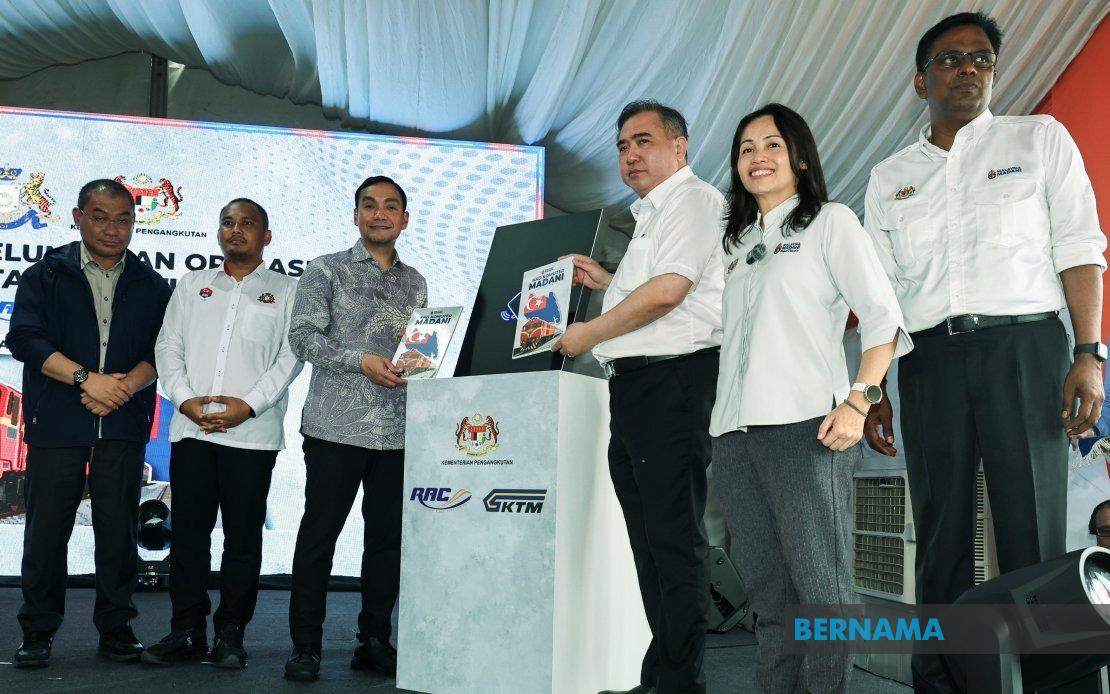
Johor Bahru faces a critical moment in its infrastructure planning as the region prepares for the Johor Bahru-Singapore Rapid Transit System Link to commence operations next year. At the launch of the Southern Shuttle train service at KTM Kulai Station on June 16, Menteri Besar Datuk Seri Onn Hafiz Ghazi underscored that the Elevated Autonomous Rapid Transit (E-ART) project represents an indispensable component of the state's broader transport strategy, positioning it as a fundamental safeguard against anticipated gridlock.
The challenge confronting Johor Bahru stems from its geographic and demographic reality. With approximately 1.8 million residents—a population comparable to Penang—the state capital functions as Malaysia's primary international gateway and a crucial conduit for cross-border commerce and travel. The RTS Link, designed to streamline connectivity between Johor Bahru and Singapore, promises substantial benefits for regional mobility and economic integration. Yet this advancement carries a consequential risk: the influx of commuters and passengers using the rapid transit connection will inevitably channel enormous volumes of people through Johor Bahru's existing transport networks, potentially creating chokepoints throughout the urban landscape.
Onn Hafiz articulated a pragmatic three-tier approach to managing this transition. The government has already activated short-term interventions, including expanded Park & Ride facilities and intelligent traffic management systems deployed at JB Sentral. These measures, while valuable in their immediate application, function as temporary palliatives rather than permanent solutions. The Menteri Besar candidly acknowledged that such initiatives can only provide limited relief, functioning as stopgaps while the state awaits the deployment of more comprehensive infrastructure.
Medium-term strategies similarly offer incremental benefit without addressing the fundamental capacity challenge. As passenger volumes multiply with the RTS Link's operational launch, the pressure on roads and existing transit corridors will intensify markedly. Current infrastructure, designed for pre-RTS traffic patterns, cannot absorb such expanded demand without significant augmentation. This reality frames the entire strategic conversation around transport planning in Johor Bahru, forcing policymakers to look beyond conventional road expansion toward innovative solutions.
The E-ART project emerges from this analysis as the genuine long-term answer. Unlike conventional road-based solutions, which consume urban land and offer limited capacity expansion, an elevated autonomous system promises high throughput, weather-protected operations, and the ability to move substantial populations across congested urban zones. The system's autonomous operation reduces labour costs and increases efficiency, while its elevated configuration preserves ground-level space for other urban uses. For a metropolis grappling with the dual pressures of rapid population growth and intensifying cross-border mobility, such innovation addresses structural limitations inherent in traditional transport models.
The timing of this infrastructure debate carries particular significance for Southeast Asia's broader development trajectory. As regional economies deepen integration through improved connectivity—exemplified by the RTS Link itself—port cities and border hubs face mounting pressure to accommodate surging passenger and freight flows. Johor Bahru's experience therefore offers a template for other regional cities confronting similar challenges. The question of how to manage congestion whilst facilitating the economic benefits of enhanced cross-border connectivity represents a recurrent challenge across the region.
Onn Hafiz's emphasis on expediting the E-ART project reflects recognition that delays carry tangible costs. Every month of postponement represents foregone opportunity to deploy infrastructure that could ease subsequent congestion. Moreover, the political dimension merits consideration: transport infrastructure projects that demonstrably improve daily mobility generate substantial public appreciation and political capital. The Menteri Besar framed E-ART as a form of Federal intervention that voters could directly perceive and value, suggesting awareness that infrastructure delivery remains central to public legitimacy.
Transport Minister Anthony Loke and Deputy Communications Minister Teo Nie Ching, present at the Southern Shuttle launch, represent the Federal government's involvement in Johor's transport ecosystem. This ministerial presence signals commitment to coordinating multi-level government action, though the pace of implementation will ultimately determine whether aspirations translate into functional infrastructure. The Federal government's role in facilitating project funding, approvals, and coordination remains critical to accelerating E-ART's deployment timeline.
The Johor Bahru transport scenario illustrates a broader pattern in Malaysian urban development: infrastructure planning often lags behind demographic and economic realities. The state capital's 1.8 million residents create demands that conventional planning frameworks, often calibrated to slower-growth assumptions, struggle to accommodate. The RTS Link represents an exogenous shock—a transformative connectivity improvement that mandates corresponding adaptation of absorptive infrastructure. Without the E-ART or comparable high-capacity transit systems, Johor Bahru risks becoming a victim of its own success, with enhanced regional connectivity creating internal bottlenecks that frustrate users and undermine economic benefits.
Looking forward, the success of Johor Bahru's transport modernisation depends fundamentally on whether the E-ART project advances from policy pronouncement to concrete implementation. Current short- and medium-term measures buy time, but cannot substitute for the strategic infrastructure investment that a city of Johor Bahru's scale and role demands. The state has articulated the challenge clearly; execution now becomes the test of whether infrastructure planning can match the region's evident economic dynamism.