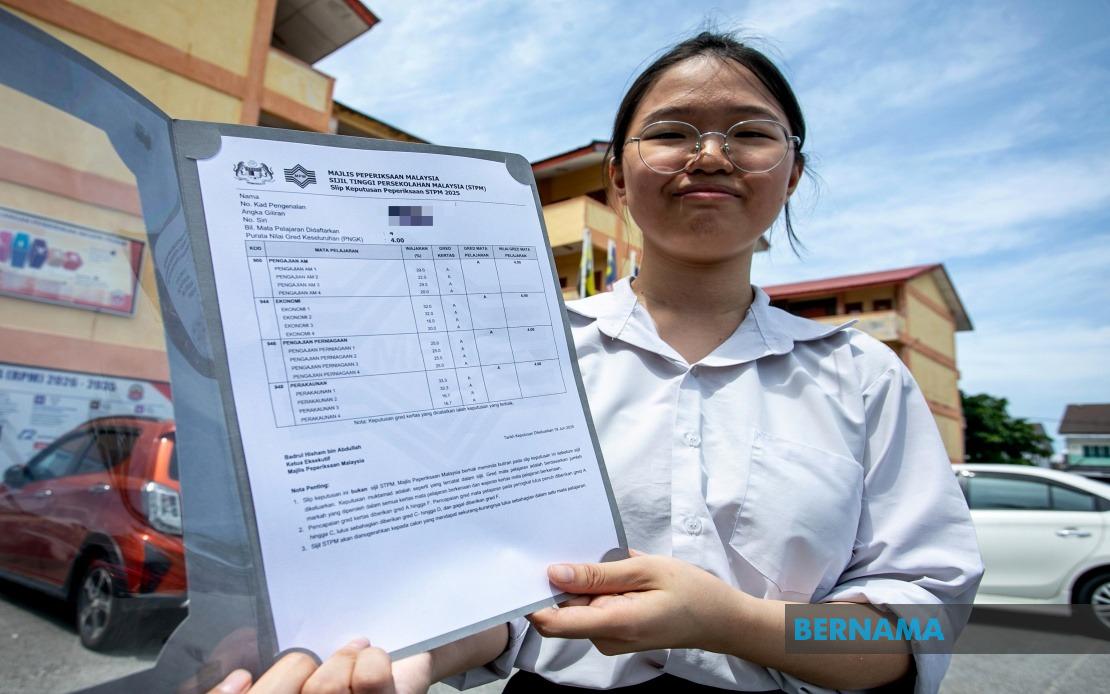
Yong Xin Yi, a 20-year-old student from SMK Jalan Tasek in Ipoh, has joined the ranks of high achievers by securing four A grades in the 2025 Sijil Tinggi Persekolahan Malaysia (STPM) examination. Her academic triumph underscores a fundamental truth about examination success in Malaysia's secondary education system: structured discipline and consistent effort often trump raw talent alone. The accomplishment is particularly noteworthy as she was among only five students from her school to achieve this stellar result, highlighting the competitive nature of Malaysia's most demanding pre-university qualification.
Xin Yi's pathway to success rested on a carefully orchestrated study schedule that carved out five dedicated hours each evening for revision work. Beginning at 5:00 pm and extending to 10:00 pm after regular school hours, this substantial time commitment represented a significant portion of her daily routine. What distinguishes her approach, however, was not merely the quantity of hours invested but the intentionality behind them. She paired these evening study sessions with absolute concentration during classroom instruction, recognising that thorough understanding during lessons directly reduced the cognitive burden during independent revision. This dual-focus strategy—maximising classroom learning while buttressing it with systematic home study—reflects a sophisticated understanding of how knowledge consolidation actually works in adolescent learners.
The student was equally meticulous about completing all assigned homework, viewing these tasks not as obligations to discharge but as essential mechanisms for mastering course content. Her philosophy that homework completion fostered deeper subject mastery reveals a maturity in academic approach that extends beyond simply passing examinations. Many students treat homework as a perfunctory exercise, yet Xin Yi grasped that these structured assignments serve pedagogical purposes beyond their surface requirements. By treating them as integral learning tools, she maximised the educational value embedded within her school's curriculum design.
Xin Yi earned A grades across General Studies, Principles of Accounting, and Economics, achieving a perfect 4.00 Cumulative Grade Point Average. Her performance across three distinct subject domains—spanning humanities, vocational business skills, and social sciences—demonstrates intellectual versatility. This breadth of excellence is particularly significant in the Malaysian education context, where students must juggle disparate disciplinary frameworks within a single examination cycle. The ability to excel simultaneously in subjects requiring different cognitive approaches—analytical reasoning for accounting, critical essay writing for general studies, and conceptual thinking for economics—suggests she developed sophisticated metacognitive strategies applicable across domains.
When reflecting on her challenges, Xin Yi identified General Studies as her most demanding subject. This frank acknowledgment of struggle reveals important psychological dimensions of academic success often overlooked in media celebrations of achievement. Rather than possessing innate superiority in all areas, she confronted genuine difficulty in a subject requiring strong writing mechanics, understanding of abstract format requirements, and familiarity with marking rubrics. Crucially, rather than avoiding or minimising this weakness, she deliberately allocated additional attention to General Studies, implementing targeted remediation strategies. This proactive confrontation of academic deficiency—acknowledging struggle and responding with intensified focus—models the resilience essential for sustained educational progress.
As the sole child in her family, Xin Yi benefited from undivided parental attention and support, though her parents' occupational backgrounds—her mother works as a clerk while her father sells mobile phones—situate her within Malaysia's working middle class. Significantly, she articulates her achievement not as personal triumph but as collaborative family endeavour, explicitly crediting her parents' encouragement throughout her studies. This framing reflects culturally grounded values emphasising familial interdependence rather than individualistic self-realisation. Her aspiration to improve her family's circumstances through educational advancement—a desire to transform her parents' financial security through her own career success—represents an economic mobility narrative deeply meaningful within Malaysian society.
Xin Yi's choice to pursue economics at Universiti Putra Malaysia emerged from deliberate self-assessment of both personal interests and career market dynamics. She conducted what amounts to a personal SWOT analysis, evaluating how her capabilities aligned with sector prospects. Her identification of economics as a field offering broad future potential suggests awareness of labour market realities and sectoral growth trajectories. In an era of rapid technological change and economic restructuring across Southeast Asia, this forward-thinking orientation towards career viability—balancing passion with pragmatism—positions her well for professional success beyond university.
The discipline Xin Yi demonstrated throughout her STPM studies offers instructive lessons for Malaysian secondary students navigating examination pressures. Her integration of classroom focus, systematic homework completion, and extended evening revision created a comprehensive learning ecosystem rather than relying on any single study mechanism. The five-hour nightly commitment, while substantial, remains achievable for disciplined students and suggests that STPM success need not require superhuman effort but rather consistent, purposeful application. Her approach avoided common pitfalls such as cramming, last-minute desperation studying, or neglecting classroom learning in favour of external tuition.
For Malaysian parents and educators, Xin Yi's success story carries implications about supporting student achievement. Her parents provided encouragement rather than pressure, trusted their daughter's agency while remaining emotionally invested, and created a home environment conducive to sustained study. Teachers at SMK Jalan Tasek similarly enabled success through rigorous classroom instruction that reduced subsequent confusion, clear homework assignments that reinforced learning, and transparent communication about subject requirements and assessment criteria. The institutional environment within which Xin Yi studied—a school where five students achieved perfect STPM grades—suggests effective systemic support structures within her institution.
Broader questions emerge from examining Xin Yi's achievement within Malaysian educational discourse. Her excellence in an examination system increasingly critiqued for narrowness and examination-centrism raises questions about whether STPM's format and content genuinely capture intellectual capability or simply reward test-taking discipline. Her particular strengths in accounting and economics might suggest natural mathematical and analytical inclinations, yet her success across General Studies demonstrates capacity for argumentative writing and critical thinking. Whether the STPM examination adequately assesses these latter competencies or whether Xin Yi simply possessed unusual ability to compartmentalise different cognitive skills remains debatable.
The economic implications of Xin Yi's trajectory warrant consideration as well. The correlation between educational achievement in Malaysia and subsequent labour market positioning remains strong, particularly for university-educated professionals. Her pursuit of economics at UPM, a leading national university, positions her advantageously for roles within banking, finance, government economic planning, or international development organisations. Her achievement thus represents not merely personal success but potential contribution to Malaysia's human capital development, particularly given the nation's ongoing need for skilled economists and policy analysts.
Ultimately, Yong Xin Yi's STPM accomplishment illustrates that educational excellence within Malaysia's demanding secondary system emerges from the convergence of personal discipline, supportive family environment, effective institutional teaching, and strategic subject-specific interventions. Her story lacks dramatic flourishes—no accounts of overcoming devastating hardship or discovering sudden revelations about learning. Instead, it reflects the unglamorous reality that sustained achievement typically results from unglamorous consistency applied over extended periods. For Malaysian students contemplating their own examination journeys, perhaps this represents the most valuable lesson her success can offer.