Vietnamese police in Phu Tho province have filed charges against four people implicated in a plot to transplant a foreign-controlled online fraud enterprise from Cambodia into Vietnamese territory, according to an announcement made Thursday. The coordinated investigation represents another manifestation of cross-border criminal networks attempting to exploit regulatory gaps across Southeast Asia, demonstrating how organised scam operations adapt when facing pressure in one jurisdiction by relocating to neighbouring countries with potentially weaker enforcement mechanisms.
At the heart of the conspiracy stood Zhao Wei Zhong, a 37-year-old Chinese national who investigators determined had been dispatched to Vietnam under orders from an overseas superior. His stated mission involved establishing the necessary infrastructure—identifying safe houses, arranging accommodation, and preparing logistics—to receive an anticipated wave of workers from the fraudulent operation based across the border in Cambodia. Police characterised his role as essential groundwork for what authorities believed would have become a substantial criminal enterprise operating on Vietnamese soil.
The genesis of this case lay in intelligence gathering that identified Zhao's connections to established Chinese-run scam syndicates already operating throughout Cambodia. Investigators uncovered that during his tenure working for these fraudulent enterprises, Zhao had cultivated relationships with two Vietnamese nationals who would subsequently become crucial to his relocation scheme. Tran Thi Thu Huong, aged 24, and Dình Nam, 27, both hailing from Bac Ninh province in the north, represented vulnerable recruitment targets given their existing familiarity with Zhao and their command of languages necessary for the operation's success.
Once Zhao established himself in Vietnam, he moved quickly to mobilise his newly recruited Vietnamese associates into the conspiracy. The pair were tasked with providing essential operational support that only locals could effectively deliver—translating communications, driving personnel to reconnaissance sites, and identifying suitable locations where foreign workers could be housed discreetly once they crossed from Cambodia. This division of labour reflected the sophisticated approach these criminal networks employ, leveraging both foreign expertise and local knowledge to minimise detection risk.
A fourth conspirator, Nguyen Thanh Long, a 43-year-old based in Hanoi, played a supporting logistical role in architecting the broader scheme. His involvement centred on coordinating the practical arrangements that would facilitate the smooth transition of the scam operation's human infrastructure from Cambodia into Vietnam. The multi-layered structure suggested a well-organised criminal hierarchy with clearly defined responsibilities distributed across different individuals and locations.
The investigation's success hinged upon Vietnamese authorities detecting the operation before it reached full operational capacity. Police intervened before the anticipated shipment of personnel from Cambodia could occur, effectively preventing what would likely have become a substantial organised crime foothold within the country. The timeliness of the intervention proved crucial in disrupting what criminal investigators assessed would have been a fully functional fraud call centre had the conspirators succeeded.
Following the conclusion of the evidence-gathering phase on June 17, authorities moved decisively with formal charges. Zhao, Huong, and Long faced prosecution for organising and facilitating the illegal stay of foreign nationals within Vietnam—a charge that carries serious implications for transnational human trafficking and organised criminal activity. All three individuals were remanded into pretrial detention pending further judicial proceedings.
Dình Nam, the fourth charged party, received differential treatment reflecting perhaps his perceived lesser culpability or role within the hierarchy. Rather than custodial detention, he was placed under a movement restriction order, a punitive measure that confines him to his residence pending trial but allows greater personal liberty than full detention. This distinction suggests prosecutors viewed his participation as more peripheral compared to the other conspirators.
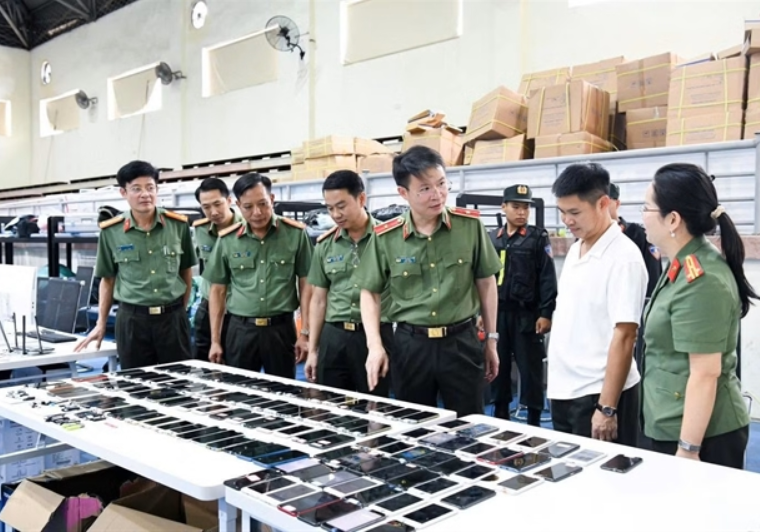
The material evidence seized at properties connected to the suspects provides tangible testimony to the intended scale of the criminal enterprise. Police recovered 73 computers, 134 mobile phones, 34 USB storage devices, and 20 Wi-Fi routers—equipment specifically intended to equip the anticipated scam call centre. These technological assets, collectively worth substantial sums, were designed to enable the fraudsters to conduct simultaneous communications with victims across multiple international jurisdictions, a hallmark of modern organised cybercrime.
The case illuminates the persistent challenge facing Southeast Asian nations as criminal enterprises continuously seek jurisdictions offering lower risk or enforcement capacity. Cambodia has long been identified as a base for such operations, and this incident demonstrates how criminal networks remain agile, promptly seeking alternatives when authorities strengthen oversight. For Malaysian readers, this pattern carries particular relevance given Malaysia's own experience with organised fraud networks operating both domestically and across borders throughout the region.
The successful disruption sends a signal that Vietnamese law enforcement possesses the investigative capability and determination to interdict such schemes. However, experts recognise that preventing the relocation of one operation represents merely a temporary victory; the fundamental business model remains attractive to criminals given the substantial profits derived from defrauding victims internationally. Regional cooperation mechanisms and information sharing among ASEAN nations become increasingly vital as these networks exploit jurisdictional fragmentation.