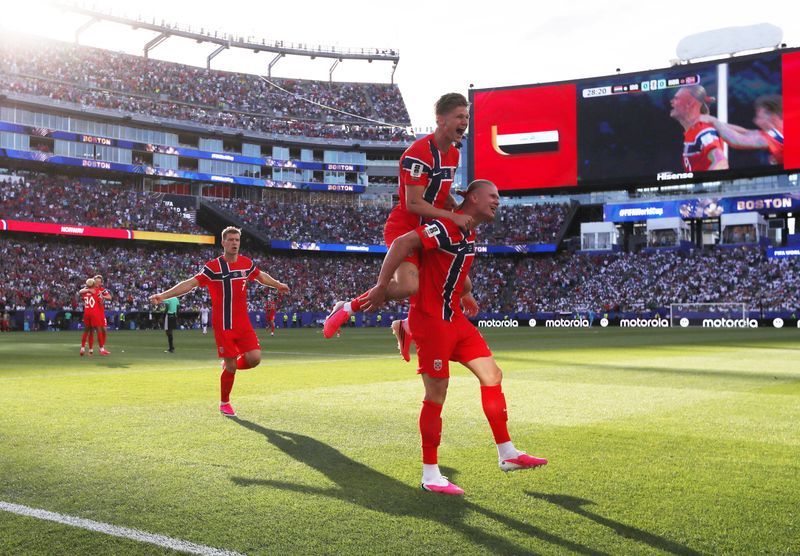
Erling Haaland wasted no time making an impression at the World Cup finals, delivering a commanding two-goal performance that steered Norway to a commanding 4-1 victory over Iraq on Tuesday. The prolific striker seized the spotlight with both strikes arriving in the opening 45 minutes, underscoring his reputation as one of football's most devastating finishers when handed opportunities at the grandest stage.
Haaland's double adds another chapter to an extraordinary record of scoring on his debuts across football's elite competitions. The 22-year-old has now found the net in his first appearance for the German Bundesliga, English Premier League, Champions League and World Cup finals—a sequence that speaks to both his consistency under pressure and his predatory instincts in the penalty area. Few observers harboured doubts that he would capitalise when given the chance to represent his country in this tournament, yet the emphatic nature of his contribution underscored why Norway's attacking strategy revolves so heavily around providing service to their talismanic forward.
Despite the commanding scoreline, Norway's overall performance revealed considerable room for improvement. The team struggled to impose sustained control throughout the match, with wayward passing and lapses in concentration creating unnecessary difficulties against an opponent they were expected to dominate. Iraqi defenders mounted a spirited resistance, and had it not been for Haaland's clinical finishing and opportunism, the margin of victory could have been considerably tighter. This reality prompted the Norwegian striker to issue a measured assessment afterwards, cautioning his teammates that such inconsistency would prove punishing against stronger opposition later in the tournament.
The mechanics of Haaland's opening goal exemplified his prowess in transition play and box awareness. David Moller Wolfe's delivery across the six-yard box presented a straightforward finish, yet the positioning and timing required to convert such chances separates elite strikers from the rest. His second goal showcased a different facet of his game—the aggressive pressing that generates turnovers and forces defensive mistakes. By pressurising Iraq's backline, Haaland prompted a careless backwards pass, then reacted faster than the goalkeeper to block the clearance attempt and deflect the ball into the net. This combination of instinct, athleticism and ruthlessness encapsulates why manager Stale Solbakken has constructed the Norwegian tactical framework around maximising opportunities for his principal weapon.
Norway's approach reflects a pragmatic understanding of their squad's strengths and limitations at this level. As Norwegian Prime Minister Jonas Gahr Stoere articulated before the fixture, whilst individuals may score the goals that capture headlines, collective team performances determine tournament outcomes. The coaching staff's philosophy requires all outfield players to prioritise creating or advancing situations where Haaland can operate—positioning him in dangerous spaces, winning the ball in transition, and maintaining possession sequences that break down opposition defences. This singular focus occasionally produces the kind of disjointed displays witnessed against Iraq, where the team's functional approach to supporting their striker supersedes more expansive, possession-based football.
Captain and playmaker Martin Odegaard, typically instrumental in orchestrating Norway's attacking sequences, operated below his usual influence on Tuesday. The midfielder's relative quietness in the centre of the pitch meant fewer penetrating passes reached Haaland, forcing the striker to create openings through individual endeavour. Meanwhile, the defence afforded Iraq a moment of encouragement through a lapse in concentration that allowed Aymen Hussein to reduce the deficit. These moments of vulnerability suggest that despite the victory, Norway's rear guard will require sharper focus against more incisive attacking units in their subsequent Group B encounters.
The three-point haul from this opening fixture positions Norway atop their group on goal difference above France, who earlier dispatched Senegal 3-1. This standings arrangement carries psychological significance for Stale Solbakken's side, yet the Norwegian camp recognises that the group contains sufficient quality that further inconsistent performances would swiftly erode their advantageous position. The next assignments against heavyweight opposition will provide a more reliable gauge of whether Norway's defensive solidity and attacking efficiency can sustain a genuine challenge for qualification from what represents a formidable pool of nations.
For Norwegian supporters, Tuesday's victory represented something precious—a successful return to the World Cup finals following a 28-year absence from the global tournament. The last Norwegian side to compete at this level departed in 1998, meaning an entire generation had been denied the prospect of witnessing their national team at football's premier event. Haaland's performance provided tangible evidence that the long wait might prove worthwhile, offering hope that this squad possesses the capability to progress beyond the group stage and potentially challenge for knockout-round advancement.
The striker himself adopted a characteristically understated demeanor when reflecting on his contribution, deflecting individual praise and expressing satisfaction with the team's opening outcome. Nevertheless, his caution regarding the need for improved collective performances carried implicit weight—an acknowledgment that personal brilliance alone cannot compensate for systematic weaknesses elsewhere in the team's structure. As Norway prepares for increasingly demanding opposition, Haaland's continued sharpness in the finishing phases will remain essential to their tournament ambitions, yet the supporting cast must deliver the consistency and discipline required to provide their forward with sufficient opportunities to decide close contests.