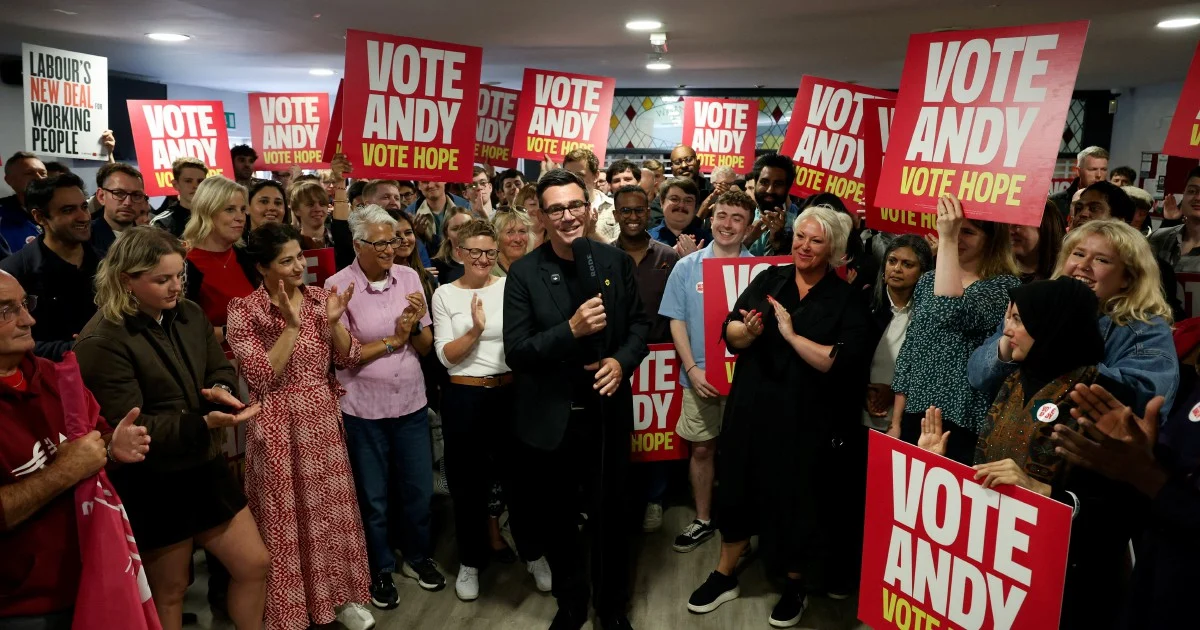
Andy Burnham's path toward challenging Prime Minister Keir Starmer for Britain's top job has been inadvertently cleared by discord among conservative political forces. The Labour figure is preparing for Thursday's election in Makerfield, a seat critical to his ambitions to reshape the country's leadership hierarchy. Yet his prospects rest less on his own political magnetism and more on the significant rupture dividing the right-wing vote between two rival populist parties whose competition threatens to scatter support across the spectrum.
The Conservative Party and Reform UK have emerged as the primary vessels for Britain's right-wing electorate, yet their shared ideological terrain and overlapping voter bases have created fierce competition that works against both organisations' interests. This internal struggle within the broader right-wing movement reflects deeper fractures in British politics that extend beyond personality clashes or policy disagreements. The fragmentation stems from fundamental questions about the direction of conservatism itself, with Reform UK positioning itself as a more muscular alternative to the establishment Conservative Party's perceived compromises.
Makerfield represents precisely the type of constituency where such vote-splitting dynamics prove most consequential. As a traditionally Labour-inclined seat, the division of right-wing support creates opportunities for the main opposition to capitalise on weakened opposition unity. Burnham's candidacy carries particular significance given his growing prominence within Labour's ranks and his distinct regional power base, which could strengthen his claim to leadership credentials beyond Westminster's traditional hierarchies.
The fractious relationship between Conservative and Reform factions has exposed vulnerabilities in Britain's broader right-wing coalition. Where once these voters might have coalesced around a single party banner, they now find themselves distributed across competing organisations with differing philosophies on Europe, immigration, and the relationship between state and market. This splintering mirrors similar phenomena across Western democracies where traditional centre-right parties struggle to contain more radical populist movements within their own structures.
For Burnham specifically, the timing proves advantageous as Labour seeks to consolidate its recent electoral victories and establish deeper roots in communities traditionally vulnerable to right-wing appeals. His northern English roots and prior experience as both an MP and mayor of Greater Manchester provide authentic connections to working-class constituencies that have shifted between Labour and Conservative allegiances in recent decades. The Makerfield election offers a platform to demonstrate that such voters remain capable of supporting progressive alternatives when right-wing political alternatives appear fragmented and unfocused.
The broader implications for Malaysian and Southeast Asian observers relate to how established political systems respond to populist challengers and vote fragmentation. Britain's experience illustrates that dominant parties lose coherence when internally divided, creating unexpected opportunities for opposition forces. In regional contexts where multi-party systems already operate, understanding how vote-splitting dynamics determine electoral outcomes becomes increasingly relevant for political strategists and analysts tracking political realignment across Asia.
Burnham's positioning as a potential challenger to Starmer's premiership should not be interpreted solely as an individual ambition, but rather as a symptom of Labour's internal dynamics and the party's determination to maintain generational renewal while building regional political infrastructure. His candidacy speaks to questions about who will inherit progressive leadership in post-industrial Britain, where communities face economic restructuring and demand politicians with demonstrated track records in managing complex urban economies.
The right-wing feud also reveals how electoral mathematics can produce unexpected beneficiaries. When political adversaries concentrate their energy on defeating each other rather than their primary opponents, they inadvertently strengthen those opponents' competitive position. This principle applies across electoral systems and cultural contexts, offering lessons for how parties navigate competitive landscapes when internal divisions weaken aggregate opposition strength.
Thursday's Makerfield election therefore carries significance extending beyond a single parliamentary seat. It functions as a barometer for whether Labour's strategy of positioning itself as a stable, centrist alternative to fractious right-wing politics resonates with voters wearied by political turbulence. Burnham's victory would validate this approach while simultaneously advancing his personal political trajectory toward greater national prominence and potential future contests for the party's leadership.
The deeper question animating British politics involves whether right-wing fragmentation represents a temporary aberration or a structural realignment that will persist across future electoral cycles. If Conservative and Reform divisions prove durable rather than tactical, the British political landscape will have undergone fundamental transformation with consequences reaching far beyond Makerfield's constituency boundaries and affecting how progressives can expect to compete for power across the coming decade.