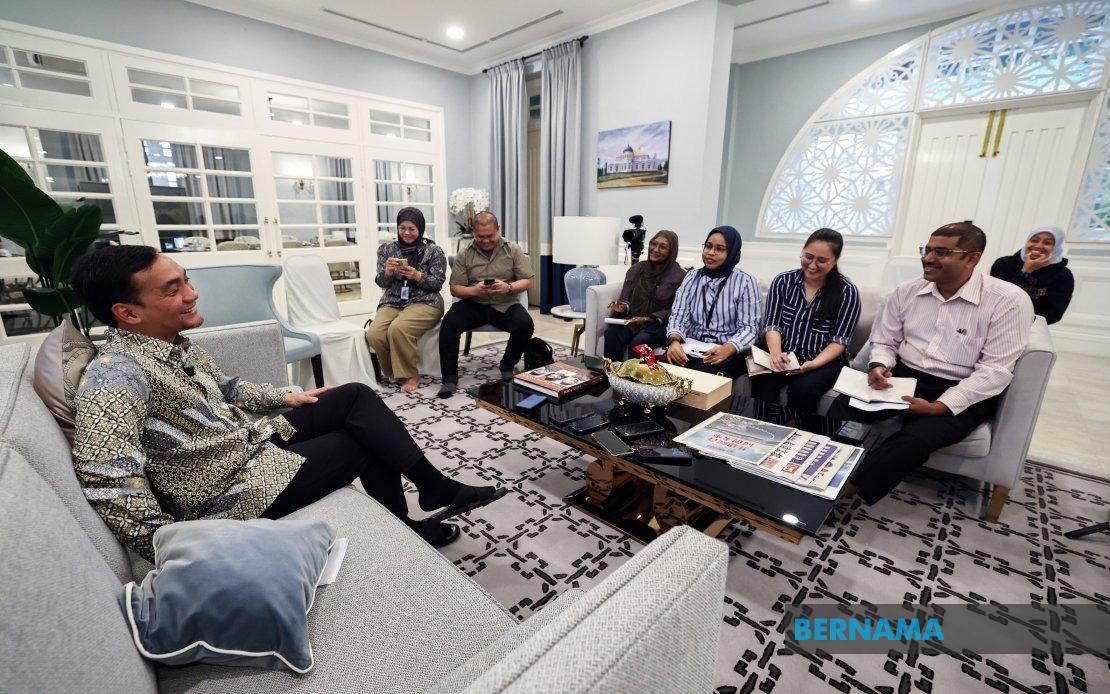
Datuk Onn Hafiz Ghazi, the Johor Barisan Nasional chairman and Menteri Besar, has delivered a message of perseverance to party members who have been left out of the upcoming state election candidate list. Speaking during a media interview at his official residence in Saujana on June 18, he underscored that non-selection does not represent a terminus for political ambition or service within the coalition framework. Instead, he framed the situation as an opportunity for party members to explore alternative roles within the broader BN structure, whether through federal representation or internal party mechanisms.
The Machap assemblyman's remarks come as Johor prepares for its state election on July 11, with nomination day scheduled for June 27 and early voting on July 7. His comments appear designed to manage expectations among disappointed party members and maintain internal cohesion during the crucial pre-election period. The timing of such reassurance is significant, as candidate selection processes often generate friction within political parties when aspirations outpace available positions.
Onn Hafiz clarified that the candidate selection process remains fluid, with approximately 80 per cent of positions decided. Crucially, he noted that no decision becomes final until candidates officially receive their watikah, or letters of appointment. This stipulation carries practical weight, as the Johor leader acknowledged that previously issued appointment letters have been withdrawn in certain circumstances. The reminder serves a dual purpose: it provides hope to those still awaiting notification while also signalling to selected candidates that their position is not entirely secure until formal documentation is exchanged.
The selection criteria employed by Johor BN reflect a strategic approach to candidate identification beyond conventional metrics. According to Onn Hafiz, the process prioritises professional diversity, avoids age restrictions, and emphasises strong constituency-level recognition and community acceptance. This philosophy aligns with the WALI framework previously articulated by BN leadership: candidates must be winnable, acceptable, and likeable. The Menteri Besar emphasised that age constitutes a secondary consideration; rather, the capacity to effectively serve constituents represents the primary qualification benchmark.
Onn Hafiz stressed that candidate selection decisions operate within a collaborative governance structure rather than through unilateral determination. All major selections require endorsement from BN chairman and UMNO president Datuk Seri Dr Ahmad Zahid Hamidi, alongside consultation with senior party leadership. This institutional approach, while potentially cumbersome, provides a safeguard against perception of arbitrary decision-making and distributes accountability across the coalition's upper echelons.
Demographic considerations feature prominently in Johor BN's electoral calculations. The party has identified voters aged below 40 as a critical electoral segment, constituting between 20 and 40 per cent of Johor's population according to Onn Hafiz. He indicated that party representatives have intensified engagement with younger constituencies, reflecting recognition that this demographic will substantially influence which coalition forms the next state government. This acknowledgement represents an implicit admission that traditional voter bases can no longer be taken for granted, a reality underscored by recent electoral volatility across Malaysia.
The Menteri Besar extended his call for electoral participation beyond Johor's geographic boundaries, specifically addressing Johoreans employed in Singapore. His inclusion of this cross-border workforce demonstrates awareness that diaspora populations maintain significant electoral stakes in their home state's governance trajectory. By framing voting participation as a civic responsibility and expression of democratic engagement, rather than as a partisan appeal, Onn Hafiz employed inclusive messaging intended to transcend traditional party boundaries.
Onn Hafiz articulated the case for the incumbent BN government's continuation, arguing that the state administration has prioritised service delivery and programme implementation during its tenure. He positioned a fresh electoral mandate as the pathway toward sustained commitment to public welfare and development objectives. His reference to serving "Bangsa Johor"—the Johor people as a collective entity—employed terminology designed to elevate the discourse beyond narrow partisan competition toward broader communal interest.
The electoral environment in Johor carries significance beyond the state's boundaries, as the outcome will shape the broader political balance in Malaysia. Johor's traditionally strong BN support has faced challenges in recent years, with opposition coalitions demonstrating increased capacity to mobilise voters across multiple constituencies. The state election therefore functions as a significant barometer of coalition strength heading toward any potential federal electoral test. Onn Hafiz's management of internal party morale through assurance of continued opportunity for disappointed candidates reflects political pragmatism; maintaining party cohesion ranks as essential infrastructure for electoral success.
The candidate selection framework described by Onn Hafiz also reflects evolving BN thinking regarding meritocratic principles and contemporary electoral expectations. By explicitly rejecting age-based hierarchies and emphasising professional diversity, the coalition signals responsiveness to voter preferences for representation that mirrors broader societal composition. However, the tension between maintaining party organisational coherence and accommodating newer, more diverse candidate profiles remains a persistent challenge for established political movements seeking reinvigoration.
For Malaysian observers monitoring Johor's political trajectory, Onn Hafiz's remarks reveal both the sophistication of internal party management and the underlying vulnerabilities within even traditionally strong political organisations. The necessity for senior leadership to invest effort in retaining disappointed party members' loyalty signals that electoral competition has intensified and that party loyalty can no longer be presumed. The Menteri Besar's emphasis on democratic participation and voter engagement, regardless of party affiliation, suggests a broader acceptance that electoral outcomes in contemporary Malaysia reflect genuine competitive dynamics rather than predetermined results.