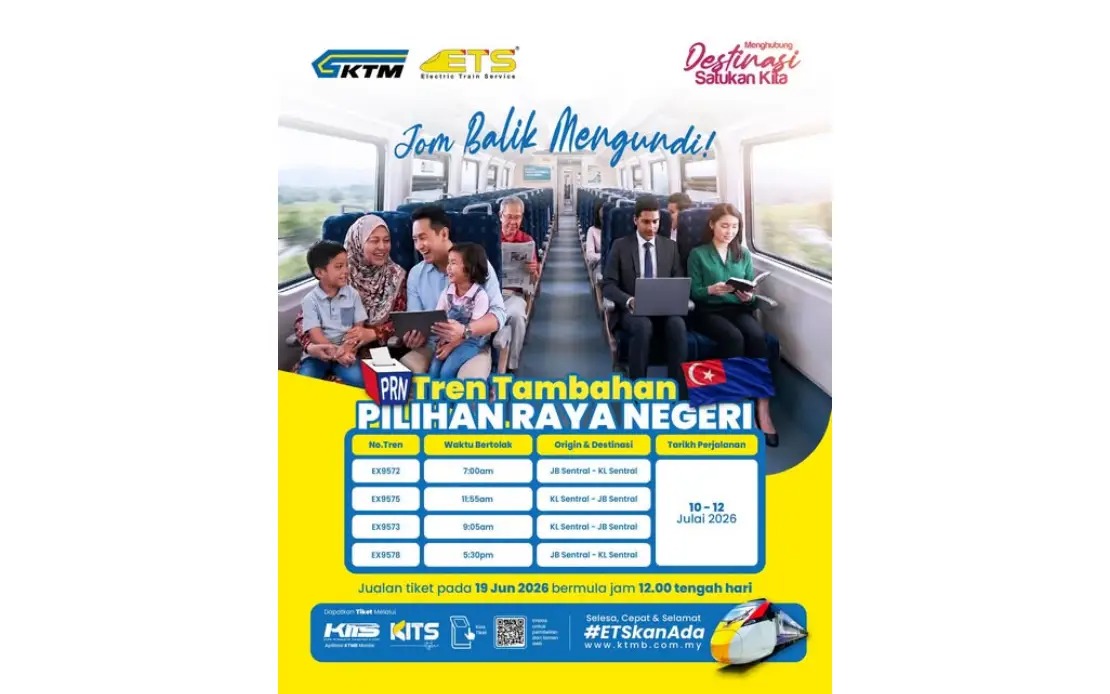
Keretapi Tanah Melayu Berhad (KTMB) is boosting its capacity on the southern ETS corridor to accommodate the influx of voters travelling home for the Johor state election, announced on June 19 via its official social media channels. The move reflects widespread expectations of significant cross-state movement as residents from elsewhere in Malaysia return to cast their votes in what promises to be a closely watched state-level contest.
Ticket purchasing commenced at noon on June 19 through a variety of channels, reflecting KTMB's attempt to make the booking process as accessible as possible. Prospective travellers can secure reservations via the KTMB Mobile application, the KITS Style platform, or the official online ticketing website at online.ktmb.com.my, with traditional ticket kiosks also remaining operational for those who prefer in-person transactions. This multi-channel approach acknowledges the diverse preferences of Malaysian rail users, from tech-savvy mobile app users to those more comfortable with conventional counter services.
The additional services will operate across a three-day window spanning July 10 through 12, bracketing the polling day itself on July 11. This scheduling allows voters to make their journeys before, during, and immediately after the election, providing flexibility for those with varying commitments and travel arrangements. The timing is particularly significant for northern Malaysians and those working in the Klang Valley who maintain voter registration in Johor, a large and economically important state that regularly experiences substantial internal migration patterns.
The Johor state election follows the dissolution of the State Legislative Assembly on June 1, with the Election Commission subsequently setting July 11 as polling day. This dissolution was not unexpected, but the compressed election timeline means that railways and other transport operators must act quickly to accommodate anticipated demand surges. Such surge planning has become standard practice in Malaysian elections, as the country's internal migration patterns mean that significant numbers of registered voters live outside their constituencies.
The ETS network, which connects major population centres across peninsular Malaysia, has proven increasingly vital during election periods. The southern ETS route connecting the Klang Valley and Kuala Lumpur to Johor Bahru and beyond is among the nation's busiest, carrying both daily commuters and long-distance travellers. Additional train services represent a substantial operational commitment, requiring KTMB to secure crew availability, rolling stock allocation, and track scheduling alongside regular commercial and freight operations.
For voters residing outside Johor, the railway option offers distinct advantages over road travel during peak election periods. Highway congestion is a recurring challenge during Malaysian elections, particularly on routes to and from major state contests. The ETS provides a predictable, reliable alternative that insulates passengers from traffic delays, though it does require passengers to adhere to departure schedules. The integration of these extra services into the broader transport ecosystem demonstrates recognition that enabling voter participation requires logistical support from both public and private sectors.
The announcement also reflects broader policy considerations around electoral accessibility. Malaysian electoral authorities have consistently emphasized removing barriers to voting participation, and coordinating with transport operators represents a practical dimension of that commitment. When voters face excessive travel delays or costs, participation rates can suffer, particularly among those with work or family commitments that make lengthy journeys difficult. By providing additional capacity at a standard pricing model, KTMB contributes to maintaining healthy democratic engagement.
From a regional perspective, this initiative underscores Malaysia's transport infrastructure capabilities and the integration of rail services into national civic functions. Other Southeast Asian nations watching Malaysia's election management practices may note how transport coordination supports electoral processes. The sophistication of Malaysia's ETS system, combined with operator responsiveness to temporary demand fluctuations, reflects decades of infrastructure investment and institutional development.
The practical details of ticket availability through mobile and online channels also merit attention. Malaysia's substantial digital adoption means that many voters can complete bookings instantly without visiting physical locations, reducing contact points and crowds during a period of heightened civic activity. Simultaneously, the retention of traditional counter services ensures that less digitally-connected populations remain accommodated, reflecting inclusive service design principles.
Voters should note that ticket demand during election periods typically exceeds normal levels substantially, suggesting that early booking through the KTMB Mobile app or online platform would be prudent. Once additional services are announced, institutional and family groups often coordinate travel, meaning available seats on attractive departure times sell quickly. Flexibility in travel dates and times across the July 10-12 window can improve booking prospects for those without fixed schedules.